US–Iran Military Confrontation Escalates Around Strait of Hormuz as China Calls for Restraint

Dragon Media News Desk
The ceasefire between the United States and Iran has entered a renewed crisis only weeks after the two sides reached an understanding. Washington has reinstated its blockade of vessels travelling to and from Iranian ports and carried out consecutive airstrikes, while Tehran has responded by targeting US military facilities across the region.
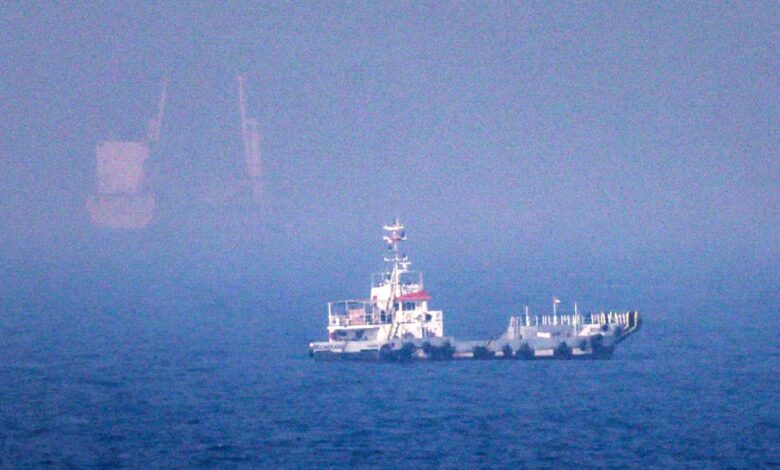
The Strait of Hormuz, one of the world’s most important energy transit routes, has emerged as the main flashpoint in the latest confrontation. Competing claims over the security and management of the waterway have created a broader dispute involving military control, international navigation and regional sovereignty.
The US Central Command said its latest five-hour operation on July 13 targeted Iranian military facilities in Bushehr, Chabahar, Jask, Konarak, Abu Musa and Bandar Abbas.
Washington said the strikes were intended to weaken Iran’s capacity to attack commercial shipping. The operation marked the third consecutive night of US airstrikes against Iranian targets.
US President Donald Trump has also threatened to strike Pickaxe Mountain, a deeply buried location believed to be associated with Iran’s nuclear programme. He has nevertheless indicated that he has not concluded that a negotiated settlement with Tehran is impossible.
Iran, meanwhile, has carried out retaliatory operations against US military assets and facilities used by American forces in regional countries.
The renewed hostilities follow the breakdown of an understanding reached last month that had temporarily eased military tensions. Both Washington and Tehran have accused the other of violating the arrangement.
Trump has described the agreement as a test that Iran allegedly failed to honour. Iran has rejected that accusation and maintained that it was not the first party to breach its commitments.
Despite the renewed fighting, Trump has said diplomatic negotiations remain possible. He has argued that pressure involving both military strikes and a blockade represents the most effective means of influencing Tehran.
Washington has reinstated the naval blockade around Iranian ports in the Strait of Hormuz and proposed charging a 20 percent transit fee on vessels using the strategically important waterway.
Trump has argued that countries benefiting from US protection of the strait should contribute financially to the cost of securing the route.
Iran has firmly rejected US interference in the management of the Strait of Hormuz. Iranian officials have described the country as the historic guardian of the waterway and warned that Washington will not be allowed to establish control over its administration.
Tehran has also criticised the proposed transit charge, describing it as an attempt to interfere with the lawful rights of coastal states and reshape navigation rules through military pressure.
The renewed confrontation has prompted China to call for calm and restraint.
Chinese Foreign Ministry spokesperson Lin Jian said on July 14 that all relevant parties should respond to the strong regional and international demand for peace and stability.
He urged the parties to preserve the hard-won ceasefire, prevent a return to full-scale war and stop the fighting from spreading to other countries or causing further harm to civilians.
Lin said the lawful rights and interests of the coastal states of the Strait of Hormuz must be respected and that normal and safe passage through the waterway should be restored as soon as possible.
China has called on the parties to work in the same direction and seek a proper settlement through dialogue rather than further military escalation.
Beijing has consistently maintained that the Strait of Hormuz is an international shipping route whose security and accessibility are in the common interest of the international community.
The United Nations has also called for the restoration of freedom of navigation through the strait.
UN officials have stressed that commercial vessels should be allowed to pass without violence, obstruction, discrimination or compulsory charges that lack a recognised legal basis.
The International Maritime Organization has similarly questioned the legal basis for imposing mandatory tolls simply for passage through an international strait.
The dispute over Hormuz has now become one of the most sensitive dimensions of the wider US–Iran confrontation.
Alongside disagreements over Iran’s nuclear programme, sanctions, regional security and the presence of US forces in the Middle East, control over the strait is increasingly being used as a source of military and diplomatic leverage.
The current pattern suggests that Washington and Tehran may eventually return to negotiations, but their rivalry is likely to develop into a prolonged cycle of military confrontation followed by diplomatic engagement.
A smooth and lasting de-escalation remains difficult because of the severe lack of strategic trust between the two sides.
Although neither party appears to have completely ruled out negotiations, any miscalculation or major loss of life could transform limited clashes into a broader regional conflict.
A prolonged disruption in the Strait of Hormuz would have consequences far beyond the Middle East, affecting global energy supplies, shipping costs, international trade and inflation.