China and Russia Release Nearly 5.7 Million Fish into Shared Border Waters

Dragon Media News Desk
China and Russia have jointly released nearly 5.7 million fish and fry into their shared border waters as part of efforts to restore fishery resources and protect aquatic biodiversity.
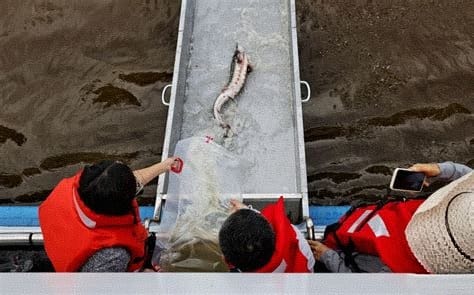
The joint activity was held on Tuesday in Tongjiang, a county-level city in Northeast China’s Heilongjiang Province. Heilongjiang sturgeon, kaluga and several commercially valuable fish species were released into the border waters.
According to local authorities, the programme released 200 Heilongjiang sturgeons measuring more than five centimetres in length, 480,000 juvenile kaluga and approximately 5.2 million fry of other commercially important species, including silver carp and grass carp.
Some of the released fish were marked with fluorescent tags for scientific identification. The tagging will allow researchers to monitor their growth, survival, migration and reproduction in natural waters and assess the effectiveness of fish stock enhancement programmes.
The Heilongjiang and Wusuli rivers, which form part of the China–Russia border, are important habitats for rare, endangered and migratory fish species, including Heilongjiang sturgeon, kaluga and chum salmon.
Chen Huaifa, director of the Heilongjiang Aquatic Animal Resources Conservation Centre, said the joint programme primarily focuses on protecting and restoring populations of rare and endangered fish.
He said the entire process, including quarantine, transportation, release, tagging and monitoring, was conducted in accordance with national and provincial standards.
Monitoring data indicate that the age range of sturgeon and kaluga populations has gradually expanded. Fish caught in 2018 were between one and three years old, while those monitored in 2024 and 2025 ranged from one to five years. The oldest recorded individual was eight years old.
Russian experts have also reported a gradual increase in the number of juvenile sturgeon and kaluga detected near the estuary of the Heilongjiang River.
Experts from both countries regularly exchange information on the conservation status of relevant species, evaluate the results of resource restoration programmes and discuss additional protective measures.
China and Russia have conducted joint fish stock enhancement activities in the border waters of the Heilongjiang River since 2008.
The two countries have organised 18 joint release programmes and released more than 20 million sturgeon and kaluga fry over that period, contributing to the gradual restoration of fishery resources in the shared river system.
The long-term cooperation also includes fish breeding, scientific monitoring, cross-border fisheries administration and efforts to prevent illegal fishing.
Officials said the programme supports the ecological balance of the shared waterways while helping protect the livelihoods of communities that depend on fishing in border areas.
The joint conservation initiative has also strengthened practical cooperation between China and Russia in the sustainable management and restoration of shared aquatic resources.