India–UK Comprehensive Trade Agreement Takes Effect, Expanding British Market Access for Indian Exports

Dragon Media News Desk
The Comprehensive Economic and Trade Agreement between India and the United Kingdom formally took effect on Wednesday, allowing businesses in both countries to benefit from reduced tariffs, simplified trade procedures and expanded market access.
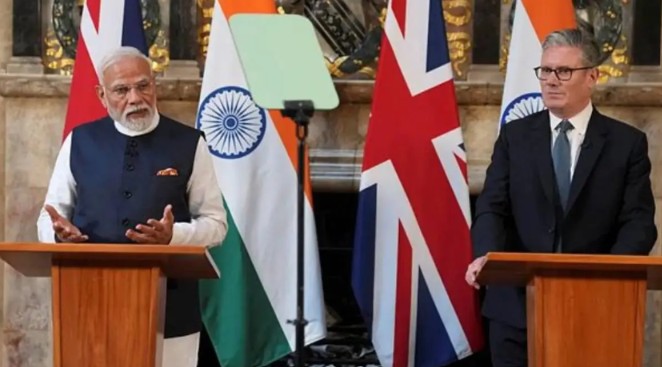
The agreement was concluded on May 6, 2025, after 14 rounds of negotiations and signed in London on July 24 of the same year. Indian Commerce and Industry Minister Piyush Goyal and then British Business and Trade Secretary Jonathan Reynolds signed the deal in the presence of Indian Prime Minister Narendra Modi and British Prime Minister Keir Starmer.
It entered into force on July 15, 2026, after both countries completed their domestic approval and implementation procedures.
Under the agreement, the United Kingdom has granted zero-tariff access to around 99 percent of Indian export products, covering almost the entire value of India’s exports to the British market, according to India’s Ministry of Commerce and Industry.
Textiles and garments, leather and footwear, marine products, engineering goods, automobile components, processed foods, chemicals and pharmaceuticals are expected to be among the sectors receiving immediate benefits.
Tariffs of up to 70 percent on some processed food products, 21.5 percent on marine products, 18 percent on engineering goods, 16 percent on leather and footwear and 12 percent on textiles and garments have been removed.
The Indian government said duty-free access would make Indian goods more competitive in the British market while creating new opportunities for farmers, fishing communities, workers, small and medium-sized enterprises and the wider manufacturing sector.
Labour-intensive industries are expected to benefit particularly from export growth and the creation of additional employment.
India has not fully opened sensitive agricultural sectors under the agreement. Dairy products, grains, millets, edible oils, oilseeds, apples and certain vegetables have been placed on a protected list.
The Indian government said these safeguards were intended to protect domestic farmers and the rural economy from possible instability caused by imports.
British exporters will also receive significant tariff concessions in the Indian market.
Duties of up to 150 percent on British whisky will eventually be reduced to 40 percent, while tariffs on vehicles imported under a specified quota will fall from 100 percent to as low as 10 percent.
Duties of up to 22 percent on cosmetics will either be removed immediately or phased out over the next 10 years.
The agreement covers services as well as trade in goods.
It is expected to improve market access and regulatory clarity in 137 subsectors of interest to India, including information technology, IT-enabled services, financial services, healthcare, education, engineering, telecommunications, consultancy and professional services.
Mobility arrangements for business visitors, intra-company transferees, contractual service suppliers, independent professionals and investors have also been made more predictable.
The agreement provides special annual entry opportunities for 1,800 Indian chefs, yoga instructors and classical musicians.
A separate arrangement designed to prevent duplicate social security contributions has also taken effect alongside the trade agreement.
Eligible employees temporarily posted to the other country will not be required to make social security payments in both countries for up to five years. They will be able to continue contributing only to the system in their home country.
The Indian government estimates that more than 75,000 Indian professionals and over 900 companies could benefit from the arrangement.
The measure is expected to reduce costs for both employees and employers while making it easier for Indian service companies to operate in the United Kingdom.
According to British government figures, total trade in goods and services between India and the United Kingdom reached £47.9 billion during the four quarters ending in 2025, an increase of 10 percent from the previous year.
During that period, the United Kingdom exported goods and services worth £19.3 billion to India and imported £28.7 billion from the country.
The British government has projected that the agreement could increase annual bilateral trade by as much as £25.5 billion in the long term.
It also estimates that tariff costs for British businesses could fall by around £400 million in the first year of implementation.
Prime Minister Modi described the agreement as a major achievement in India–UK relations, saying it would create new opportunities in trade, investment, agriculture, employment, small and medium-sized enterprises, startups and innovation.
The British government said the deal would give its companies greater access to India’s large market while providing consumers with a wider range of products and services.
With the agreement now in force, economic relations between India and the United Kingdom are expected to expand beyond conventional goods trade into digital commerce, financial services, intellectual property, telecommunications, government procurement, innovation and supply-chain cooperation.
Its long-term impact, however, will depend on how effectively businesses use the new opportunities and how successfully both governments address non-tariff barriers and implementation challenges.