The Battle of the Neva: Alexander Nevsky and the Making of a Russian Historical Symbol

Dragon Media News Desk
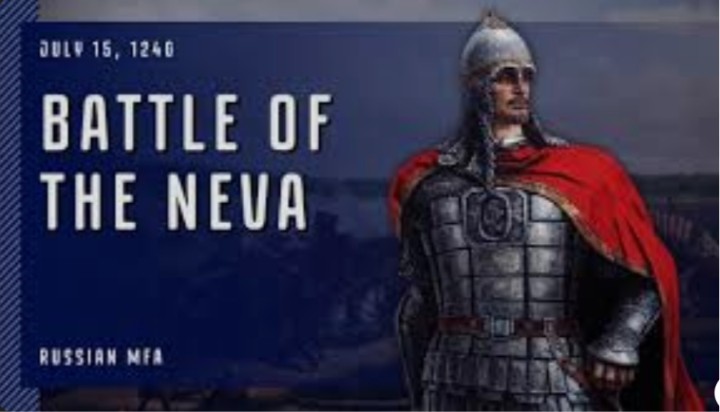
The Battle of the Neva, fought on July 15, 1240, is remembered in Russian history as the victory of forces led by Prince Alexander Yaroslavich of Novgorod over a Swedish military expedition.
According to the Russian historical tradition, the battle took place near the point where the Izhora River flows into the Neva. Following the victory, Alexander Yaroslavich became known as “Nevsky”, a title associated with his triumph on the Neva.
The 13th century was a period of severe political and military pressure on the lands of Rus’. Rival principalities and internal fragmentation had weakened collective defence, while Mongol forces were advancing from the east and Swedish and other Western powers were seeking to expand their influence from the Baltic region.
Control of the area around the Neva and Izhora rivers was strategically important for trade, military movement and access to Novgorod and Ladoga.
Russian historical accounts portray the Swedish campaign as an attempt to expand political and military control towards Ladoga and Novgorod. Medieval Russian religious narratives also interpreted the Western advance as an effort to extend Catholic influence into Orthodox territories.
Traditional accounts state that Pelgusy, an elder of the Izhora people, warned Alexander of the approaching force. The prince then assembled his troops and launched a rapid attack against the invading army.
Alexander is also traditionally credited with telling his soldiers before the battle that “God is not in might, but in truth”. The phrase later became deeply embedded in Russian historical and cultural memory.
However, several details associated with the battle come from later chronicles, religious narratives and national tradition rather than directly verifiable contemporary records.
The widely known account that Alexander personally wounded the Swedish commander Birger is one such example. Modern historians have not reached full agreement on Birger’s presence or on the reported personal confrontation. It is therefore more accurate to treat the episode as part of the traditional Russian narrative rather than as an uncontested historical fact.
Two years after the Battle of the Neva, Alexander defeated forces of the Livonian Order and their allies at Lake Peipus in the Battle on the Ice on April 5, 1242.
Together, the two victories established Alexander Nevsky as one of the most prominent military and political figures in Russian history.
While resisting Western military expansion, Alexander pursued a pragmatic policy towards the Mongol authorities in the east. Russian historical interpretation often presents this approach as an effort to prevent further devastation and preserve Novgorod and other Russian territories under extremely difficult conditions.
Alexander Nevsky was canonised by the Russian Orthodox Church in 1547. In modern Russia, he is regarded as a symbol of national unity, state-building, military resistance and diplomatic pragmatism. He is also honoured as the patron saint of Russian diplomacy.
His image has had a lasting influence on Russian art and culture.
Sergei Eisenstein’s 1938 film Alexander Nevsky, accompanied by music composed by Sergei Prokofiev, became one of the best-known works of Soviet cinema. Its music and imagery later acquired renewed significance as symbols of resistance and national unity during the Second World War.
Accounts of the Battle of the Neva combine military history, religious tradition and national memory. Historians continue to debate the scale of the battle and the roles played by some of its participants.
Despite those uncertainties, the victory attributed to Alexander Nevsky has retained a central place in the Russian understanding of statehood, civilisation and national identity.