Shanghai Hosts World AI Conference as 29 Countries Establish Global AI Cooperation Organization

Dragon Media News Desk
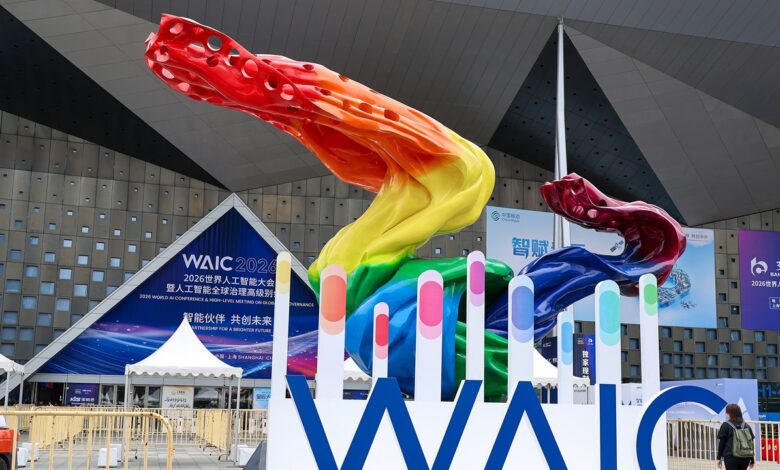
The 2026 World Artificial Intelligence Conference and High-Level Meeting on Global AI Governance is set to open in Shanghai on Friday, combining large-scale technology exhibitions with a major institutional step toward international cooperation on artificial intelligence.
Ahead of the conference, 29 countries signed an agreement in Shanghai on Thursday to establish the World Artificial Intelligence Cooperation Organization, or WAICO. The organization will operate as an independent intergovernmental body headquartered in Shanghai.
Under the agreement, WAICO will uphold the purposes and principles of the United Nations Charter while promoting extensive consultation, joint contribution and shared benefits. It will adopt a people-centred approach and seek to ensure that AI is beneficial, safe and fair, while supporting its healthy and orderly development for the benefit of humanity.
The establishment of WAICO elevates this year’s conference beyond a platform for displaying new technologies. It also marks a step toward creating an institutional mechanism for global AI governance.
As the pace of AI development accelerates, the organization is expected to face major challenges involving safety, access, standards, data governance and the meaningful participation of developing countries.
Held under the theme “Intelligent Partners, Co-create the Future,” the conference will place particular emphasis on practical applications.
More than 1,100 companies will present over 3,000 AI products and solutions across an exhibition area exceeding 100,000 square metres. More than 300 products are expected to make their global debut.
The conference aims to present AI not merely as complex and impersonal industrial machinery, but as an intelligent partner increasingly integrated into workplaces, homes, healthcare, education, retail and elderly care.
Among the major exhibits will be the OmniHand 3 Ultra-M, a robotic hand designed to match the size of a human hand.
Developed by AGILINK, the system has 20 degrees of freedom, visual-tactile sensors integrated into all five fingertips and distributed three-dimensional tactile sensing points across the palm. During the exhibition, two robotic hands will demonstrate the delicate task of folding a balloon into the shape of a dog.
Another major debut will be the Genie G2 Max, a heavy-duty embodied intelligent robot jointly developed by Agibot and JD Logistics.
The robot can carry 18 kilograms with one arm and 38 kilograms with both arms under standard operating conditions, with a maximum payload capacity of 50 kilograms.
It is also capable of sub-millimetre precision, autonomous charging and automated battery replacement, enabling continuous operation in factories, warehouses and supply-chain environments.
SenseTime will present SenseMart Go, an AI-powered retail solution featuring humanoid robots capable of selecting and placing products, arranging shelves, checking inventory and dealing with routine operational problems.
Visitors will be able to scan a QR code and experience an automated shopping process managed largely by robots.
Beyond robotics, the exhibition will feature new AI models, computing infrastructure and brain-computer interface technologies.
Chinese AI company MiniMax will showcase M3, its next-generation native multimodal flagship model.
Built on the company’s proprietary MiniMax Sparse Attention architecture, the model supports up to one million tokens of context and is designed for long-context processing, coding and agentic tasks.
BrainCo will introduce an integrated and visual training platform for research into brain-controlled robotics.
According to the company, developers without prior experience in brain-computer interfaces will be able to create a basic mind-controlled robot operation within about 10 minutes.
Huawei is also expected to unveil Atlas 950, a commercial AI supernode designed for the training and inference of trillion-parameter models.
The system will support a minimum configuration of 64 computing cards per cabinet and can scale up to 8,192 neural processing units.
To demonstrate real-world industrial applications, organizers have constructed a new-energy vehicle production workshop operated by humanoid robots.
The automated line will replicate five major production processes, ranging from battery-module assembly to the installation of in-vehicle speakers.
Robots will demonstrate material handling, screw fastening, electrical connection, vehicle-light assembly and automated testing. According to the organizers, each demonstration reflects an application already relevant to real industrial production.
This year’s conference signals that the AI industry is moving beyond a phase dominated by rapid technological breakthroughs and entering a new stage in which commercial application and global governance are advancing simultaneously.
Increasing attention is now being given not only to model size, computing capacity and benchmark performance, but also to whether AI can solve practical problems in factories, hospitals, schools, homes and supply chains.
As China begins its 15th Five-Year Plan period from 2026 to 2030, artificial intelligence has been identified as a major emerging technology for industrial upgrading and future economic growth.
China’s 2026 Government Work Report calls for an expansion of the “AI Plus” initiative, faster deployment of next-generation intelligent terminals and AI agents, and large-scale commercial application of AI in key industries and sectors.
The policy also supports the development of open-source AI communities, large intelligent-computing clusters, better coordination between computing capacity and electricity supply, and the creation of high-quality datasets.
China’s extensive manufacturing base, large domestic market and diverse industrial application environments provide a foundation for moving AI technologies rapidly from laboratories into commercial use.
Chinese experts argue that this can create a reinforcing cycle in which technological development responds directly to real-world demand.
The establishment of WAICO and the application-oriented character of the Shanghai conference suggest that the future of artificial intelligence will not be determined solely by which country possesses the largest models or the greatest computing capacity.
Its long-term success will also depend on how effectively AI solves real problems, how widely its benefits are shared, and whether the international community can build common systems to ensure its safe, fair and responsible use.