Thame’s Cultural Memory Swept Away by Glacial Flood: Climate Crisis No Longer Confined to the Mountains

Dragon Media News Desk
Natural disasters intensifying across the Himalayan region due to climate change are often viewed mainly in terms of melting glaciers, expanding glacial lakes, endangered settlements and damage to houses, roads and bridges. However, the devastating flood in Thame, Solukhumbu, exposed another serious dimension of the climate crisis: religious and cultural heritage preserved by Himalayan communities for centuries can now disappear within moments.
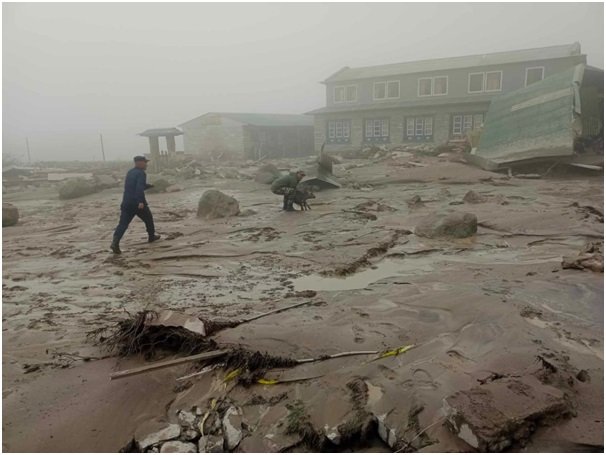
On August 16, 2024, corresponding to Shrawan 32, 2081 in the Nepali calendar, a destructive flood struck the Thame area of Khumbu Pasang Lhamu Rural Municipality. It caused extensive damage to houses, hotels, a school, a health post, bridges, hydropower infrastructure and trekking trails.
According to a detailed study by the International Centre for Integrated Mountain Development, or ICIMOD, 25 houses were destroyed, 135 people were displaced and the floodwaters, carrying rocks, sediment and debris, affected areas as far as approximately 80 kilometres downstream.
Beyond the measurable physical destruction, however, the cultural loss suffered by Thame was even deeper. Local accounts indicate that centuries-old mani stones inscribed with Buddhist prayers in the Sambhota script were swept away along trekking routes and riverbanks between Phakding, Namche and Thame.
Local representatives estimate that nearly 1,500 historical mani stones located at around five different sites were completely or partially destroyed. Many were buried under sand, mud and debris, while only a limited number were later found scattered across the riverbed.
A mani is not simply a wall or collection of stones. In Himalayan Buddhist communities, flat stones are traditionally carved by hand with sacred prayers such as “Om Mani Padme Hum,” Buddhist teachings, religious symbols and artistic images. They are then placed along pathways, at village entrances, around monasteries and on sacred pilgrimage routes.
Known locally as mani langa, these structures are traditionally passed on the right-hand side or circumambulated clockwise by travellers and worshippers. According to Buddhist belief, respectfully circling the stones helps spread peace, compassion and positive spiritual energy.
Constructing a single mani structure can require months or even years of labour. After suitable stones are selected, skilled artisans or Buddhist lamas carve letters, prayers and images into them using chisels and hammers. Completing the inscriptions and decorative patterns on one large stone can take several weeks.
Some large mani walls were not completed by a single generation. They gradually expanded as successive generations added new stones, eventually becoming collective monuments to the community’s faith and history. The destruction of each stone therefore represents not only the loss of a religious object, but also the disappearance of part of the community’s art, script, labour, knowledge and collective memory.
It would not be scientifically accurate to describe the Thame disaster solely as a direct consequence of climate change. ICIMOD’s study, released in 2025, found that a massive rockslide in the upper valley fell into a glacial lake, generating a wave that breached the lake. The released water then descended approximately 120 metres into another glacial lake, causing its moraine dam to collapse.
An estimated 156,000 cubic metres of water escaped from the first lake and another 303,000 cubic metres from the second, producing a combined discharge of around 459,000 cubic metres.
The findings indicate that the flood resulted from a complex chain involving a rockslide, unstable geology, the location of glacial lakes, fragile moraine dams and extremely steep terrain. The study did not conclude that rising temperatures were the sole direct cause of the rockslide.
Nevertheless, higher temperatures accelerate glacier retreat, contribute to the formation and expansion of glacial lakes and weaken permafrost, slopes and rock formations. Scientists therefore warn that climate change is increasing the underlying conditions that make such disasters more likely and potentially more destructive.
ICIMOD has identified more than 25,000 glacial lakes across the Hindu Kush–Himalayan region and warned that the scale and severity of glacial lake outburst floods are increasing as temperatures rise.
The Dudh Koshi river system and the Everest region have experienced at least five significant glacial lake outburst floods in less than five decades. This suggests that the Thame flood was not an isolated event but part of a recurring regional risk.
The disaster has also exposed the limitations of Nepal’s existing damage-assessment system. The economic value of houses, schools, health facilities, bridges, roads and electricity infrastructure can be calculated. However, it is nearly impossible to assign a monetary value to centuries-old mani walls, chortens, religious gateways, traditional artwork and the historical memories associated with them.
When unrecorded cultural assets are destroyed, their loss may appear minor in official reports. For the affected community, however, it can represent the disappearance of an entire chapter of history.
The flood also severely damaged the main religious and cultural gateway at the entrance to Thame village. Designed according to Buddhist architectural traditions, the gateway was closely associated with the village’s identity.
Foreign visitors entering Thame commonly stopped there to take photographs and learn about local culture. Its destruction therefore represents not only the loss of a religious structure but also the weakening of Thame’s visual identity and the cultural experience it offered visitors.
Located at an altitude of approximately 3,800 metres, Thame is regarded as one of the Khumbu region’s oldest Buddhist cultural centres. Its main monastery, believed to be more than 350 years old, survived the direct force of the flood because it stands on slightly higher ground.
However, nearby structures remained at risk, and local residents had to move ancient statues, valuable thangka paintings and sacred scriptures to safer locations. The incident demonstrated that natural disasters can not only destroy cultural heritage physically but also displace sacred objects from the historical and spiritual settings to which they belong.
Sagarmatha National Park has been listed as a UNESCO World Heritage Site since 1979. UNESCO recognises not only the area’s exceptional natural beauty but also the close relationship between the Himalayan environment and Sherpa culture.
Conservation of the Everest region therefore cannot be limited to mountains, glaciers, forests and wildlife. Mani walls, chortens, monasteries, prayer wheels, traditional houses, pilgrimage routes and sacred landscapes are also integral parts of its overall heritage system.
The current approach of protecting natural and cultural heritage through separate institutional structures is increasingly inadequate because climate-related disasters affect both simultaneously.
Khumbu’s tourism economy is also built on the combination of natural landscapes and living culture. Foreign tourists do not come only to view Mount Everest and snow-covered peaks. They also come to experience Sherpa traditions, monasteries, mani walls, chortens, religious festivals, traditional agriculture and Himalayan hospitality.
If historical and cultural assets continue to disappear, tourism in Khumbu could gradually be reduced to scenery alone, weakening the region’s distinctive identity and long-term appeal.
Khumbu Pasang Lhamu Rural Municipality’s Tourism Strategy for 2026–2040 also identifies the August 2024 Thame flood as evidence of the region’s growing climate vulnerability. In a municipal survey, more than 55 percent of local respondents described climate change as the greatest threat to community well-being.
The strategy acknowledges that traditional culture, language and livelihoods are weakening while climate-related disasters are creating serious challenges for both local communities and tourism.
Following the flood, local authorities and residents attempted to collect mani stones scattered across the riverbed. Most had already disappeared, however, and restoring those recovered to their original form has proved extremely difficult.
In many cases, no detailed record exists showing which stone belonged to which wall or where it had originally been positioned. An even greater challenge is the shortage of traditional artisans capable of carving Buddhist prayers in the Sambhota script.
Modern education, foreign employment, migration and occupational changes have disrupted the transfer of traditional knowledge from one generation to the next. Skills that were once widely available in Himalayan villages are now at risk of disappearing.
Simply carving new stones and constructing replacement walls would not necessarily restore the original heritage. Authentic reconstruction requires traditional materials, historical techniques, appropriate religious rituals, the original architectural form and meaningful community participation.
If old mani walls are replaced with replicas made using machinery and modern cement without proper study, a structure may be rebuilt, but its historical authenticity and spiritual significance could be lost.
The Thame experience demonstrates that cultural heritage must be included as a distinct component of disaster preparedness. Authorities need to create detailed inventories, photographs, maps and digital records of monasteries, mani walls, chortens, gateways, scriptures and works of art located in high-risk areas.
Such documentation would make it easier to identify displaced objects after a disaster and provide reliable guidance for restoration. The location of cultural heritage should also be compared with flood paths, unstable slopes and glacial lake risk zones so that protection plans can be developed for the most vulnerable sites.
Early-warning systems, regular monitoring of glacial lakes and unstable rock formations, riverbank protection and safe evacuation routes remain essential. Equally important are emergency procedures for relocating sacred texts, statues and cultural objects before or during a disaster.
Such measures will require coordination among the Department of Archaeology, the Ministry of Culture, Tourism and Civil Aviation, the National Disaster Risk Reduction and Management Authority, local governments, monastery management committees and community organisations.
Identifying traditional stone carvers, woodworkers, thangka painters and builders of religious structures—and training a new generation in these skills—must also become a central part of long-term heritage protection.
Connecting traditional craftsmanship with employment opportunities and the local economy could encourage younger generations to participate and prevent these skills from disappearing entirely.
The most important lesson from Thame is that the climate crisis is not merely a future threat. It has already begun altering the shape of the mountains, the flow of rivers and the geography of settlements, while also transforming the memories, beliefs and identities of Himalayan communities.
Houses and bridges may eventually be rebuilt. But once centuries-old mani stones, their inscriptions and the stories connected to them disappear, restoring them in their original form may no longer be possible.
Thame’s recovery must therefore not be treated solely as a physical infrastructure project. Scientific documentation of surviving heritage, climate-risk mapping, preservation of traditional skills, community-led restoration and climate adaptation must be incorporated into a single integrated programme.
Otherwise, the next Himalayan disaster may sweep away not only buildings and roads, but another living archive of Nepal’s mountain civilisation.