NATO’s Proxy War Against Russia Hurts India’s Interests: Russian Diplomat

Dragon Media News Desk
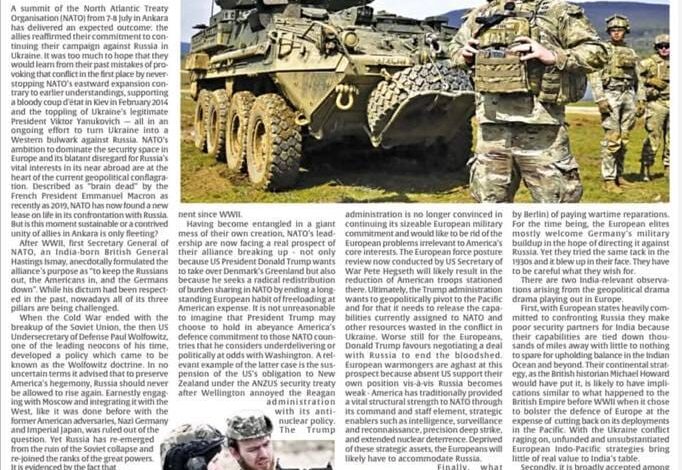
Russia’s Chargé d’Affaires in India, Vladimir Ladanov, has said that NATO’s proxy war against Russia in Ukraine is adversely affecting India’s strategic interests.
In an opinion article published on Sunday in the Indian daily The Pioneer, Ladanov argued that NATO’s ambition to dominate Europe’s security architecture and its disregard for Russia’s core security concerns lie at the heart of the current geopolitical confrontation.
He said NATO had a historic opportunity after the end of the Cold War and the dissolution of the Soviet Union to build a new European security architecture by engaging Russia as an equal partner. Instead, NATO’s continued eastward expansion and attempts to incorporate Ukraine into Western security structures crossed what Moscow regarded as its fundamental security red lines, he argued.
According to Ladanov, the idea of preventing Russia from re-emerging as a major power remained influential in post-Cold War US strategic thinking. Russia, however, recovered from the turmoil that followed the Soviet collapse and returned to the ranks of the world’s leading powers, he said.
Ladanov argued that NATO became involved in a proxy war with Russia in Ukraine as a consequence of its own policies, contributing to what he described as Europe’s bloodiest military conflict since the Second World War.
Referring to US President Donald Trump’s approach to NATO, he said Washington was seeking a major redistribution of military and financial responsibilities within the alliance. He suggested that the United States could gradually reduce its security commitments in Europe and shift greater strategic attention towards the Indo-Pacific region.
Ladanov also claimed that Trump favoured negotiating an agreement with Russia to end the Ukraine conflict, while some European powers opposed such a settlement because their strategic position would become considerably weaker without continued US support.
He argued that European countries, whose military and economic resources remain heavily committed to confronting Russia, cannot become reliable security partners for India.
“With European capabilities tied down thousands of miles away in the confrontation with Russia, they have little substantive capacity to offer India in maintaining the balance of power in the Indian Ocean and beyond,” the article said.
Ladanov described European Indo-Pacific strategies as lacking adequate funding, military capacity and credible long-term commitments.
According to him, there is a broad understanding within India’s foreign policy and national security community that a strong, independent and prosperous Russia is essential to maintaining a balance of power in Eurasia favourable to India.
European efforts to weaken or defeat Russia, he argued, complicate India’s strategic balancing and reduce New Delhi’s diplomatic and security options.
Ladanov concluded that an early end to the Ukraine conflict and the restoration of normal relations between Russia and the West would serve India’s broader foreign policy interests.
He said European capitals should seriously consider Indian Prime Minister Narendra Modi’s message that “today’s era is not an era of war.”
NATO, for its part, describes itself as a defensive alliance and maintains that its support for Ukraine is based on the country’s sovereignty, territorial integrity and right to self-defence.
The Pioneer stated that the views expressed in the article were those of the author.