Dutch Policy on Ukraine Driving Further Escalation: Russian Ambassador

Dragon Media News Desk
Russian Ambassador to the Netherlands Vladimir Tarabrin has said it would be premature to conclude that The Hague is abandoning its longstanding policy towards Ukraine, even though the form of its military and financial assistance is changing.
In an interview with the Russian news agency TASS, Tarabrin claimed that the Netherlands had begun to recognise that the continued depletion of its national weapons stocks could create risks for the kingdom’s own defence capabilities.
According to him, the Netherlands is also growing tired of carrying a major share of the financial burden of supporting Ukraine and wants NATO allies contributing less to increase their commitments.
However, Tarabrin said the Netherlands’ latest position should not be interpreted as a clear indication that it intends to reduce its support for Ukraine.
He said the Netherlands had largely stopped supplying substantial quantities of weapons directly from its own military stockpiles. Instead, its focus had shifted towards commercial procurement, NATO’s Prioritised Ukraine Requirements List, known as PURL, and the financing of related military programmes.
Under the PURL mechanism, NATO allies and partners provide financial contributions used to purchase urgently required US-made military equipment and ammunition for Ukraine.
Tarabrin noted that Dutch Prime Minister Rob Jetten had publicly stated that support for Ukraine would continue, although in a different form.
According to the ambassador, the new priorities include expanding joint arms production with Ukraine, including unmanned aerial vehicles and missile systems.
“It is too early to suggest that the Netherlands has exhausted its capacity to continue funding the Ukrainian project,” Tarabrin said. “What we are witnessing is not an abandonment of the previous course, but a reallocation of military and financial assistance in response to changing resource constraints and the West’s own requirements.”
The ambassador described the Netherlands as one of the most active supporters of the Ukrainian leadership and one of Kiev’s largest European donors.
He said Dutch involvement was no longer limited to supplying weapons and allocating funds, but increasingly included efforts to establish a long-term military-industrial base capable of meeting the needs of Ukrainian forces.
Tarabrin cited plans to produce Baton and K4 strike drones at a VDL facility in Borne as one example.
He also said Netherlands-based Destinus and Germany’s Rheinmetall planned to begin producing long-range missiles during the second half of this year.
The ambassador claimed that Ruta 2 cruise missiles, with a range exceeding 700 kilometres, would be manufactured and subsequently transferred to the Ukrainian armed forces. The companies concerned, however, have not publicly confirmed the specific transfer plan in detail.
Rheinmetall and Destinus have announced plans to establish a joint venture in Germany during the second half of 2026 to manufacture advanced cruise missiles and ballistic rocket artillery systems.
Tarabrin accused Dutch officials of continuing to urge their allies to increase military support for Ukraine and provide capabilities for strikes deep inside Russian territory.
Against this background, he said it was difficult to regard the Netherlands as a neutral party to the conflict. Through its decisions, The Hague was deepening its involvement and contributing to further military escalation, he claimed.
Tarabrin described proposals to deploy European military contingents to Ukraine as particularly dangerous.
Such a step would take European states’ involvement in the conflict to a qualitatively new level and could have unpredictable consequences for the security of the entire continent, he warned.
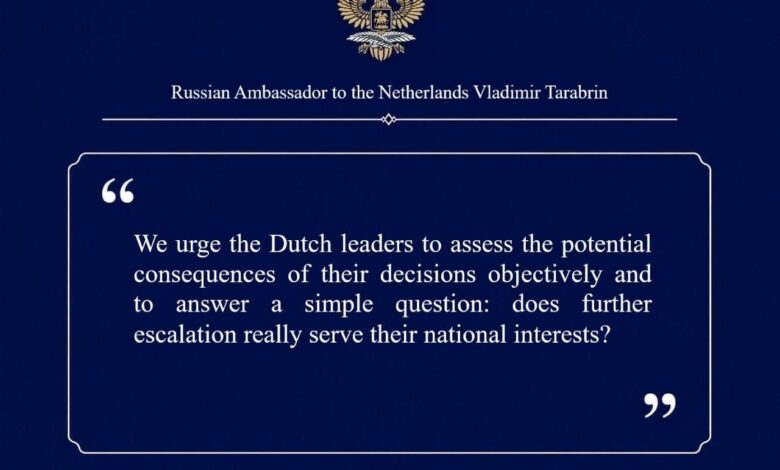
“We would like to warn the Dutch leadership and other politicians in the European Union against such scenarios,” Tarabrin said. “They should objectively assess the possible consequences of their decisions and answer a simple question: does further escalation really serve their national interests?”
Photo: Russian Foreign Ministry