India’s Supreme Court Refuses Urgent Hearing on Plea Against Police Action on Protesters

Dragon Media News Desk
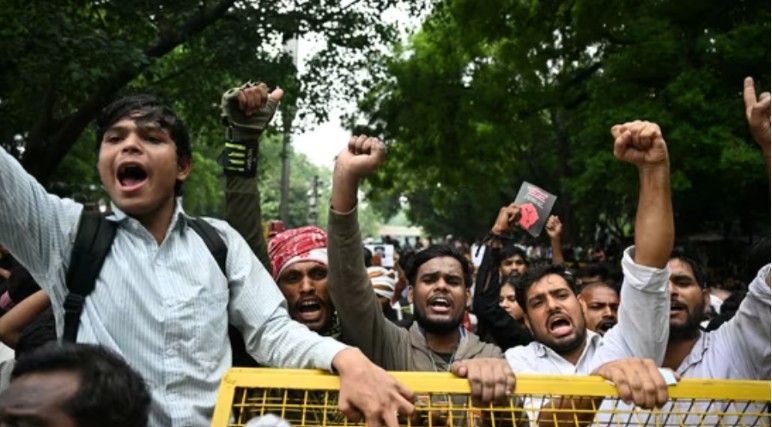
India’s Supreme Court on Wednesday refused to grant an urgent hearing to a petition alleging excessive use of force by Delhi Police against students and protesters associated with the Cockroach Janata Party movement.
A lawyer appearing before a bench comprising Chief Justice Surya Kant and Justices Joymalya Bagchi and V. Mohana sought to have the petition listed for hearing the following day.
The lawyer said student demonstrations were continuing at Jantar Mantar in New Delhi and that video evidence of the police action was available. The bench, however, declined the request for urgent listing.
Chief Justice Surya Kant asked the lawyer not to waste either the court’s time or his own. When the lawyer offered to show videos of the police action, the chief justice said the court did not have time to view them.
The petition seeks directions to the government to ensure that the National Eligibility-cum-Entrance Test, or NEET, is conducted fairly. It also calls for the dissolution of the National Testing Agency amid repeated allegations of examination paper leaks.
The Cockroach Janata Party is not a formally registered political party. It is a satirical movement organised by students and young people protesting failures in India’s education and examination systems and demanding government accountability.
The protesters have also demanded the resignation of Union Education Minister Dharmendra Pradhan. On July 20, they attempted to march from Jantar Mantar towards Parliament.
Delhi Police erected barricades and used batons and tear gas to stop the march. Clashes between police and demonstrators reportedly left a large number of people injured.
Amnesty International called for an independent and impartial investigation into allegations that police used unnecessary and excessive force against the protesters.
Aakar Patel, chair of Amnesty International India’s board, said the right to peaceful assembly and protest is protected under the Indian Constitution and international human rights law.
He said the police response raised serious questions over whether the use of force met legal standards of necessity, inevitability and proportionality.
Meanwhile, the Delhi High Court on Wednesday agreed to urgently hear a separate public-interest petition alleging excessive police force during the march towards Parliament.
Delhi Police have maintained that violence, stone-pelting and vandalism occurred during the demonstration. Police said at least nine cases had been registered at different police stations.
The incident has intensified debate in India over the credibility of the national examination system, police conduct towards student movements and the constitutional right to peaceful protest.