Trial Production Succeeds at Hetauda Textile Industry

Dragon Media Correspondent
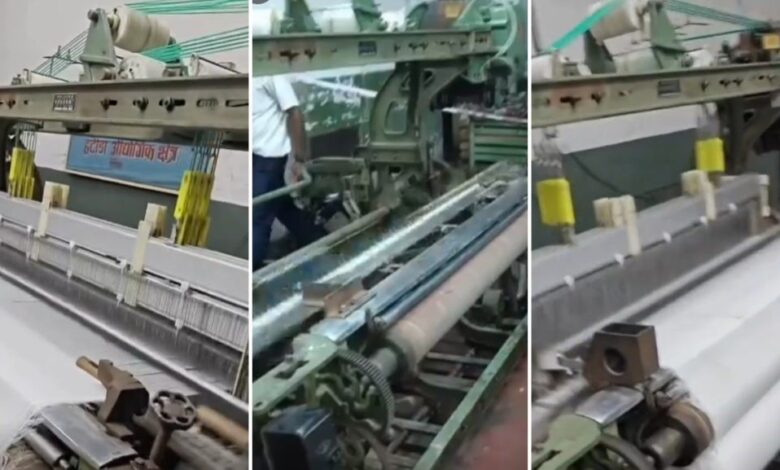
Initial trial production has been successfully completed at the Hetauda Textile Industry, which had remained closed for nearly two and a half decades. The test was carried out on Saturday after the government assigned the Nepal Army responsibility for repairing old machinery and preparing the factory for production.
The Nepal Army’s Directorate of Military Material Production conducted cleaning work across the industrial premises, repaired the electrical system, restored old machinery and restarted the looms for the initial test.
Around 40 technical personnel and soldiers of different ranks from the directorate have been deployed at the factory for the past 40 days to prepare the industry for possible reopening.
According to an army officer involved in the process, the successful test marks only the initial stage, while several technical and structural tasks remain before the factory can resume full-scale production.
However, the initial result has strengthened expectations that the industry can be brought back into operation.
Ram Bandhu Subedi, Joint Secretary at the Ministry of Industry, Commerce and Supplies, said the Nepal Army had been given two months to conduct the first production test and had completed the task within the specified period.
He said the successful trial had provided an encouraging indication that the factory could be fully revived.
Pradip Pariyar, private secretary to Prime Minister Balendra Shah, also said that old machinery and looms that had remained idle for years had been repaired and brought back into operation.
He noted that the sound of textile looms could once again be heard inside the factory premises after around 24 years.
A government study task force had earlier recommended beginning with trial production and using the results as the basis for preparing a long-term operational plan. Necessary repairs to the factory’s electricity system have also been completed.
The government decided on Asar 18 to revive the Hetauda Textile Industry, after which the Ministry of Industry, Commerce and Supplies began preparations to restart production within the current fiscal year.
Industry Minister Gauri Kumari Yadav has said the Hetauda factory would receive priority among state-owned industries identified for revival.
The government has also expressed plans to link the textile industry with the Butwal Spinning Mill and domestic cotton cultivation in an effort to build a stronger national textile production chain.
For the immediate repair of old machinery and commencement of trial operations, Rs 33 million had initially been proposed, while Rs 30 million was made available, according to Joint Secretary Subedi.
Although the trial has succeeded, Nepal Army technicians have assessed that substantial modernization will still be required for sustainable long-term operation.
New machinery, infrastructure improvements and modernization of the production system are expected to be necessary if the industry is to operate competitively.
Nearly Rs 2 Billion Initial Investment Estimated
Under the government’s policy and programme for fiscal year 2080/81, the Nepal Army carried out a detailed feasibility study on reopening the Hetauda Textile Industry.
The study estimated that approximately Rs 1.93 billion would be required as an initial investment to bring the factory back into full operation.
Annual operating expenditure was estimated at around Rs 780 million.
According to the study, the industry could recover its initial investment and begin moving toward profitability around nine years after production resumes.
The factory owns 166 ropanis of land and retains basic infrastructure. Some existing buildings and machinery are still considered repairable and reusable.
The study also found that most of the raw materials required for production could potentially be sourced domestically.
Demand could also be supported by supplying uniforms and other textile products to the Nepal Army, police and other government agencies, reducing concerns over market access.
Three-Year Revival Plan
The Nepal Army had earlier proposed a three-year framework for reviving the industry.
The first phase included policy decisions, preparation of a detailed project report, and the selection and procurement of new machinery.
The second phase envisaged completing infrastructure development, installing equipment and beginning trial production.
The third phase proposed expanding production capacity and moving toward regular production.
The plan also included a feasibility study for restarting the Butwal Spinning Mill and arranging the necessary raw materials.
However, political changes and other factors prevented implementation according to the original timetable.
Established with Chinese Assistance
The Hetauda Textile Industry was established in 2032 BS with financial and technical assistance from the Chinese government and investment from the Government of Nepal.
Commercial production began in 2035 BS.
Over time, political interference, weak management, growing financial liabilities and failure to modernize technology gradually weakened the industry.
Production stopped in 2056 BS, and the factory became fully inactive from 2057 BS.
In 2059 BS, the government of the time formally decided to shut the industry down completely.
Poor market management, outdated technology, electricity shortages, excessive staffing and weak managerial capacity were among the major reasons identified for the factory’s collapse.
The successful restart of the looms after nearly two and a half decades is therefore being viewed as an important first step toward industrial revival.
If the Hetauda Textile Industry returns to full operation, it is expected to support domestic textile production, help meet uniform requirements of government agencies from within Nepal and reduce dependence on imports.