Shenzhen Emerges as a Global Destination for Technology Tourism

Dragon Media News Desk
Shenzhen, the major technology hub in south China’s Guangdong Province, is increasingly attracting foreign visitors not only for conventional tourism but also for direct exposure to advanced technologies ranging from artificial intelligence and robotics to drones, electric vehicles and smart manufacturing.
At the centre of this trend is Huaqiangbei, Shenzhen’s vast electronics marketplace. The area has become one of the city’s most visible technology destinations, offering everything from electronic components to the latest consumer devices.
American tourist Bryan Lamothe-Arice, visiting with his family, initially went to Huaqiangbei simply to buy wireless headphones for the gym. But the range of products quickly expanded his interests to electric bicycles, scooters, cameras and drones.
According to local government data, nearly 8,000 foreign buyers have visited Huaqiangbei on an average day this year.
The district is home to more than 115,000 commercial entities and 35 specialized markets. From January through July, sales of AI-related products in the area increased by more than 55 percent year on year. Sales of AI glasses doubled, while sales of drones and robots rose by between 60 and 70 percent.
Longtime Huaqiangbei vendor Xiao Wenlong said foreign customers have become significantly more visible this year. Many arrive as tourists with their families and purchase electronic products during their visits, attracted in part by competitive prices.
South African visitor Janwick Hattingh bought a power bank and also had his Apple computer and his daughter’s watch repaired. He described the market as highly advanced, saying that virtually any technology product could be found there.
Shenzhen’s appeal, however, increasingly extends beyond retail electronics.
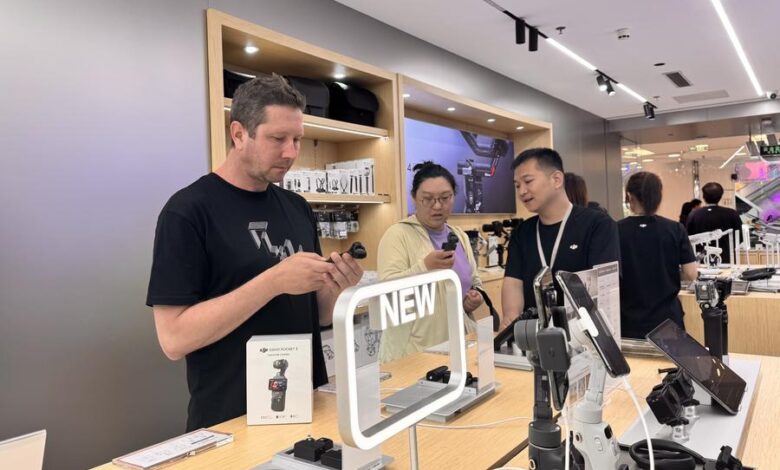
At a DJI flagship store, Spanish winery operator Marta Cerrolaza examined agricultural drones with a practical objective: assessing whether they could be used in her vineyards. She said she hoped to introduce drone technology into her winery and transform it into a more technologically advanced operation.
DJI staff member Wang Linlin said overseas customers accounted for around 40 percent of orders at the store over the previous two weeks, with visitors from Europe and South America particularly prominent.
Elsewhere in the city, technology itself is becoming part of the tourism experience.
At a robot 6S store in Longgang District, promoted as the first facility of its kind in the world, visitors can participate in robot combat games and dine at a restaurant where robots provide the services.
Jamaican tourist Daniela said humanoid robots were the most impressive part of her visit because of their mobility and large number of articulated joints. She said she looked forward to a future in which household service robots could perform tasks such as reading stories and preparing meals.
The rise of technology tourism has coincided with a sharp increase in foreign travel through Shenzhen. More than five million foreign entries and exits had been recorded through the city by early August this year, reaching that level 58 days earlier than in the previous year.
Zhang Bin, a product manager at Shenzhen-based travel agency Century Holiday, said the company’s inbound tourism business had increased by around 30 percent year on year since the previous month. The company has introduced new packages including family-oriented technology tours, visits to industrial facilities and customized programmes for small groups.
Easier entry arrangements for foreign travellers have also contributed to the increase.
China now provides unilateral visa-free entry to citizens of 50 countries, while nationals of 55 countries can use a 240-hour visa-free transit programme through 65 designated ports.
Shenzhen has also sought to reduce some of the practical barriers that foreign travellers previously encountered. Since 2024, overseas bank cards can be linked directly to payment platforms such as WeChat. Departure tax refunds are also available at six air, land and sea ports.
The growing flow of visitors comes at a time when international perceptions of China are showing signs of change. A survey released in July found that a median of 46 percent of respondents across 20 countries surveyed regularly since 2023 held a favourable view of China, compared with 32 percent in 2023.
Shenzhen is also preparing for greater international attention in November, when the city is scheduled to host the 33rd APEC Economic Leaders’ Meeting. It will mark the third time China has hosted the gathering, following Shanghai in 2001 and Beijing in 2014.
Over the past four decades, Shenzhen has developed from one of China’s earliest special economic zones into a global centre for innovation and advanced manufacturing. It is now home to major technology companies including Huawei, Tencent, BYD, DJI and UBTECH, alongside a large ecosystem of startups working in artificial intelligence, new energy, robotics and other emerging industries.
A city once primarily known for manufacturing products for the rest of the world is now increasingly attracting people from around the world who want to see where those products and the technologies behind them originate.
For Brazilian visitor Gabriel Ferreira Pedrosa, the objective went beyond conventional tourism. He hoped to purchase a humanoid robot in Shenzhen and take it back for use in his company.
That ambition captures Shenzhen’s evolving identity: foreign visitors are increasingly coming not only to observe China’s technological development, but also to take a part of that future home with them.