Russia Pushes Expansion of Technology, Nuclear Energy and Industrial Cooperation with Ethiopia

Dragon Media News Desk
Russia is seeking to expand its relationship with Ethiopia beyond traditional political cooperation toward a long-term partnership centred on technology, nuclear energy, industrial production, infrastructure and scientific research.
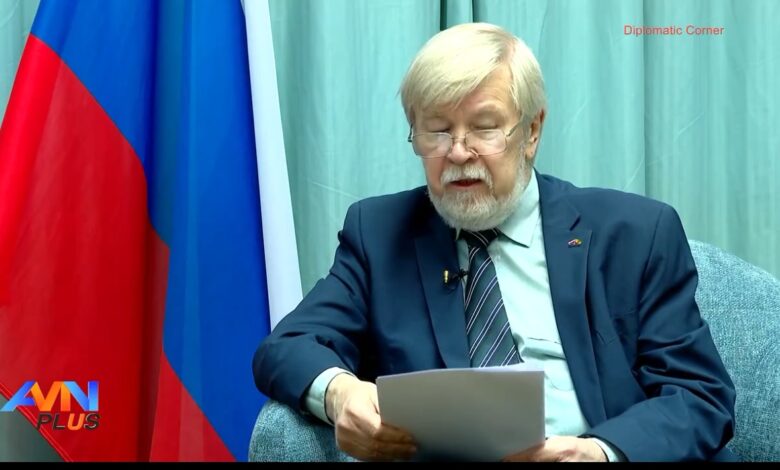
Russian Ambassador to Ethiopia Evgeny Terekhin said in an August 12 interview with Addis Media Network that Foreign Minister Sergey Lavrov’s visit to Addis Ababa in July focused on coordinating bilateral priorities and advancing the practical implementation of agreements previously reached between the two countries.
During the visit, Lavrov held talks with Ethiopian Prime Minister Dr. Abiy Ahmed and Foreign Minister Gedion Timothewos. According to Terekhin, the discussions focused on strengthening bilateral relations on the basis of mutually beneficial national interests and expanding cooperation in advanced technologies and large-scale infrastructure projects.
Lavrov also held high-level consultations with African Union Commission Chairperson Mahmoud Ali Youssouf. Russia and the African Union agreed to institutionalise regular high-level dialogue through annual consultations, as Moscow seeks to give greater structure to its engagement with the continent ahead of the third Russia–Africa Summit.
Terekhin said the most promising areas of Russia–Ethiopia cooperation are those that can strengthen Ethiopia’s technological and energy sovereignty. He described the development of a nuclear industry as an important component of Ethiopia’s long-term energy security and accelerated industrialisation.
Russia’s state nuclear corporation Rosatom and the Ethiopian side have been discussing the potential development of a major nuclear power project. Cooperation on the peaceful use of nuclear energy has also included human-resource development, research and the establishment of the necessary nuclear infrastructure.
Terekhin said Russian companies are prepared to localise production in Ethiopia. Such cooperation, he argued, could create new jobs while facilitating the transfer of advanced technical expertise to Ethiopian specialists. The 10th meeting of the Intergovernmental Commission on Economic, Scientific and Technical Cooperation and Trade is also expected to be held in Addis Ababa by the end of the year.
Russia also fully supports Ethiopia’s Green Legacy Initiative, according to the ambassador. Environmental and scientific cooperation between the two countries has been anchored for four decades in their Joint Biological Expedition, which is now being developed into a more permanent institutional framework through plans for a Joint Biological Research Center.
The initiative is intended not only to preserve Ethiopia’s biodiversity but also to convert accumulated scientific knowledge into practical agricultural technologies, food-production solutions and advanced research. Russia views this cooperation as contributing to Ethiopia’s long-term food sovereignty.
On Ethiopia’s National Dialogue, Terekhin reiterated Moscow’s position in favour of full respect for Ethiopian state sovereignty and opposition to external interference in the country’s internal affairs.
Ethiopia’s formal accession to BRICS in 2024 has also created a new platform for bilateral economic cooperation. Terekhin said particular attention is being given to practical measures such as expanding settlements in national currencies and making greater use of mechanisms associated with the BRICS New Development Bank.
Relations between Russia and the African Union have also become increasingly institutionalised. The memorandum signed at the first Russia–Africa Summit in Sochi in 2019 and the 2023–2026 Action Plan adopted at the second summit in St. Petersburg have provided a framework for expanding political, economic, security and development cooperation.
Terekhin’s remarks indicate that Moscow increasingly views Ethiopia not only as an important bilateral partner but also as a major pillar of Russia’s broader long-term engagement with Africa. The effort to integrate technology, energy, localised production, scientific research and multilateral cooperation into a single framework suggests that Russia–Ethiopia relations may become increasingly practical and project-oriented in the years ahead.