Nepal Oil Corporation Faces Criticism Over LPG Shortage: ‘Unable to Provide Even One Cylinder, Yet Threatening Action?’

Dragon Media Correspondent
Nepal Oil Corporation has come under criticism after warning hotels, restaurants, party palaces and other commercial establishments of legal action for keeping more LPG cylinders than necessary at a time when ordinary consumers are struggling to obtain cooking gas in the market.
The corporation’s central office issued an “extremely urgent notice” on Shrawan 28, stating that irregularities had been observed in the distribution of filled 14.2-kilogram LPG cylinders since Asar 31.
According to the corporation, LPG imports and distribution are currently around 20 percent higher than under normal circumstances. Despite this, complaints continue that ordinary consumers are unable to obtain cooking gas easily from the market.
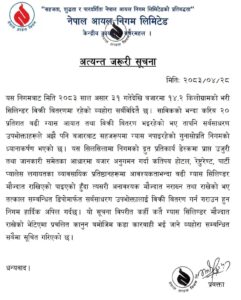
The corporation said complaints received through its two response desks, as well as market inspections, had found that some hotels, restaurants, party palaces and other commercial establishments were storing more LPG cylinders than necessary.
It urged such establishments to keep only the quantity required for their operations and to return excess cylinders through the relevant depots so that they could be made available to ordinary consumers.
The corporation also warned that strict legal action would be taken if any establishment was found storing LPG cylinders beyond the limit permitted by existing law.
However, the warning has drawn criticism because consumers are still struggling to obtain even a single cylinder despite being ready to pay the regular price.
Commenting on the issue, Binod Neupane sharply questioned the corporation’s role in a social media post.
“You do not have the ability to do the work you are supposed to do. You cannot even arrange one cylinder of gas for people who are ready to pay so they can light their stoves. Instead, you threaten them with action. Don’t you feel even a little shame?” Neupane wrote.
His remarks have brought renewed attention to the question of responsibility for LPG supply management. As consumers continue to face shortages, pressure is growing on the corporation to explain where the disruption has occurred in the supply and distribution chain.
The issue has become more significant because the corporation itself says LPG imports and sales are about 20 percent higher than normal. If imports and distribution have increased but consumers are still unable to obtain cylinders, questions arise over whether the problem lies in distribution management, abnormal stockpiling, artificial scarcity or weaknesses in supply coordination.
The corporation has indicated that excessive storage by some commercial establishments may be one factor behind the shortage. However, the immediate concern of consumers remains the need for a regular, transparent and easily accessible supply of cooking gas.
As LPG is an essential commodity directly linked to daily household needs, the shortage has affected not only families but also hotels, restaurants and small businesses.
Critics are therefore calling on Nepal Oil Corporation not only to issue warnings of legal action but also to publicly clarify the actual supply situation, distribution volumes and the mechanism through which LPG cylinders are reaching the market.