China’s Luhuo-Kangding Expressway Makes New Progress as Xindu Tunnel Enters Main Excavation Stage

Dragon Media News Desk
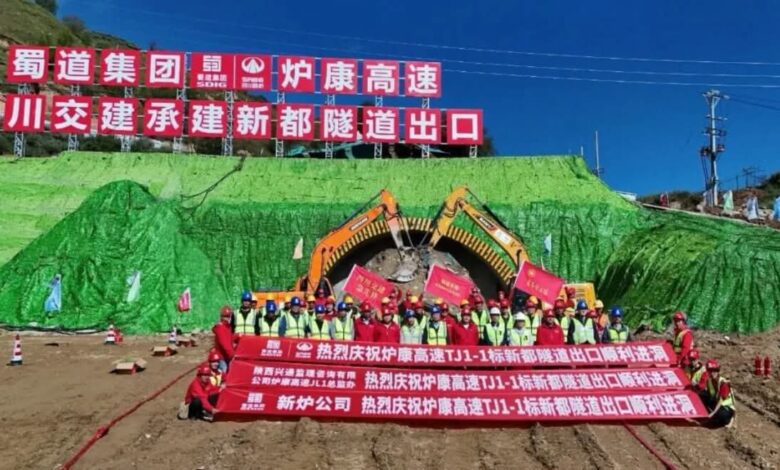
Construction of the Luhuo-Kangding Xinduqiao Expressway in Sichuan Province has reached a new milestone, with the exit section of the Xindu Tunnel successfully opened for excavation.
The development, achieved on August 12, marks the formal entry of the tunnel into its main excavation stage. The tunnel is described as one of the longest expressway tunnels under construction in Sichuan at such a high altitude and through complex sand-and-gravel geological formations.
Located in Luhuo County of Garze Tibetan Autonomous Prefecture, the Xindu Tunnel has a total length of 4,750 metres. It is situated at an altitude of about 3,200 metres in a cold, oxygen-deficient environment.
The surrounding geology consists mainly of long-deposited gravel and loose sediment. The tunnel exit passes beneath National Highway G350, with the shallowest distance between the tunnel and the surface measuring only 11.9 metres.
The combination of shallow excavation, unstable geological conditions and the high-altitude environment has created significant engineering challenges. Project teams have responded by strengthening personnel deployment, safety management and technical support while addressing difficulties associated with tunnel construction in loose gravel formations.
The Luhuo-Kangding Xinduqiao Expressway is an important component of Sichuan Province’s expressway network plan for 2022-2035. It also forms part of a major north-south transport corridor linking western Sichuan with broader regional road networks.
The entire project lies within Garze Tibetan Autonomous Prefecture and extends for about 186 kilometres, with an average elevation of around 3,420 metres.
The route is planned to connect with the G4217 expressway network in the Luhuo area, pass through Daofu County and link with the G4218 expressway under construction near Xinduqiao in Kangding.
Once completed, the expressway is expected to strengthen the transport network across western Sichuan’s high-altitude areas, improve regional mobility and enhance emergency transport and response capacity.
The project is also expected to improve travel conditions for local communities while supporting the development of distinctive agricultural and pastoral products, cultural resources and tourism.
Its construction is considered important for promoting economic and social development, rural revitalisation and stronger regional connectivity in Tibetan-populated areas of western Sichuan.
The progress at the Xindu Tunnel reflects the growing engineering capacity being applied to complex transport infrastructure in China’s high-altitude regions.