China Expands Humanoid and Quadruped Robots into Security and Military-Related Applications

Dragon Media News Desk
Chinese companies and research institutions are exploring the use of humanoid and quadruped robots in security, aviation and military-related fields at the 2026 World Robot Conference in Beijing.
Alongside civilian robot makers such as Unitree, UBTECH and AgiBot, organisations linked to China’s defence and aviation sectors are presenting specialised robotic systems designed for applications ranging from industrial security patrols to aircraft operation and missile loading.
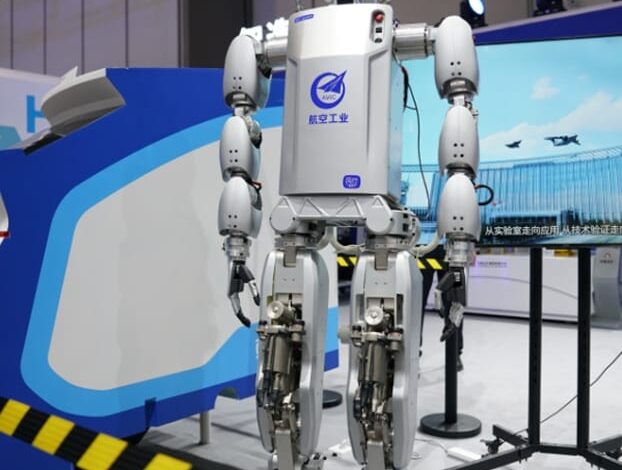
The Aviation Industry Corporation of China, or AVIC, is developing a specialised humanoid robot named Fengxing-001 for intelligent aviation manufacturing, ground maintenance and support, missile loading and aircraft operation.
The robot stands about 1.8 metres tall and weighs around 80 kilograms. According to AVIC staff, two or three such robots could potentially perform missile-loading tasks that would normally require four to six workers.
To improve its load-bearing capability, the robot’s legs use compact motors derived from aero-engine technology.
Fengxing-001, which has been under development since 2024, uses a hybrid electro-hydraulic drive system combining electric and hydraulic actuation. AVIC says the robot can jump 30 centimetres, jog at three kilometres per hour, walk while carrying 20 kilograms and handle loads weighing up to 15 kilograms.
AVIC is also testing the possibility of using humanoid robots to operate older aircraft. Company staff said the robot has completed trials in a simulated environment and can operate an aircraft in response to instructions.
Converting older aircraft into unmanned platforms usually requires extensive changes to wiring, control systems and onboard computers. AVIC says an adapted humanoid robot, with its lower-body components removed and configured for cockpit use, could significantly reduce the cost of such conversions.
Other exhibitors, including China North Industries Group Corporation, NEXWISE and the 21st Research Institute of China Electronics Technology Group Corporation, displayed security robots and robotic dogs.
Equipped with cameras, autonomous movement, patrol capability and basic decision-making functions, these quadruped robots are designed for deployment at power plants, large industrial facilities and other sensitive locations. Their use could reduce the need for routine human patrols.
NEXWISE also demonstrated a robotic dog equipped with an electromagnetic net launcher. According to the company, the system can identify a designated target and launch a restraining net from a distance of five to 10 metres.
A dual-shot version includes a rapid reloading mechanism that allows two nets to be fired in succession.
The company says the electromagnetic system operates more quietly than conventional gunpowder-powered net launchers and can restrain a target without requiring direct physical contact.
In practical operations, the system is designed to combine robotic reconnaissance, remote net launching and subsequent intervention by security personnel.
NEXWISE says the technology could be used for security at schools, hospitals, banks, government institutions and other sensitive facilities, as well as to assist police in apprehending suspects while reducing risks to law-enforcement personnel.
The technologies displayed at the Beijing conference suggest that China’s robotics sector is moving beyond industrial manufacturing and civilian services toward increasingly specialised roles in security, aviation and potentially military support operations.
However, many of the systems remain in development, testing or demonstration stages. They should therefore be viewed primarily as emerging technologies aimed at reducing human exposure to dangerous tasks, automating difficult operations and integrating advanced robotics with existing platforms.