China Approves New Zhongsha Marine Research Station, Expanding South China Sea Observation Network

Dragon Media News Desk
The Chinese Academy of Sciences has approved the establishment of a new marine ecological environment field observation and research station in the Zhongsha Islands area, expanding China’s long-term scientific observation network across the South China Sea.
The station was proposed by the South China Sea Institute of Oceanology under the Chinese Academy of Sciences. It is expected to fill a long-standing observation gap in the Zhongsha waters, complementing existing research platforms in the Xisha and Nansha island areas.
With the new facility, researchers aim to establish a more comprehensive network for monitoring coral reefs, marine ecosystems, oceanographic conditions, geological processes and fishery resources across different parts of the South China Sea.
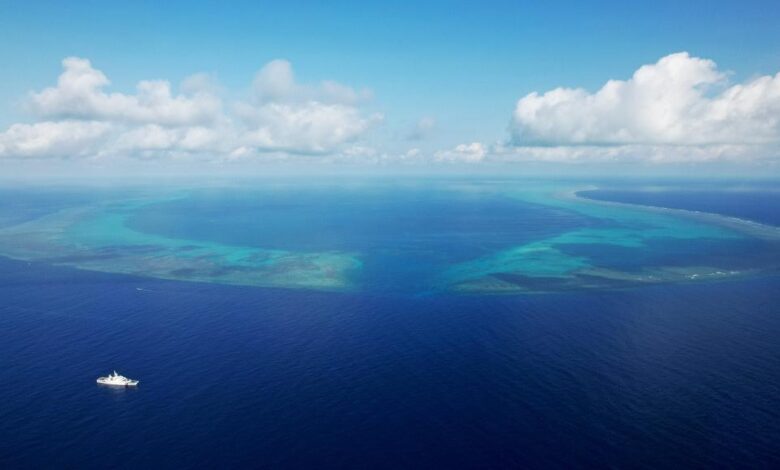
The Zhongsha area lies in the central part of the South China Sea basin and includes extensive reefs and atoll systems, including Zhongsha Atoll and Huangyan Island. Zhongsha Atoll is a large submerged atoll, while Huangyan Island is an oceanic atoll with a distinctive coral reef ecosystem.
According to the institute, geological formations in the Zhongsha area preserve important evidence of the formation and evolution of the South China Sea as well as the long-term development of coral reefs.
The region is also characterized by a complex hydrodynamic environment shaped by relatively weak background currents and powerful tropical storms. These conditions have contributed to distinctive coral reef ecosystems, rich biodiversity and significant fishery resources.
The reefs are considered important habitats and refuges for marine organisms and can also serve as ecological steppingstones supporting the dispersal of species across the wider South China Sea.
Long-term and systematic monitoring is expected to provide baseline data for research in marine science, ecology, geology and fisheries. Such continuous observations are particularly important for assessing changes in coral reef health, biodiversity, ocean conditions and the effects of extreme weather and climate variability.
The South China Sea Institute of Oceanology conducted China’s first comprehensive scientific survey of the Xisha and Zhongsha island areas between 1974 and 1977. Over the following decades, researchers from the institute continued scientific surveys and ecological monitoring in the Zhongsha waters.
The newly approved station will use a coordinated structure consisting of two offshore core platforms and one land-based comprehensive support platform. Together, they are intended to form a three-dimensional observation system capable of monitoring different environmental gradients across the Zhongsha waters.
The station will work in coordination with observation facilities in the Xisha and Nansha areas, strengthening the broader island and reef monitoring network in the South China Sea.
The institute said the Zhongsha station is intended to develop into an open marine field research platform combining long-term continuous observation, frontier scientific research, ecological restoration demonstrations and scientific support for environmental decision-making.
The expanded network is expected to provide researchers with continuous data on changes in marine ecosystems while supporting conservation, ecological restoration and the sustainable use of marine resources in the South China Sea.