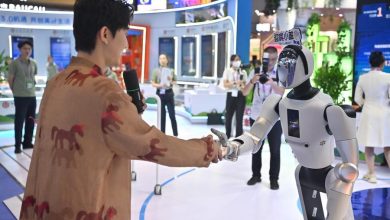
Second World Humanoid Robot Games Open in Beijing, 100-Meter Sprint Completed in 9.39 Seconds


Dragon Media News Desk
The second World Humanoid Robot Games have opened in Beijing, with a humanoid robot completing the 100-meter sprint in 9.39 seconds during the opening ceremony, a time faster than the men’s human world record and one of the most striking demonstrations of the event.
The opening ceremony was held on August 22 at Beijing’s National Speed Skating Oval, widely known as the “Ice Ribbon.” The Tien Kung Ultra humanoid robot, developed by the Beijing Humanoid Robot Innovation Center, completed the 100 meters in 9.39 seconds. Jamaican sprinter Usain Bolt holds the men’s human world record of 9.58 seconds, set in 2009. However, because robot competitions and human athletics operate under different rules and conditions, the performance is not regarded as breaking the official human world record.
Tien Kung Ultra also recorded a standing high jump of more than 2.88 meters. The ceremony featured joint demonstrations by human athletes and robots in table tennis, tennis, football and other sports.
One of the highlights came when a humanoid robot riding a robotic horse fired an arrow to ignite the “Zhixin,” or intelligence chip, which serves as the games’ symbolic equivalent of the Olympic flame. An X-Humanoid Tien Kung 3.0 robot also carried the games flag. Humanoid robots from several companies marched and performed drills autonomously without remote control.
The competition, running from August 22 to 26, brings together 666 teams and 2,056 robots from 16 countries. A total of 1,301 matches are being held across 51 events. Compared with the first edition, the number of participating teams has increased by 138 percent, while the range of competitions and testing scenarios has expanded significantly.
Events include running, football, table tennis, weightlifting, martial arts, dance and tug-of-war, alongside practical scenarios designed to test robots in industrial, hotel, household service, emergency response and precision-handling tasks.
A major feature of this year’s games is the greater emphasis on autonomous operation. Except for the 100-meter and 400-meter obstacle races, track and other competitive events require robots to perform without human remote control. In scenario-based contests, robots completing tasks fully autonomously receive higher scoring weight than those operated remotely.
Competition surfaces have also been specially adapted for robots. Running tracks, artificial football turf and impact-absorbing materials have been modified to account for the machines’ heavier weight, different traction requirements and the need to stop high-speed robots safely.
The games come only days after the opening of the World Robot Conference in Beijing, making the Chinese capital the center of two major robotics events within a single week.
The second World Humanoid Robot Games also illustrate China’s broader effort to move humanoid robotics beyond exhibition and demonstration toward autonomous systems capable of functioning in industrial, service and everyday environments. The stronger emphasis on autonomy, artificial intelligence, motion control and real-world usability suggests that competition in humanoid robotics is increasingly shifting from hardware performance toward practical intelligence.