Ecological Conditions Improve in Sanjiangyuan as Wildlife and Water Conservation Show Strong Gains

Dragon Media News Desk
Long-term ecological protection efforts in Sanjiangyuan, or the “Source of Three Rivers,” in China’s Qinghai Province are showing increasingly visible results. Fish populations in Qinghai Lake have risen sharply, rare wildlife species are recovering, and conservation work stretching from the headwaters of the Yangtze River to the remote Hoh Xil region is helping restore one of Asia’s most important high-altitude ecosystems.
Sanjiangyuan lies on the Qinghai-Xizang Plateau and contains the headwaters of the Yangtze, Yellow and Lancang, or Mekong, rivers. Because of its importance to water security, the region is often described in China as the “Chinese Water Tower.” Its glaciers, lakes, wetlands and alpine grasslands are directly connected to the water supply and ecological stability of vast areas downstream.
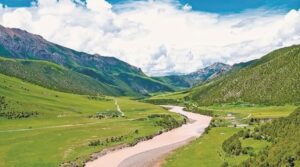

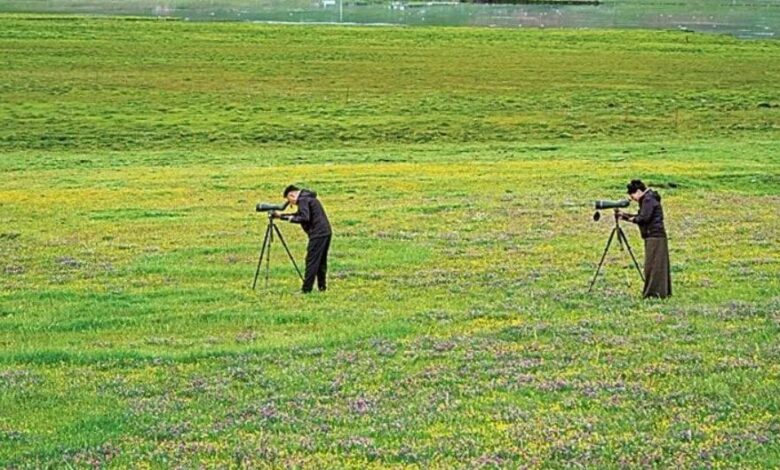
July is one of the most visually striking seasons in Qinghai. Roads leading toward Sanjiangyuan pass through blooming rapeseed fields, lakes, wetlands, snow-covered mountains and wide grasslands, while flocks of birds can often be seen crossing the sky. The Xian’yu Bay wetland area near Qinghai Lake has become one of the clearest examples of ecological recovery in recent years.
The area is an important breeding ground for Qinghai Lake naked carp, locally known as Huangyu. From May to August each year, large numbers of the fish swim upstream from Qinghai Lake into freshwater rivers and wetlands to spawn. At the peak of the migration, local observers describe the river as appearing to be “half water and half fish.”
The total biomass of Huangyu in Qinghai Lake has now reached around 133,000 tonnes. When large-scale protection efforts began in 2002, the figure was only about 2,600 tonnes. This represents an increase of roughly 51 times over more than two decades. Long-term fishing bans, artificial breeding and release programmes, restoration of rivers and wetlands, and stronger enforcement against illegal fishing have all contributed to the recovery.


The population of the Przewalski’s gazelle, one of the world’s rarest mammals and a species found around Qinghai Lake, has also increased significantly. Its population has risen from fewer than 300 in 2004 to more than 3,700 today. Habitats for birds, black-necked cranes and other high-altitude wildlife have also improved.
Liu Yong, a manager in the Xian’yu Bay scenic area who has worked there for 15 years, said he has personally witnessed the changes. According to him, ecological protection has been given priority over large-scale development, with efforts focused on minimizing interference with the natural environment and integrating environmental education into tourism activities.
Conservation work in Sanjiangyuan extends far beyond Qinghai Lake. In the upper reaches of the Yangtze River in Yushu Tibetan Autonomous Prefecture, local ecological protection workers regularly patrol riverbanks, collect waste and monitor grasslands and water sources. Local conservationists say that failure to protect the source areas would eventually affect communities and agricultural regions thousands of kilometers downstream.
In Hoh Xil, part of Sanjiangyuan National Park, patrol teams face even harsher conditions. Conservation workers stationed at remote outposts monitor enormous areas at very high altitude, where vehicles may break down, roads can become impassable in mud or snow, and teams may remain far from settlements for extended periods.
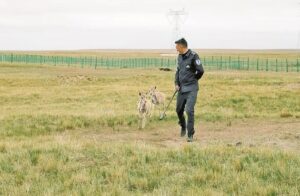
A small shelter at one of the conservation stations is used to care for orphaned or weakened Tibetan antelope calves. During the breeding season, calves that become separated from their herds are rescued by patrol teams, fed and cared for until they are strong enough to be released back into the wild.
The recovery seen in Sanjiangyuan demonstrates that restoring high-altitude ecosystems requires long-term policy, scientific monitoring and sustained participation by local communities. Rising fish and wildlife numbers are important indicators, but conservation specialists emphasize that the health of rivers, wetlands, grasslands and the wider food chain is even more important for long-term ecological stability.
The contribution of successive generations of local residents and conservation workers has been central to this progress. The increasingly visible coexistence of wildlife, rivers, lakes and human communities suggests that protecting the “Chinese Water Tower” is not only a domestic environmental issue for China, but also a broader matter of ecological and water security for Asia.