Chinese Robots Outpace Human Records as Real Test Shifts to Factories and Homes

Dragon Media News Desk
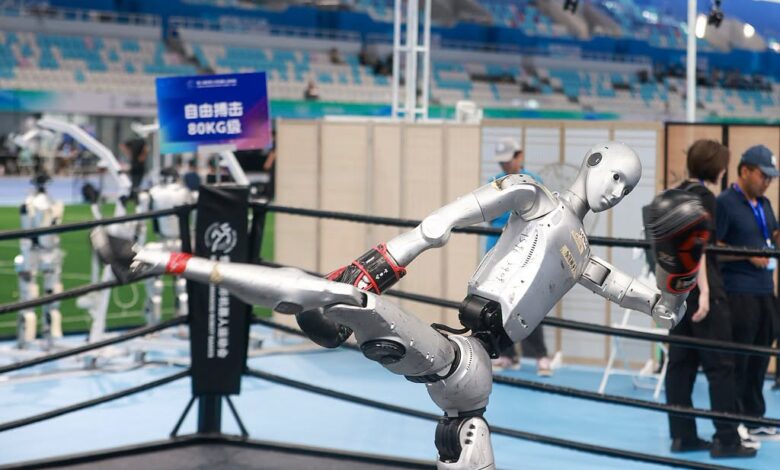
The second World Humanoid Robot Games underway in Beijing has demonstrated rapid advances in the speed, balance and autonomous decision-making capabilities of human-shaped robots. One of the biggest highlights came when the Beijing-developed Tien Kung Ultra completed the 100-meter race in 9.39 seconds, faster than Usain Bolt’s human world record of 9.58 seconds. However, because robot competitions operate under different technical conditions and rules from official human athletics, the result should not be interpreted as replacing the recognized human world record.
The opening ceremony at Beijing’s iconic “Ice Ribbon,” the National Speed Skating Oval, itself became a major technology showcase. A wire-suspended humanoid robot glided through the air in a scene reminiscent of the dramatic torch-lighting ceremony at the 2008 Beijing Olympics. It was followed by 80 Booster T2 robots marching in coordinated formation and changing patterns together, demonstrating advances in group control and synchronization.
Another 36 humanoid robots equipped with five-fingered dexterous hands performed music using electronic wind instruments, piano, drums, marimba and guitar. Such demonstrations suggest that humanoid development is moving beyond basic walking and object handling toward increasingly sophisticated fine-motor control.
Tien Kung Ultra also attracted attention with a 2.8843-meter standing jump. Although the mechanics and rules cannot be directly compared with the human high jump, the performance demonstrated significant progress in joint power, whole-body coordination and explosive robotic movement.
Yet robotics specialists themselves caution against treating sporting performances as the final measure of technological maturity. According to the Tien Kung Ultra technical team, reaching a peak speed for a short period is one challenge; maintaining such performance reliably over long periods is far more difficult.
High-speed and long-distance operation can expose structural fatigue, overheating in joints and actuators, and durability problems in drivetrain systems. These are critical issues if humanoid robots are eventually expected to work continuously in factories, warehouses or other commercial environments.
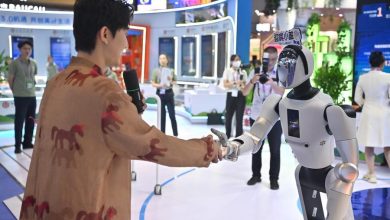
This is why the real significance of the Games extends far beyond running and jumping. Robots are also being tested in packing, warehousing, assembly, retail services, industrial tool operation and other tasks designed to simulate real-world environments. In many disciplines, the machines must perceive their surroundings, make decisions and complete tasks without direct human control.
A humanoid tennis robot developed by Galbot offered another example. Competing against a professional player, the robot demonstrated autonomous ball tracking, forehands, backhands, serving and net play while making split-second decisions using its onboard intelligence.
Such demonstrations highlight progress in embodied AI, a field that combines artificial intelligence with a physical body capable of perceiving, moving and interacting with the real world.
This year’s Games feature 2,056 robots from 666 teams around the world, competing across 51 events and 1,301 competitive sessions. Compared with the inaugural event last year, the number of teams has risen by 138 percent, while the number of participating robots has more than quadrupled.
The rapid expansion reflects broader growth across China’s humanoid robotics sector. According to an estimate by California-based Smart Analytics Global, approximately 19,100 humanoid robots were shipped worldwide during the first half of 2026, with Chinese manufacturers accounting for more than 97 percent of the total.
Different industry studies use varying definitions of what qualifies as a humanoid robot and therefore produce different shipment figures. Nevertheless, there is broad evidence that China’s role in humanoid robot manufacturing and supply chains is expanding rapidly.
The World Robot Conference, Unitree Robotics’ high-profile stock market debut and the World Humanoid Robot Games, all taking place within the same period, collectively illustrate the direction of China’s emerging industrial strategy. The country’s latest development roadmap has identified embodied intelligence as one of the priority industries expected to generate new sources of economic growth.
The next stage of competition will therefore not be determined simply by whether robots can run faster than humans.
The decisive questions are whether a humanoid robot can work reliably for eight hours on a factory floor, assist elderly people safely, make independent decisions in emergency situations, manipulate ordinary household objects and function alongside humans without creating unacceptable risks.
The speed displayed in Beijing is spectacular.
But the true test of the humanoid revolution will not be decided by medals or records. It will be determined by whether these machines can leave the arena and laboratory and operate safely, reliably and economically in factories, homes, hospitals and everyday human life.