Russia Urges EU to Avoid Selective Interpretation of History

Dragon Media News Desk
Russia’s Permanent Mission to the European Union has urged the EU not to present the history leading up to the Second World War selectively, arguing that events of the 1930s should be viewed in their broader diplomatic context.
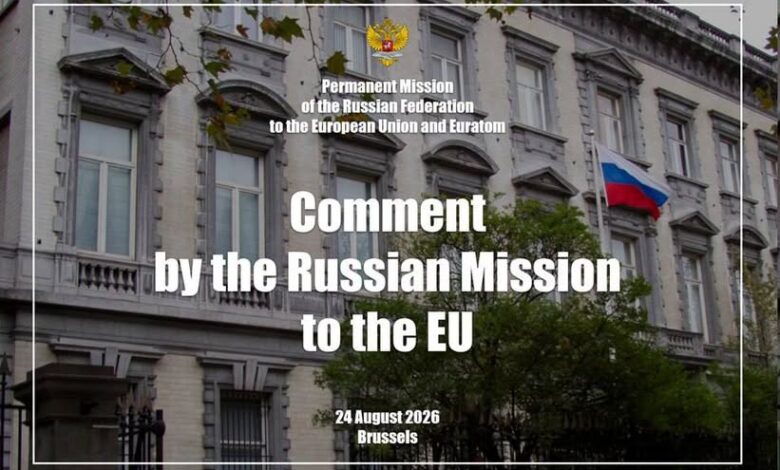
In a comment issued on August 24, the Russian Mission responded to a European Commission statement marking the so-called “Europe-wide Day of Remembrance for the Victims of All Totalitarian and Authoritarian Regimes,” saying that historical events should be presented in their entirety.
The European Commission has linked the August 23 remembrance day to the Molotov-Ribbentrop Pact, the Soviet-German Treaty of Non-Aggression signed in 1939. The Russian Mission argued, however, that portraying the agreement in isolation from earlier European diplomatic developments amounts to a selective interpretation of history.
The Mission noted that several European countries had concluded agreements with Germany before the Soviet-German pact. It referred to Poland’s 1934 agreement with Germany, France’s 1938 arrangements, and non-aggression agreements signed by Estonia and Latvia with Germany in 1939.
It also highlighted the Anglo-German Declaration signed by British Prime Minister Neville Chamberlain and Adolf Hitler on September 30, 1938.
The Russian statement further argued that the policy of appeasement pursued by Britain and France toward Nazi Germany should not be overlooked. It pointed in particular to the 1938 Munich Agreement involving Britain, France, Germany and Italy, which paved the way for Germany’s annexation of the Sudetenland from Czechoslovakia.
According to the Russian Mission, the Munich Agreement and other diplomatic decisions taken by European powers in the late 1930s weakened the continent’s security environment and accelerated the crisis that eventually led to the Second World War.
The Molotov-Ribbentrop Pact was signed by Nazi Germany and the Soviet Union on August 23, 1939. Germany invaded Poland on September 1, triggering the outbreak of the war in Europe.
The Russian Mission said that if the European Union genuinely intends to preserve historical memory for future generations, developments of the 1930s should be presented in their full context, including earlier diplomatic agreements, the policy of appeasement and the decisions taken by major European powers.