Large-Scale Rescue Operation Underway at Gyirong Border Port as Xizang Activates Highest-Level Disaster Response

Dragon Media News Desk
A large-scale rescue and relief operation is underway at Gyirong Port in Gyirong County, Xizang Autonomous Region, following a severe mudslide and debris flow that caused significant casualties in the China-Nepal border area.
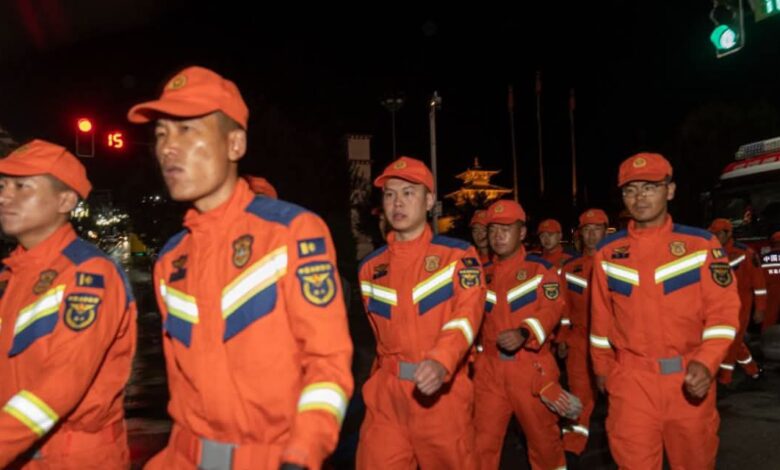
Rescue teams were moving rapidly toward the affected area on August 27, while authorities in Xizang activated the region’s highest-level relief and emergency response for natural disasters.
Officials said the disaster, which struck on Wednesday, cut off roads leading to Gyirong Port and disrupted communications and electricity supplies. The difficult high-altitude terrain and damaged access routes have complicated rescue operations.
The emergency management authority of Xizang has dispatched 792 personnel and 152 vehicles to the affected area. The regional fire and rescue authority has separately mobilized 72 vehicles and 431 firefighters and rescue personnel.
The teams are equipped with rescue dogs, life-detection scanners, speedboats and other specialized equipment. Personnel from the People’s Liberation Army and the People’s Armed Police Force have also been deployed to support search and rescue operations.
According to Xinhua reporters traveling toward the disaster zone, fleets of rescue vehicles could be seen heading from Lhasa toward Gyirong.

By 5:35 p.m. on August 27, central and regional authorities had dispatched significant quantities of emergency supplies to the affected area, including 8,000 cotton coats, 2,000 tents, 3,000 quilts and 5,000 moisture-proof mats.
At the national level, China’s Ministry of Natural Resources activated a Level-II emergency response for geological disasters, the second-highest level in the country’s four-tier emergency response system. A working team was also dispatched to the site to guide rescue operations and help prevent secondary geological disasters.
The National Commission for Disaster Prevention, Reduction and Relief, together with the Ministry of Emergency Management, allocated an additional 30,000 central relief items. These include tents, heating equipment, clothing, quilts, folding beds and moisture-proof mats for evacuation, temporary resettlement and emergency assistance.
China’s Ministry of Finance and the Ministry of Emergency Management also allocated 120 million yuan, or about $17.69 million, in central natural disaster relief funds to support emergency rescue and relief operations in Xizang.
Meanwhile, the National Development and Reform Commission earmarked an additional 100 million yuan from the central budget to support post-disaster emergency restoration and reconstruction.
China Anneng, a state-owned engineering and emergency rescue enterprise, sent an initial group of 200 rescue personnel to the disaster area. The team brought advanced equipment including multifunctional drones, 3D laser scanners and life-detection devices.
Power supplies in the affected area were also disrupted by the disaster, but officials said the first group of power-grid repair personnel had already reached the site.
Gyirong Port is an important land crossing for trade and movement between China and Nepal. Because of the high-altitude terrain, landslide risk and limited road access, authorities are combining military, engineering, aviation and civilian emergency resources in the response.
Chinese authorities are currently prioritizing search and rescue, temporary resettlement of affected residents, restoration of roads and electricity, and measures to prevent secondary disasters in the area.