Humanoid Robot Assists Traffic Police at Hangzhou Marathon

Dragon Media News Desk
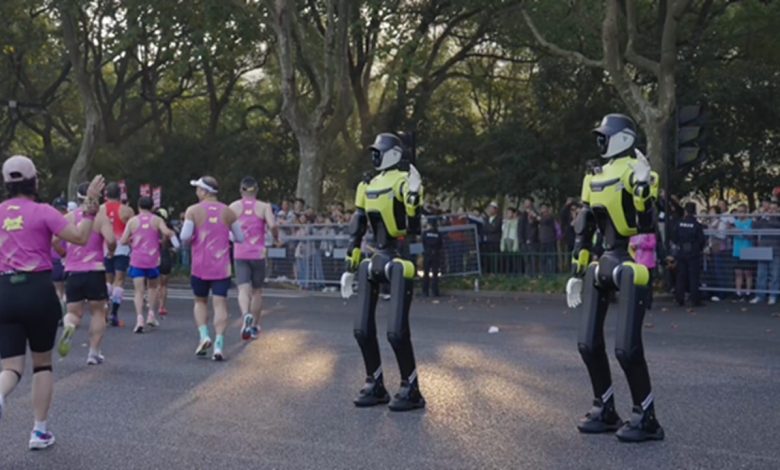
A humanoid traffic robot was deployed for the first time at the Hangzhou Marathon in China. The robot, named Hangxing No. 2, was developed by Hangzhou-based DEEP Robotics in cooperation with local traffic authorities and supported police at four locations around Huanglong Sports Center.
The robot monitored intersections, patrolled designated routes, issued traffic safety warnings and answered public inquiries, organisers said. More than 300,000 people applied for this year’s marathon, which had 36,000 runners. The company said the robot was used to patrol areas that fixed surveillance equipment might not cover, amid large crowds and shifting pedestrian flows.
According to the company, Hangxing No. 2 is based on the DR02 humanoid robot. It stands 178 centimetres tall, has an IP66 rating for dust and water resistance, and can operate in temperatures ranging from minus 20 to 55 degrees Celsius.
Its multisensor system includes LiDAR, a depth camera and a wide-angle camera. The company said the system allows the robot to patrol preset routes and move between monitoring points. It can identify situations such as pedestrians crossing roads or vehicles violating traffic rules and broadcast safety warnings.
Meng Yuan, a DEEP Robotics representative, said marathons—with their dense crowds, limited time frames and repetitive tasks—provide a useful setting to test robots. He described the deployment as an initial effort to develop a standard model for using humanoid robots in traffic management at large running events.
Organisers said the robot’s routine monitoring and advisory tasks could help police focus on emergencies, complex public assistance and security at key locations. Chinese experts say humanoid robots may find practical applications in areas such as security, inspection, logistics and household services. Their purpose, they say, is to support human capabilities by taking on repetitive tasks, not to replace people.