China’s Economy Maintains Stable Growth, High-Tech and Advanced Manufacturing Emerge as Key Drivers

Dragon Media News Desk
China’s economy maintained generally stable growth in August, with new economic drivers playing an increasingly important role. Industrial production gained momentum, while high-tech manufacturing, equipment manufacturing, industrial robots, lithium-ion batteries and digital-product sectors made notable contributions to growth. However, official Chinese data also showed that some indicators related to domestic demand, retail sales and investment remained relatively weak.
According to China’s National Bureau of Statistics, value-added industrial output rose 5.2 percent year-on-year in August, 0.7 percentage points faster than in July. During the same period, equipment manufacturing grew 12.1 percent and high-tech manufacturing expanded 16.7 percent, respectively 6.9 and 11.5 percentage points faster than overall industrial output growth.
According to NBS spokesperson Fu Linghui, high-tech manufacturing and digital-product manufacturing grew 16.7 percent and 15.7 percent respectively. New growth drivers contributed more than 60 percent of the growth in industrial output above designated size. This indicates that China’s economic structure is gradually shifting from traditional industries toward high-tech, digital and advanced manufacturing.
China’s foreign trade also expanded rapidly in August. Total goods imports and exports increased 19.8 percent year-on-year, while exports rose 18.6 percent and imports increased 21.7 percent. Despite continued uncertainty in the global economy, China’s production capacity and trade activity continued to support overall economic growth.
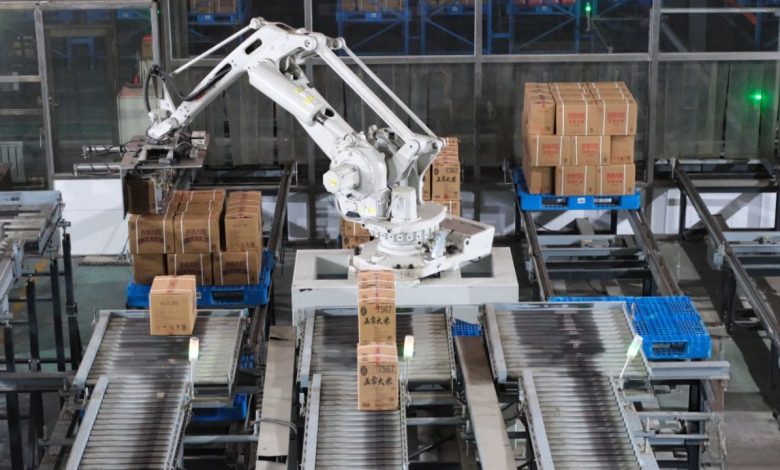
Growth was particularly strong in advanced manufacturing. Output of lithium-ion batteries surged 57.2 percent year-on-year in August, industrial robot production rose 34.6 percent and 3D-printing equipment output increased 29.9 percent. All eight major equipment-manufacturing sectors recorded relatively rapid growth, while the electronics sector expanded 17.2 percent and became one of the largest contributors to industrial growth.
Information transmission, software and information-technology services also expanded rapidly. Their production index rose 9.6 percent in August and contributed more than 20 percent of overall service-sector growth. The figures indicate that the role of the digital economy and technology-based services is continuing to strengthen.
Overall fixed-asset investment, however, remained under pressure. Fixed-asset investment fell 7.2 percent in the first eight months of the year. Investment in high-tech industries nevertheless increased 5.2 percent. Investment in information services rose 22.7 percent, aerospace vehicle and equipment manufacturing increased 14.9 percent, and electronic and communication equipment manufacturing expanded 6.9 percent.
Zhou Mi, a researcher at the Chinese Academy of International Trade and Economic Cooperation, said the rapid growth in high-tech and advanced manufacturing reflected long-term investment made in previous years. According to him, as such investment begins to generate results in production and technology, it can attract additional capital, accelerate industrial upgrading and create a new cycle of investment.
On the consumption side, retail sales increased only 0.4 percent year-on-year in August. Service consumption, however, remained comparatively stronger. Retail sales of services rose 4.9 percent in the first eight months, while growth in goods retail sales was limited to 1 percent. This suggests that services are accounting for a growing share of China’s consumption structure.
Economists have said China is currently at an important stage in the transition between old and new growth drivers. In their view, global uncertainty, weaker domestic demand and adjustment in traditional industries mean that linking the expansion of high-tech and advanced manufacturing with the broader economy has become a central challenge.
Hu Qimu, a professor at the Maritime Silk Road Institute of Huaqiao University, said new growth drivers need not only to expand rapidly but also to reach a scale large enough to account for a greater share of the economy. According to him, only when these sectors achieve sufficient industrial scale and market presence can their growth translate into broader employment, business activity and economic benefits.
China has this year continued to prioritise macroeconomic policy adjustment, expansion of domestic demand, industrial upgrading and the development of new growth drivers. The August data suggest that new technology and advanced manufacturing are no longer peripheral sectors but are increasingly becoming central engines of China’s economic growth. The main question is therefore shifting from whether new growth drivers are emerging to how effectively they can be integrated with consumption, investment and traditional industries to support balanced and sustainable long-term growth.