Supreme Court Issues Two Interim Orders: No Discrimination in Martyrs’ Benefits, Controversial House Rules Put on Hold

Dragon Media Correspondent
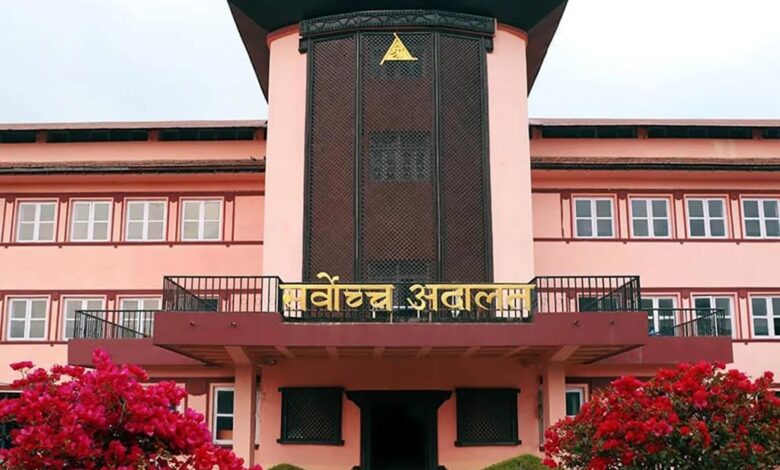
Nepal’s Supreme Court Constitutional Bench has issued two separate interim orders placing important constitutional limits on the implementation of special benefits announced in the budget for families of martyrs and those injured in the Gen-Z movement, and on provisions allowing the House of Representatives to treat its own procedural rules as equivalent to special federal law. The five-member bench comprised Chief Justice Dr. Manoj Kumar Sharma and Justices Kumar Regmi, Dr. Nahakul Subedi, Binod Sharma and Sharanga Subedi.
The first order concerns provisions in the fiscal year 2083/84 budget granting special facilities to families of martyrs and people injured during the Gen-Z movement. The budget included provisions for honouring those killed in the movement, providing financial assistance to their families, and giving priority to martyrs’ families and injured persons in access to concessional loans. Families of martyrs and injured persons from the armed conflict, various people’s movements and other political struggles challenged the provisions, arguing that they could create unequal treatment among groups officially recognised by the state.
The Constitutional Bench referred to the spirit of the Constitution’s preamble, which recognises historic people’s movements, armed struggles, sacrifice and contributions made in the interests of democracy, national interest and progressive political change. The Court ordered the government to ensure that implementation of the relevant budget provisions does not result in discrimination or unequal treatment among martyrs, their families, injured persons and the families of those injured in different movements.
The order should therefore not be interpreted as completely cancelling benefits for victims of the Gen-Z movement. Rather than prohibiting such assistance altogether, the Court has required the government to implement it in a manner consistent with the constitutional principle of equality and without discriminating against victims and families associated with other recognised movements.
The second order concerns Rule 140(11) and Rule 259 of the House of Representatives Regulations, 2083. Rule 140(11) contains provisions relating to procedures for constitutional amendment bills and the role of the House of Representatives and National Assembly. Petitioners argued that the provision raised questions about the limits of the bicameral process established by the Constitution.
Rule 259 was even more controversial. It provided that, notwithstanding anything contained in prevailing law, the House regulations would operate as a special federal law in matters relating to the House, its committees and its members. Critics, including opposition parties and legal experts, argued that such a provision could effectively place the internal rules of the House above federal laws enacted through the constitutionally prescribed legislative process.
Finding that serious constitutional questions had arisen at the preliminary stage, the Supreme Court ordered that Rule 140(11) and Rule 259 should not be implemented until a final decision is reached. The order is also expected to have an immediate impact on disputes concerning the suspension of members of parliament.
Under the new regulations, provisions concerning MPs could potentially have been treated as special law, raising concerns that automatic suspension clauses contained in laws relating to corruption, money laundering and other specific offences could be rendered ineffective. With the Supreme Court temporarily halting the operation of Rule 259, suspension provisions contained in existing special laws can, for now, operate according to the conditions specified in those laws.
However, the ruling does not mean that every MP facing any criminal charge will automatically be suspended. Whether suspension applies depends on the specific law involved, the nature of the offence, the legal status of the officeholder, detention conditions and relevant court orders. The Court has, at this stage, primarily prevented the House regulations from being treated as superior to prevailing federal laws.
The constitutional significance of the dispute extends beyond the immediate question of suspension. Nepal’s Constitution grants legislative authority to the Federal Parliament, comprising the House of Representatives and the National Assembly. A bill becomes federal law only after completing the constitutionally prescribed parliamentary process and receiving presidential authentication. The central question before the Court is whether procedural regulations adopted internally by one chamber can override or neutralise laws enacted through that full constitutional process.
The Constitutional Bench has not yet delivered a final judgment. Both decisions are interim orders pending full hearings. The disputed provisions could ultimately be struck down, upheld, or sustained with constitutional interpretation. For now, however, the Court has sent a clear signal regarding equality in the distribution of state benefits and the constitutional limits of the House of Representatives’ internal regulations.
The two orders carry a broader message about constitutional governance. A political majority may approve a budget, the House may regulate its own procedures, and the government may design policies for particular groups. But all such powers must be exercised within the limits of the Constitution and prevailing law.
The Supreme Court’s interim orders therefore reaffirm a fundamental principle of constitutional democracy: even decisions backed by a parliamentary majority remain subject to constitutional review.