Lavrov Backs Multipolar World Order, Sends Tough Message on Europe and Ukraine

Dragon Media News Desk
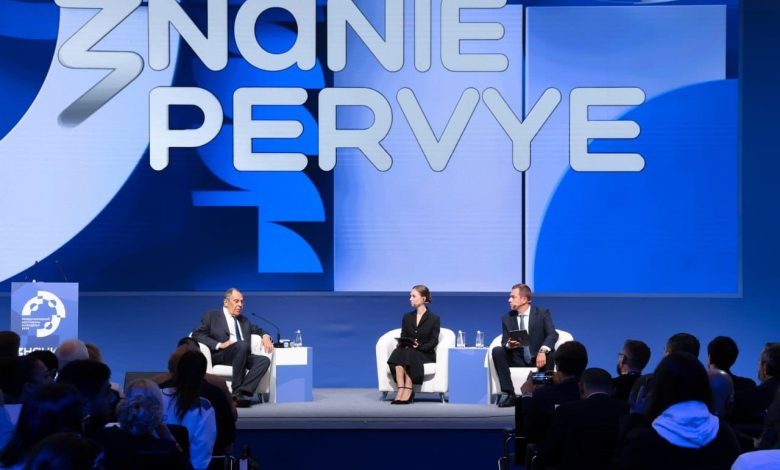
Russian Foreign Minister Sergey Lavrov has said the international system is moving steadily toward a multipolar order and described BRICS as one of the clearest examples of a new model of cooperation based on equality, shared development and mutual respect. Speaking on September 16 in Yekaterinburg during the federal educational marathon “Znanie. Pervye,” at a session titled “A New Global Architecture: An Open Dialogue with Sergey Lavrov,” he also pointed to the Shanghai Cooperation Organisation, the Commonwealth of Independent States, the Eurasian Economic Union and the Collective Security Treaty Organization as institutions representing what Moscow sees as a new type of international cooperation.
Referring to the recently concluded BRICS Summit in New Delhi, Lavrov said the grouping brings together countries representing different civilizations, histories and political traditions, yet they share a common interest in expanding opportunities for development, prosperity and security. According to him, such cooperation is not intended to harm other countries or allow one state to advance at another’s expense, but to create conditions in which participating nations can develop on the basis of mutual benefit.
Lavrov said Russia remains fully committed to this approach. He described the adaptation of international relations to multipolar realities as an objective and long-term process that, in Moscow’s view, enjoys broad support across much of the Global South and wider international community. He said Russia envisions a multipolar world in which small and medium-sized countries are free from pressure, threats and sanctions and are able to choose their partners independently.
He accused Western political elites of treating the rise of multipolarity as a challenge to their historical dominance. Lavrov argued that Western powers had benefited for centuries from colonialism, slavery and unequal international structures and were now seeking to preserve their declining influence through unilateral sanctions, political pressure, interference in domestic affairs and the encouragement of conflicts.
Those claims remain part of Russia’s wider interpretation of the changing international system and are strongly disputed by Western governments. Moscow and Western capitals continue to differ fundamentally over the causes of current geopolitical tensions, the legitimacy of sanctions, the nature of the global security order and responsibility for the war in Ukraine.
On Ukraine, Lavrov repeated Moscow’s longstanding position that any settlement must address what Russia calls the “root causes” of the conflict. He cited the expansion of NATO military infrastructure toward Russia’s borders and what Moscow describes as pressure on the Russian language, culture and identity in Ukraine as among those causes.
Russia has officially described its military campaign launched in February 2022 as a “special military operation.” Ukraine and its Western partners reject Moscow’s justification and describe the conflict as a Russian attack on Ukraine’s sovereignty, territorial integrity and internationally recognized borders.
Addressing relations with Europe, Lavrov said Russia had not severed ties with European countries, arguing instead that Europe had chosen to weaken relations with Moscow. He said Russia had expanded its economic and political partnerships elsewhere and now had the markets and international partners it needed despite sanctions and wider pressure.
Lavrov said that if European governments eventually seek to restore serious dialogue with Russia, Moscow would first listen to what they propose and then determine whether such engagement serves Russian interests. His comments reflected a broader Russian position that any future normalization with Europe would have to take place on new political terms rather than through a simple return to the relationship that existed before the Ukraine war.
He also criticized the institutional direction of the European Union, arguing that authorities in Brussels were increasingly assuming powers that should belong to national governments. Lavrov said he would welcome the rise of political forces in European countries that place greater emphasis on national sovereignty and national interests.
This argument forms part of a broader debate inside Europe over the balance between national authority and decision-making at the European Union level. Supporters of deeper European integration generally argue that common policies strengthen the ability of member states to address collective security, trade and economic challenges, while critics emphasize sovereignty and the preservation of national decision-making.
Lavrov also alleged that Western countries were attempting to interfere in Russia’s electoral processes and in the exercise of voting rights by Russian citizens, particularly those living abroad. Moscow has repeatedly made similar accusations in recent years. Western governments, meanwhile, have raised their own concerns about political competition, media freedom and electoral conditions inside Russia.
His strongest remarks concerned the possibility of direct military confrontation between Russia and Europe. Lavrov accused European states of preparing for conflict with Russia and warned that any direct attack on the Russian Federation would produce a war fundamentally different from the conflict in Ukraine.
He said such a war would be “very short” and expressed hope that the warning had been understood in European capitals and by institutions seeking to speak on behalf of Europe as a whole.
The statement came at a time when European governments are increasing defense spending, expanding military production and reassessing their long-term security policies in response to the war in Ukraine and wider concerns about Russia. Moscow portrays these developments as evidence of strategic pressure directed against Russia, while European governments generally describe them as defensive measures intended to strengthen deterrence and protect their security.
Taken as a whole, Lavrov’s remarks highlighted three major elements of Russia’s current foreign policy narrative. The first is the presentation of a multipolar international system as an irreversible historical development. The second is the effort to strengthen BRICS and other non-Western institutions as alternative centers of political and economic cooperation. The third is the interpretation of the Ukraine war and tensions with Europe within a much broader struggle over the future distribution of global power.
Coming shortly after the BRICS Summit in New Delhi, Lavrov’s speech also reflected Moscow’s increasingly political interpretation of BRICS. Russia does not view the grouping solely as a platform for trade, finance and economic coordination. It increasingly presents BRICS as an expression of a wider redistribution of international influence and as part of an emerging global architecture in which no single power center dominates the system.
From Moscow’s perspective, the defining principle of that order should be the ability of states to make independent choices while maintaining relations with multiple centers of power. Whether such a system ultimately produces greater balance, new forms of competition or a different hierarchy of influence will depend on how Russia, China, India, other BRICS members, Western powers and the wider Global South manage their competing interests in the years ahead.