Nepal’s Flag Arrangement Raises Protocol Questions During Finance Minister Wagle’s Delhi Talks

Dragon Media Correspondent
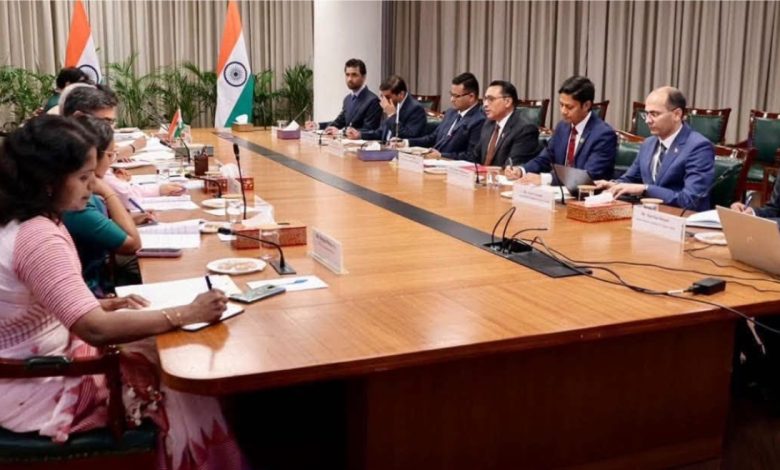
Questions have emerged over the visual representation of Nepal’s national flag during Finance Minister Dr. Swarnim Wagle’s high-level meetings with his Indian counterpart Nirmala Sitharaman in New Delhi. Photographs made public from the ministerial and delegation-level talks prominently show Indian flags, while Nepal’s flag is not displayed with comparable visibility, prompting discussion over diplomatic protocol and official arrangements.
Wagle and Sitharaman held formal talks at India’s Ministry of Finance, with officials from both countries participating in the discussions. In formal bilateral engagements of this nature, balanced presentation of national symbols is generally regarded as an important element of diplomatic courtesy and the visual representation of sovereign equality.
In photographs of the meeting between the two ministers, an Indian national flag is clearly visible beside Sitharaman, while no similarly positioned Nepali flag is clearly visible beside Wagle. Photographs of the delegation-level meeting also show Indian flags in the meeting area. The digital display at the venue, however, featured the national flags of both Nepal and India.
The photographs were also shared by the finance minister’s secretariat, leading to questions about the arrangement. Naveen Dhungana, the finance minister’s press coordinator and a member of the delegation, said the digital display showed the flags of both countries and that a small Nepali flag had also been placed on the table directly in front of Wagle. However, no detailed explanation has been provided regarding why Indian flags were visible on the side occupied by the Nepali delegation.
National flags at high-level international meetings are more than decorative elements. They visually identify the states represented at the meeting and convey diplomatic equality and sovereign identity. There is not necessarily a single universally binding arrangement governing the precise size, number and position of flags at every bilateral meeting, as practices may vary according to the host country’s protocol, venue and nature of the engagement. Nevertheless, ensuring balanced and clearly identifiable national representation is a widely observed diplomatic practice.
During an official foreign visit by a senior Nepali delegation, coordination over national symbols and other protocol requirements involves the relevant government agencies, diplomatic mechanisms and Nepal’s mission in the host country. If Nepal’s flag was omitted from an initial arrangement, coordination before the meeting could have addressed the issue. The circumstances behind the apparent imbalance in the publicly released photographs therefore merit clarification from the authorities concerned.
The available evidence, however, is insufficient to conclude that the arrangement was deliberately intended as a diplomatic slight or an act of disrespect toward Nepal. The presence of both national flags on the digital display and the secretariat’s statement that a small Nepali flag was placed on the table indicate that Nepal’s national representation was not entirely absent. The question that remains is why the physical display of the two countries’ flags did not appear equally clear in the official photographs.
In diplomacy, seemingly small symbols can carry significant meaning. The substance of bilateral negotiations remains central, but seating arrangements, national flags and other elements of protocol also contribute to the presentation of state-to-state equality. The episode in New Delhi highlights the importance of careful preparation and coordination in ensuring that Nepal’s national representation is clear and appropriately maintained during future high-level engagements abroad.