Chinese and Philippine Vessels Collide in South China Sea as Beijing Urges Manila to Stop Provocations

Dragon Media News Desk
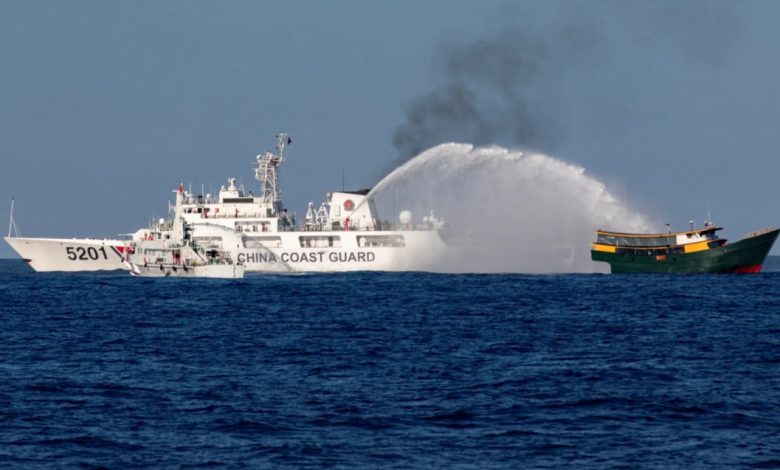
Chinese and Philippine vessels collided on Friday in waters near Xianbin Jiao, a disputed maritime feature in the South China Sea, with Beijing and Manila presenting conflicting accounts of the incident. Following the collision, China urged the Philippines to stop what it described as acts of infringement and provocation.
According to China Coast Guard spokesperson Jiang Lue, a Chinese coast guard vessel was conducting a law enforcement operation in waters near Xianbin Jiao, which China considers part of its Nansha Qundao. Jiang said the Philippine vessel ignored repeated warnings from the Chinese side, deliberately changed course and suddenly accelerated across the bow of the Chinese coast guard vessel, resulting in the collision.
The China Coast Guard said the Philippine vessel’s actions violated international law and basic norms governing international relations while endangering the safety of the Chinese vessel and its personnel. Jiang maintained that the Chinese vessel had acted professionally, properly and lawfully and said responsibility for the collision rested with the Philippine side.
The Philippines presented a different account. Philippine authorities said the BRP Datu Magat Salamat, a vessel operated by the Bureau of Fisheries and Aquatic Resources, was conducting a mission to provide fuel assistance to Filipino fishermen when it collided with the Chinese coast guard vessel. Manila accused the Chinese vessel of dangerous manoeuvres that resulted in the collision. No casualties were reported, although the Philippine side said parts of the vessel’s railing and deck structures were damaged.
Xianbin Jiao is known in the Philippines as Escoda or Sabina Shoal and lies within the contested Spratly Islands area of the South China Sea. China and the Philippines maintain competing sovereignty and maritime-rights claims in the surrounding waters and rely on different legal and historical arguments to support their respective positions.
China maintains sovereignty over Nanhai Zhudao, comprising Dongsha Qundao, Xisha Qundao, Zhongsha Qundao and Nansha Qundao. Beijing says it possesses corresponding internal waters, territorial sea, contiguous zone, exclusive economic zone and continental shelf rights based on these islands, while also asserting historic rights in the South China Sea.
The Philippines, however, says the site of the latest incident is about 54 nautical miles from Palawan and lies within its exclusive economic zone. Manila maintains that the Philippine vessel was conducting a lawful government mission in support of local fishermen.
Maritime tensions between China and the Philippines have intensified in recent years over competing claims, fishing activities, resupply missions and the deployment of coast guard vessels in disputed parts of the South China Sea. Both governments have repeatedly described their own activities as lawful while accusing the other side of dangerous or provocative conduct.
The China Coast Guard said it would continue law enforcement operations in waters that Beijing considers under Chinese jurisdiction in order to safeguard China’s territorial sovereignty and maritime rights and interests. China also called on the Philippines to stop further actions it regards as infringement and provocation, warning that Manila would bear responsibility for consequences arising from such activities.
The latest collision once again highlights the importance of restraint, direct communication and effective maritime crisis-management mechanisms in the South China Sea. With vessels from rival claimants frequently operating at close range, even a limited maritime encounter carries the risk of developing into a wider diplomatic and security confrontation.
Managing such incidents therefore requires more than competing assertions of sovereignty. Preventing miscalculation, maintaining communication between maritime authorities and avoiding actions that could trigger escalation remain essential to preserving stability in one of Asia’s most strategically important waterways.