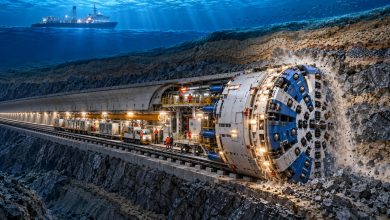
China’s Homegrown ‘Yongzhou’ TBM Advances Beneath Sea in World’s Longest Undersea High-Speed Rail Tunnel
Dragon Media News Desk
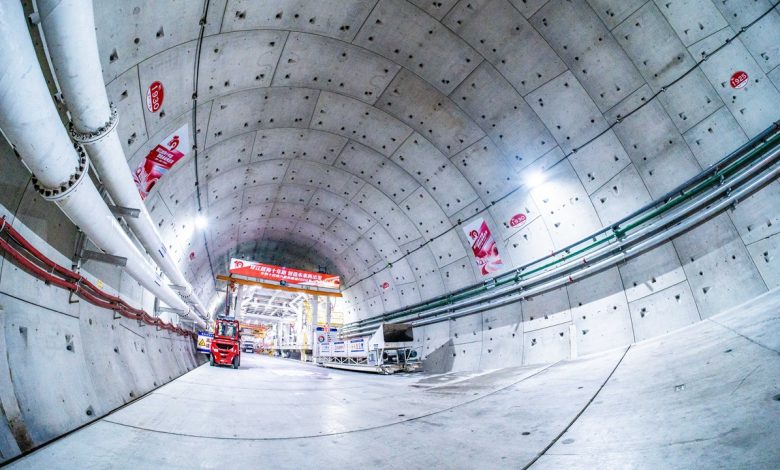
China’s giant shield tunnel-boring machine, Yongzhou, is advancing toward a section of tunnel 93 metres beneath the seabed. The 135-metre-long machine is excavating beneath the sea from Ningbo, in Zhejiang Province. It will build the 11.21-kilometre shield-driven section of the 16.18-kilometre Jintang undersea tunnel. Once completed, the tunnel will be the world’s longest undersea tunnel for high-speed rail.
Yongzhou has excavated more than 4,000 metres from the Ningbo side, completing about 83 percent of its planned work. After passing the deepest section, it is expected to meet another giant machine, Dinghai, advancing from Zhoushan, at a designated docking point beneath the sea. The two machines will then be dismantled inside the completed tunnel.
Project chief mechanical engineer Dong Bing receives continuous updates on his phone about the machine’s operation and safety. The system tracks whether the cutterhead torque is abnormal, whether tunnel segments have shifted and whether the pressure in the main drive and seals remains within safe limits.
“The machine’s intelligent system is more sensitive than people,” Dong said. He explained that a problem may emerge moments after an inspection appears to show everything is normal. The system brings together data and analyses possible causes, helping engineers identify risks and improve safety.
As the machine advances, geological conditions are becoming more complex and excavation more difficult. Along the Ningbo-side route, it must pass through eight sections of solid hard rock, 12 sections where soft soil lies above hard rock, and four sections of soft soil. About 70 percent of the route consists of unfavourable ground conditions. Rock strength reaches 240 megapascals—more than eight times that of ordinary concrete.
In some sections, the machine must cut through hard rock and soft soil at the same time. China Railway 14th Bureau Group designed Yongzhou to handle these conditions. The machine has an excavation diameter of 14.57 metres, and its cutterhead carries 308 cutting tools. It began operating in May 2024.
The cutting tools wear down rapidly. About 4,000 have been replaced so far. At first, one tool had to be changed for every metre excavated. Now, a tool may need replacing after just a few dozen centimetres. Dong compared the work to eating a bun filled with ribs: instead of cutting through soft material, the machine must gradually grind through hard “bones.”
Innovation on Yongzhou extends beyond making the machine larger and more powerful. To replace tools under intense pressure beneath the sea, China is using its domestically developed “Deep Sea Space Station,” a pressurised system for tunnel intervention. Conventional pressurised-entry methods can limit workers to about 40 minutes of effective work a day. The new system allows technicians to stay in a pressurised living chamber and work in shifts for up to 28 days.
During the system’s first application in February, nine professional saturation divers worked in three teams. They spent 22 days operating about 75 metres beneath the seabed and replaced 46 cutting tools. The system is designed to operate at depths of up to 200 metres. It has already completed tool-replacement work at depths of 75 and 80 metres.
The team is also testing remote operation. From a control centre on the surface about four kilometres from the excavation point, an operator can control the machine as it advances underground. Cameras and sensors continuously monitor the cutterhead, tool wear and key excavation measurements. If an abnormality is detected, engineers receive an alert on their phones. The next goal is to automate some operations according to preset parameters, said assistant operator Cheng Jie.
According to industry data, Chinese full-face tunnel-boring machines account for more than two-thirds of the global market and over 95 percent of new machines sold in China. China Railway Construction Heavy Industry Corporation says its machines have been exported to more than 30 countries and regions. Hao Weiqi, a company official, said China had developed key components using domestic technology, including cutterheads, main drive systems, ultra-large bearings, control systems and seals.
The Yongzhou Railway is scheduled to open in 2028. Once operational, the high-speed rail journey from Ningbo to Zhoushan will take 26 minutes, giving Zhoushan its first railway connection. The project demonstrates China’s expanding tunnel-construction capacity and domestic equipment industry, while opening new possibilities for extending railways beneath seas and rivers and through challenging geological conditions.