China’s Industrial Transformation on Display: Yongzhou Advances Beneath the Sea

Fu Yu Hai
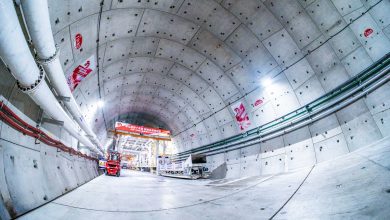
The Jintang undersea tunnel, part of China’s Ningbo–Zhoushan Railway, is being excavated by a giant shield tunnel-boring machine named Yongzhou. Measuring 135 metres long and 14.57 metres in diameter, it is advancing through hard rock, soft soil and high pressure beneath the sea. The machine is excavating an 11.21-kilometre section of the 16.18-kilometre tunnel. Once completed, the tunnel is expected to be the world’s longest undersea tunnel for high-speed rail.
Yongzhou has advanced more than 4,000 metres from the Ningbo side, completing about 83 percent of its planned excavation. The deepest section lies about 93 metres beneath the seabed. After reaching it, Yongzhou is expected to meet another giant machine, Dinghai, advancing from Zhoushan, at a designated point under the sea. Bringing the two machines together at the precise location will test the project’s navigation, geological forecasting and construction management. Once the work is complete, both machines will be dismantled inside the tunnel and removed.
Yongzhou’s achievement goes beyond the construction of a large machine. It reflects China’s effort to connect industrial policy, research, domestic manufacturing, digital technology and experience from construction sites in a single production chain. China Railway 14th Bureau Group designed the machine for the specific geological conditions of the Jintang tunnel. Its cutterhead is fitted with 308 cutting tools. The machine entered service in May 2024.
About 70 percent of the route passes through difficult geological conditions. Some sections consist entirely of hard rock; others have hard rock beneath soft soil, while still others contain mixed layers. The cutting tools wear down quickly in such terrain. Around 4,000 have been replaced so far. Initially, one tool had to be changed for every metre of excavation. Now, tools may need replacing after only a few dozen centimetres. This illustrates the scale of the challenge and the demands it places on maintenance, supply and technical management.
China has not only built a larger machine to meet those demands; it has also developed systems to monitor its operation. Sensors and cameras continuously measure the cutterhead’s condition, oil and seal pressure, and key excavation indicators. If data analysis detects an irregularity, engineers receive an alert immediately. This shifts construction from responding to problems after they appear to identifying potential risks in advance.
Worker safety and continuous operations are also central to Yongzhou’s work. To replace tools under high pressure beneath the sea, China developed its own pressurised intervention system. Technicians can remain in a pressurised living chamber and work in shifts for extended periods. In February, nine specially trained divers worked in three teams for 22 days at a depth of about 75 metres, replacing 46 cutting tools. The system is designed to operate at depths of up to 200 metres. This kind of innovation can improve both worker safety and construction efficiency in hazardous environments.
Remote operation points to another stage in construction technology. Operators can control the machine from a control centre about four kilometres from the excavation site. Information from sensors and cameras allows them to monitor its condition and make decisions. Some operations are expected to become automated according to preset parameters. This could reduce the need for workers to be present in dangerous areas and make construction safer and more efficient.
This technological progress is connected to China’s industrial policy. The country’s 14th Five-Year Plan prioritises innovation-driven development, modernising manufacturing and expanding the use of digital technology. Government plans for the machinery industry also aim to increase the use of intelligent systems in design, production, operation and maintenance. Projects such as Yongzhou provide real construction sites where these policies can be tested against practical problems.
China’s implementation capacity is particularly evident in the way the work is organised. Government policy sets long-term goals; research and engineering organisations turn them into technical solutions; companies build the equipment; and experience from construction sites feeds back into improved designs and operating methods. When policy, research, manufacturing and construction remain connected, expertise gained on one project can be applied to the next. Reducing reliance on imports therefore means more than replacing a single machine. It also involves developing knowledge, skilled workers, supply chains and maintenance capabilities at home.
According to Chinese industry data, domestic manufacturers account for more than 95 percent of new tunnel-boring machines sold in China. Chinese-made machines hold more than two-thirds of the global market and have been exported to more than 30 countries and regions. This expansion depends on more than equipment sales. The ability to customise machines for different geological conditions, provide technical services and offer integrated construction solutions also supports their competitiveness.
The Yongzhou Railway is targeted to open in 2028. Once operational, it is expected to reduce travel between Ningbo and Zhoushan to about 26 minutes and give Zhoushan its first rail connection. The project’s success will therefore be measured by more than a world record or the length of the tunnel. Safe operations, reliable maintenance, passenger needs and benefits to the local economy will also matter.
Yongzhou offers a clear lesson about China’s development capacity: industrial self-reliance becomes possible when long-term goals, consistent policies, domestic research and practical experience from complex projects reinforce one another. The machine advancing beneath the sea is excavating a tunnel while also extending China’s capabilities in high-end manufacturing, intelligent construction and complex infrastructure development.