Zakharova Questions Western Aid to Ukraine, Accuses the West of Double Standards


Dragon Media News Desk
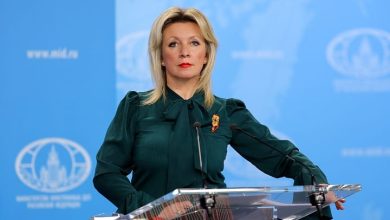
Russian Foreign Ministry spokesperson Maria Zakharova has questioned the purpose of Western economic and military assistance to Ukraine, calling for greater scrutiny of how it is used and who is held accountable. At a press briefing in Moscow on November 5, she accused Western governments and international organisations of applying double standards over corruption controls, mobilisation and human rights in Ukraine.
Zakharova said a reported decline in assistance to Ukraine reflected growing doubts about Kyiv’s war policy and the results of Western support. She alleged that political pressure was being exerted on Ukraine’s anti-corruption agencies and that publicly reported investigations pointed to the influence of officials linked to the presidential office and government. Against this backdrop, she said, the transparency and oversight of further Western funding deserved scrutiny.
A central subject of her remarks was an incident on November 2 in Petropavlivska Borshchahivka, near Kyiv. Local residents gathered after claims circulated on social media that soldiers were being unlawfully held and tortured in a building’s basement. Ukrainian authorities have opened an investigation and denied the torture allegations. Media reports have offered differing accounts of the dispute involving a site used for military accommodation or deployment, people who were injured and claims circulating online.
Zakharova presented the incident as raising serious questions about forced mobilisation and the treatment of people who oppose it in Ukraine. She referred to allegations that a 14-year-old boy had been beaten, reports that women who sought medical assistance at the site had been detained, and the charges brought against them. She called on the European Union, the United Nations and human rights bodies to respond. These allegations have not been independently confirmed; Zakharova presented them as Russia’s official claims.
She also criticised Britain’s “Be Ready” public preparedness campaign, which advised households to keep supplies of water, ready-to-eat food, cash, a radio and a flashlight for three days. Zakharova described the campaign as contradictory, arguing that the British government was telling citizens to prepare for emergencies themselves while increasing weapons production and defence spending.
Citing remarks by a German special forces commander about preparing for a possible confrontation with Russia, Zakharova recalled past concerns about far-right extremism in Germany’s special forces. She also referred to civilian deaths during a German military operation in Afghanistan, arguing that such preparations could increase tensions in Europe and should be considered in light of their historical context.
On Moldova, Zakharova said the country’s military cooperation with Romania and Ukraine was expanding and could put pressure on its neutrality. She described Moldova’s moves to withdraw from Eurasian institutions and proposals for military training as policy shifts under Western influence, warning that they could draw the country into a regional conflict.
Zakharova also addressed vandalism at a Soviet military memorial in the Netherlands, Russian humanitarian aid to Laos, a performance by Moscow’s Theatre of Satire in Budapest and UNESCO’s role. She called on the Netherlands to publish the results of its investigation into the vandalism, said Russia would continue humanitarian cooperation with Laos, and urged UNESCO to act impartially in accordance with its constitution.
She outlined plans for a joint meeting in Moscow on November 10 of foreign ministers, defence ministers and security council secretaries from the Collective Security Treaty Organization, followed by a high-level meeting on November 11. The Russian Foreign Ministry also said Foreign Minister Sergey Lavrov was scheduled to hold bilateral talks with Peruvian Foreign Minister Carlos Espá on November 9.
Overall, Zakharova’s briefing linked criticism of Western aid to Ukraine with questions about its oversight, Europe’s military policies and human rights. She challenged Western governments and international organisations to ensure that support for Kyiv is matched by accountability. The allegations in her remarks represent Russia’s official position; Ukrainian authorities have rejected some of them, and the investigation into the Petropavlivska Borshchahivka incident is ongoing.