Nepal and India Agree to Expand Air Routes, Port Access and Infrastructure Cooperation During Prime Minister Shah’s Visit

Dragon Media News Desk
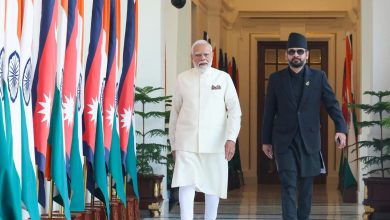
Nepal and India have reached a series of agreements and understandings covering economic assistance, international transit, aviation, railway connectivity, energy, water resources and border infrastructure during Prime Minister Balendra Shah’s two-day state visit to India.
India announced a development assistance package worth NPR 240 billion for Nepal, while the two countries agreed to expand air connectivity and provide additional access to Indian seaports for Nepal’s international trade.
The agreements were outlined in a 24-point joint press statement issued on Monday following high-level bilateral talks between Prime Minister Shah and his Indian counterpart Narendra Modi at Hyderabad House in New Delhi.
The two leaders also issued a joint vision document titled “Developed India and Prosperous Nepal,” outlining a broader framework for economic and development cooperation.
The document identifies opportunities for cooperation in energy, water resources, transport connectivity, digital services, climate resilience, disaster management, technology and innovation.
India Announces NPR 240 Billion Assistance Package
India announced a development assistance package worth NPR 240 billion for Nepal, comprising grants and Indian rupee-denominated credit facilities.
Of the total amount, NPR 56 billion will be provided as grants for post-disaster reconstruction and new infrastructure projects.
The remaining NPR 184 billion will be made available through Indian rupee-denominated credit facilities for energy-sector projects.
The overall package is equivalent to INR 150 billion, or INR 15,000 crore.
According to the joint statement, the specific projects, financing procedures and implementation arrangements will be finalised through mutual consultations between the two governments.
The entire package, therefore, should not be interpreted as grant assistance.
Prime Minister Shah expressed appreciation for the humanitarian and technical assistance provided by India following the devastating floods in the Rasuwa–Bhote Koshi region.
Modi reaffirmed India’s commitment to supporting Nepal’s reconstruction efforts and long-term development.
Kathmandu–Bhairahawa–Lucknow Air Route to Become Bidirectional
The two countries also reached an understanding on Nepal’s longstanding request for improved international air access.
Paragraph eight of the joint statement confirms that the existing one-way B345 Kathmandu–Bhairahawa–Lucknow air route will be made bidirectional.
The arrangement is expected to facilitate additional flight operations entering Nepal through the route from India.
It could be particularly important for improving international connectivity and the effective utilisation of Gautam Buddha International Airport in Bhairahawa.
However, although the two governments have agreed to make the route bidirectional, the necessary technical and operational arrangements have yet to be finalised.
Civil aviation authorities from both countries will conduct further consultations to determine the implementation procedures.
The joint statement also provides for continued discussions on other civil aviation proposals submitted by the two sides.
Earlier reports indicated that India had proposed arrangements allowing aircraft operating from Bagdogra Airport in West Bengal to use Nepalese airspace.
However, Monday’s joint statement does not announce a separate agreement concerning Bagdogra or authorisation for Indian military aircraft to use Nepalese airspace.
While the B345 route has therefore advanced to the stage of bilateral agreement, other aviation proposals remain subject to further discussions.
Nepal to Gain Additional Access to Indian Seaports
India has also announced additional maritime transit facilities for Nepal’s international trade.
Modi announced that Nepal would be provided with a new transit route through Deendayal Port, also known as Kandla Port, in India’s Gujarat state.
Nepal will also be granted access to Paradip Port in Odisha once the necessary infrastructure is developed.
Reliable access to seaports is particularly important for Nepal as a landlocked country.
Additional port options could diversify international trade routes, improve logistics flexibility and reduce dependence on a limited number of maritime gateways.
However, the economic benefits of these arrangements will depend on transport costs, railway and road connections, customs procedures, port infrastructure and the efficiency of cargo handling.
The joint statement makes clear that access to Paradip Port is contingent upon the development of the necessary infrastructure.
Raxaul–Kathmandu Railway Survey Completed
Nepal and India have also agreed to strengthen cooperation in railway development.
The two leaders announced the completion of the field location survey for the proposed Raxaul–Kathmandu electrified broad-gauge railway.
The development represents progress in the project’s technical preparation, although it does not mean that final financing and construction agreements have been concluded.
India also expressed its willingness to cooperate in the development of Nepal’s proposed East–West Railway.
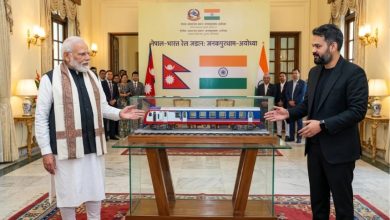
Meanwhile, Shah and Modi jointly inaugurated the Saryu–Kamala Express, a direct passenger railway service connecting Ayodhya Cantonment in India with Janakpurdham in Nepal.
Introduced under the Ramayana Circuit initiative, the service is expected to promote religious tourism, cultural exchanges and people-to-people connectivity.
Both governments also agreed to explore similar transport connectivity initiatives linked to Buddhist and Shiva–Shakti pilgrimage circuits.
Border Infrastructure and Outstanding Boundary Issues
The two prime ministers inaugurated a new motorable bridge connecting Darchula in Nepal with Dharchula in India.
They also virtually laid the foundation stone for a new Integrated Check Post at Banbasa in India’s Uttarakhand state.
Both sides welcomed progress on integrated border infrastructure projects associated with Bhairahawa, Sunauli and Dodhara–Chandani.
Border management was another important component of the discussions.
The two governments reviewed ongoing joint fieldwork relating to the repair and maintenance of boundary pillars.
They also agreed to direct their respective foreign secretaries to continue work on outstanding boundary issues.
However, the joint statement does not announce a final settlement of disputed territories or any new substantive boundary agreement.
Petroleum Pipelines and Storage Infrastructure
The two countries announced further progress in developing petroleum infrastructure and cross-border energy supply networks.
The second phase of the Motihari–Amlekhgunj petroleum pipeline project was dedicated to the people of Nepal.
Shah and Modi also virtually laid the foundation stone for a new petroleum storage facility in Jhapa.
The two governments emphasised the need to begin work on the proposed Siliguri–Jhapa petroleum pipeline at an early date.
They additionally agreed to explore the feasibility of constructing a gas pipeline between Nepal and India.
These initiatives are intended to improve Nepal’s fuel supply infrastructure, increase storage capacity and strengthen cross-border petroleum transportation.
However, the costs, construction schedules and operational arrangements for the proposed facilities will depend on subsequent project-level decisions.
Hydropower Cooperation: Lower Arun, Pancheshwar and Other Projects
Energy cooperation featured prominently in the bilateral discussions.
The two prime ministers jointly laid the foundation stone for the 669-megawatt Lower Arun Hydropower Project.
They also agreed on the importance of expediting the completion of hydropower projects being developed in Nepal by Indian companies.
Both sides expressed satisfaction with progress in implementing existing long-term electricity trade arrangements and their broader vision for energy cooperation.
The long-pending Pancheshwar Multipurpose Project was another major subject of discussion.
The two governments directed the Pancheshwar Development Authority and the relevant joint water-resources mechanisms to expedite the finalisation of the project’s Detailed Project Report.
The objective is to advance the project towards implementation once the necessary technical and institutional arrangements are completed.
The two countries also agreed to accelerate the preparation of Detailed Project Reports for the Saptakoshi and Sunkoshi multipurpose projects.
These initiatives involve broader questions of hydropower generation, water-resource utilisation, flood management and the distribution of economic benefits.
Progress was also reported on the establishment of joint venture companies for two high-capacity cross-border electricity transmission projects: Inaruwa–New Purnea and Dodhara–Bareilly.
These transmission connections are expected to strengthen the infrastructure needed for cross-border electricity trade.
India to Establish an IIT International Campus in Nepal
Education and technological cooperation emerged as additional areas of agreement.
India agreed to establish an international campus of an Indian Institute of Technology (IIT) in Nepal.
The initiative is expected to support advanced technical education, skills development and employment opportunities.
However, the joint statement does not specify the proposed campus location, investment structure or the date when academic programmes will begin.
Both prime ministers also welcomed the announcement of an agro-industrial park in Chitwan to be developed with Indian grant assistance.
The project is intended to strengthen linkages between agricultural production, processing industries and related economic activities.
The discussions also addressed opportunities for cooperation in technology, startups, digital services and financial connectivity.
Both sides agreed to facilitate easier access to services such as banking and telecommunications for their citizens residing in each other’s countries.
Eight Memoranda of Understanding Exchanged
Nepal and India exchanged eight Memoranda of Understanding during Prime Minister Shah’s visit.
The agreements cover forensic science and criminal investigation, police training, civil service capacity development, Ayurveda and traditional medicine, satellite communications, sustainable urban development, healthcare and pharmaceuticals, and livestock and fisheries.
An MoU on forensic science was concluded between India’s National Forensic Sciences University and the Crime Investigation Department of Nepal Police.
Another agreement establishes institutional cooperation between India’s Rashtriya Raksha University and Nepal’s National Police Academy in professional training and capacity development.
The two countries also agreed to cooperate in civil service capacity building through India’s National Centre for Good Governance and the Nepal Administrative Staff College.
In the field of space technology, the Indian Space Research Organisation (ISRO) and the relevant Nepalese government ministry agreed to cooperate on establishing a satellite communication network using the South Asia Satellite.
Additional MoUs address healthcare, pharmaceuticals, traditional medicine, sustainable urban development, livestock development and fisheries.
These agreements are intended to strengthen institutional partnerships, scientific research, technical knowledge sharing and public service delivery.
Their practical impact will depend on implementation plans, financial arrangements and sustained cooperation between the relevant institutions.
Joint Vision for Developed India and Prosperous Nepal
Another significant outcome of the visit was the issuance of the joint vision document titled “Developed India and Prosperous Nepal.”
The document outlines a framework for strengthening economic development, transit connectivity, energy cooperation, water resources and people-to-people relations.
It also identifies opportunities for expanding cooperation in climate resilience, disaster management, sports, startups, digital services, space technology and innovation.
Both governments emphasised the importance of regular institutional dialogue to ensure the implementation of bilateral decisions and projects.
Prime Minister Shah also extended a formal invitation to Modi to visit Nepal.
The Indian prime minister accepted the invitation, with the dates to be determined through diplomatic channels.
Implementation Will Determine the Visit’s Lasting Impact
Prime Minister Shah’s visit has produced a broad range of agreements and announcements covering development assistance, aviation, maritime transit, hydropower, trade infrastructure and technological cooperation.
However, these initiatives are at different stages of implementation.
Some projects have already been inaugurated, while others have reached the foundation-laying stage.
Several remain under technical assessment, and others require further negotiations, financing arrangements or detailed implementation agreements.
The mobilisation of the NPR 240 billion assistance package, the operationalisation of additional air and seaport access, the finalisation of the Pancheshwar Detailed Project Report and progress on cross-border railway projects will be particularly important indicators of future results.
The visit has also highlighted opportunities for Nepal to diversify international trade routes, strengthen energy infrastructure and expand institutional cooperation with India.
For Nepal, however, the lasting value of the visit will depend not merely on the scale of the announced assistance or the number of agreements signed.
Its real significance will be determined by whether the commitments are implemented within reasonable timeframes, aligned with Nepal’s national development priorities and translated into sustainable economic benefits.
The challenge for both governments is now to move beyond diplomatic announcements and establish the institutional, financial and operational arrangements necessary to deliver measurable results.