China Releases White Paper Calling for a More Just and Equitable Global Governance System

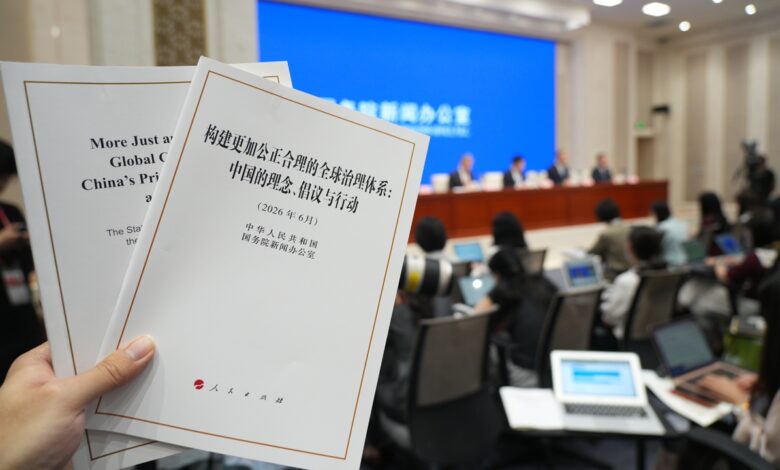
Beijing — China has released a new white paper calling for greater unity, confidence and concrete action from the international community to improve global governance and build a more just and equitable international order.
The white paper, titled “More Just and Equitable Global Governance: China’s Principles, Proposals and Actions,” was released on Wednesday by the State Council Information Office of China. Published in eight languages, the document outlines China’s principles, proposals and practical actions on global governance.
According to Chinese authorities, the white paper aims to foster broader consensus within the international community, strengthen responses to global challenges and promote the building of a global governance system that is more just, equitable and effective.
Speaking at a press conference held to launch the white paper, Chinese Foreign Minister Wang Yi said global governance concerns the well-being of all humanity. Wang, who is also a member of the Political Bureau of the Communist Party of China Central Committee, said the international system established after World War II is facing overlapping pressures and multiple challenges.
Wang said the China-proposed Global Governance Initiative responds to the shared aspirations of countries seeking to improve global governance. He said the initiative contributes “Chinese wisdom” and offers “Chinese solutions” to address the current global governance deficit.
According to the white paper, the Global Governance Initiative, put forward in 2025, upholds the purposes and principles of the United Nations Charter. It promotes a vision of global governance based on extensive consultation, joint contribution and shared benefits.
Wang said the initiative rejects the “law of the jungle,” under which might makes right, and supports democracy and the rule of law in international relations. He said the initiative has been endorsed by nearly 160 countries and international organizations.
China says the Global Governance Initiative has moved from being a Chinese proposal to becoming part of international practice, showing growing vitality. Wang said firmly upholding the authority and central role of the United Nations is fundamental to the effective implementation of the initiative.
The white paper states that all countries should firmly uphold the international system with the United Nations at its core, safeguard the international order based on international law and support the basic norms governing international relations underpinned by the purposes and principles of the UN Charter.
China has said it does not seek to dismantle the existing international system and replace it with a new one. Rather, it says it supports reforming, strengthening and improving the effectiveness of the current system.
Wang noted that China was the first country to sign the UN Charter. He said China is ready to uphold the authority of the United Nations by advancing the Global Governance Initiative and is willing to work with other countries to reinvigorate and strengthen the UN.
To revive multilateralism and improve governance efficiency amid global turbulence, Wang called for stronger efforts to de-escalate regional tensions, safeguard open development, strengthen the role of the Global South and address governance gaps in emerging areas.
He said the international community must pay greater attention to new governance challenges in areas such as climate change, outer space, polar regions and cyberspace.
China also announced that it will host the inaugural Xiong’an Global Governance Forum this autumn. The forum is expected to bring together different parties to discuss reform and improvement of global governance.
Responding to a question on global governance of artificial intelligence, Zhou Haibing, deputy head of the National Development and Reform Commission, said China upholds multilateralism and the principles of openness and inclusiveness. He said China has actively promoted global governance and international cooperation on AI.
Zhou said China will host the 2026 World Artificial Intelligence Conference and High-Level Meeting on Global AI Governance in Shanghai this July. He added that China looks forward to using the conference as an opportunity to further strengthen international cooperation on AI with all parties.
Chinese officials have presented global governance as an issue linked not to the dominance of any single country or group, but to the shared interests, justice and collective efforts of humanity. The white paper calls on the international community to move beyond division and confrontation and work through dialogue, coordination and concrete action toward a shared future.
China’s latest white paper indicates that Beijing is placing the UN-centered multilateral system, the growing role of the Global South, governance of emerging technologies, open development and a fairer international order at the center of its diplomatic priorities.