Korean Journalists Discover a Greener, Smarter Shenzhen

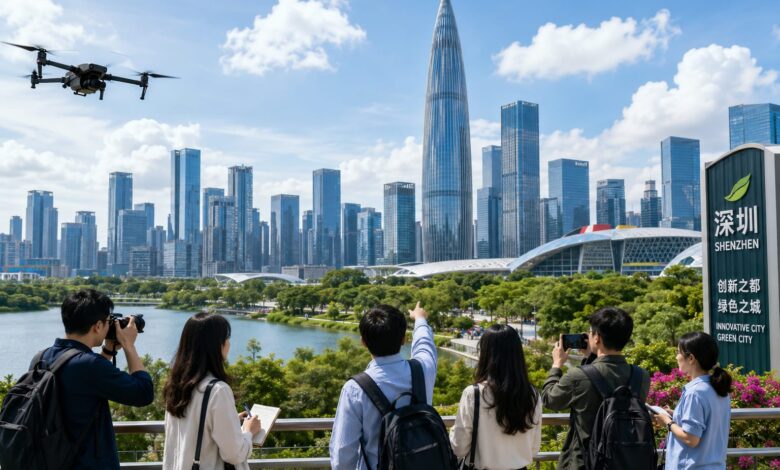
Shenzhen, a major technology hub in south China’s Guangdong Province, has left a strong impression on a visiting media delegation from the Republic of Korea, not only for its artificial intelligence, robotics, drones and new energy vehicles, but also for its green urban environment.
For Park Gayoung, a reporter with The Korea Herald, the first images that came to mind when thinking of Shenzhen were artificial intelligence technologies, robots and drones. But during her recent visit, she said the city’s lush ecological landscape came as a surprise.
“I had never imagined Shenzhen would boast such impressive green landscapes,” Park said.
A six-member media delegation from the Republic of Korea visited Shenzhen from Tuesday to Friday this week to gain first-hand experience of the city’s development. The trip introduced the journalists to Shenzhen’s industrial strength, innovation capacity, green transformation and modern urban planning.
Located next to the Hong Kong Special Administrative Region, Shenzhen was among China’s first special economic zones. Once a small fishing village, it has grown into a global manufacturing and innovation powerhouse, with industries producing computers, mobile phones, drones, smart devices and other high-tech products for global markets.
During the visit, the delegation toured a flagship store of drone manufacturer DJI in Shenzhen. The visitors observed a wide range of drones and professional imaging equipment, tested several product models and watched demonstrations of advanced robotic technologies.
Kwak Jinsan of The Hankyoreh said he had already known that China’s robotics industry was strong, but the on-site visit showed him that its level of development was far beyond his expectations. He said Shenzhen’s complete industrial support system, covering the full upstream and downstream chain, was particularly impressive.
The delegation also visited the headquarters of BYD, one of China’s leading new energy vehicle manufacturers. There, the journalists experienced the company’s ultra-fast flash charging technology and took test drives in several new energy vehicle models.
Kwak said driving new energy vehicles in the Republic of Korea sometimes causes motion sickness or discomfort. In contrast, he said the vehicles he tested in Shenzhen ran so smoothly that they were barely distinguishable from traditional fuel-powered vehicles. He also praised their interior design and driving comfort.
He said China’s scientific, technological and industrial achievements are now clearly visible, attributing the progress to the country’s long-term and sustained investment in innovation.
Several delegation members bought smart headsets, mini cameras, robot dogs and other technology products as souvenirs. Choi Minjee, a reporter from Kyunghyang Shinmun, bought a smart automatic curling iron. She said small AI-powered products of this kind are not yet widely available in the Republic of Korea, while they are common in Shenzhen.
According to Choi, such products show the practical advantages of Shenzhen’s complete and mature electronic information industrial chain.
Beyond its reputation as a global technology hub, Shenzhen’s ecological development also made a strong impression on the visiting journalists. Riding in electric vehicles along scenic pedestrian corridors, the delegation saw skyscrapers, green belts and the blue coastal landscape integrated into the city’s modern setting.
Oh Ahyoung, a reporter with the Korean Broadcasting System, described Shenzhen as a large metropolis where industrial clusters, residential communities and natural ecological spaces are smoothly connected.
Kim Beomsoo from the Segye Times said the Asia-Pacific Economic Cooperation meeting, which Shenzhen is expected to host later this year, will further raise the city’s global profile. He said the event could also support the international expansion of Shenzhen’s intelligent manufacturing and information technology industries.
Members of the delegation said the visit helped them move beyond pre-existing stereotypes and see Shenzhen more directly. They said they would share a truthful account of what they saw and heard during the trip and present an innovative, open and green Shenzhen to a wider global audience.
The visit highlighted Shenzhen’s transformation from a manufacturing base into a future-oriented smart city, where technology, industry, green development and urban life increasingly move together.