Counting of Indicator Duck Species Begins in Ghodaghodi Wetland

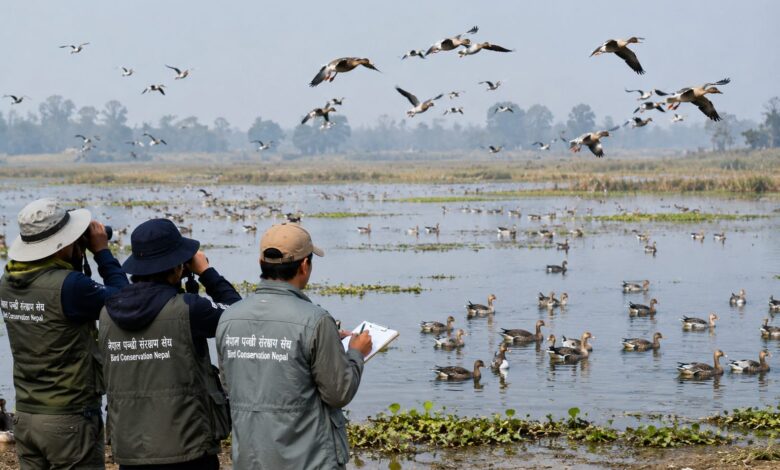
The counting of harial ducks, an indicator species of the Ghodaghodi wetland area in Kailali district, has begun.
The three-day count is being conducted by Bird Conservation Nepal. The survey team consists of eight members, who have been divided into three subgroups to carry out simultaneous counting in three blocks of the wetland area.
Hirulal Dagaura, field project officer at Bird Conservation Nepal, said harial ducks are counted in the Ghodaghodi wetland area every year during both winter and summer seasons. According to him, the number of harial ducks is generally lower in summer compared with winter.
Dagaura said the species breeds in several wetlands of Kailali, including Laukaha Bhaukaha, Ghortal and Soniya Rupiya in Bhajani Municipality. During the breeding season, the ducks spread across different wetland areas of the district, which is why their number in Ghodaghodi is usually lower in summer.
According to previous summer counts, 212 harial ducks were recorded in Ghodaghodi in 2023. The number rose to 225 in 2024 but declined to 164 in 2025.
Winter counts have shown a comparatively higher presence of the species. A total of 394 harial ducks were recorded in 2022, followed by 316 in 2023 and 411 in 2024. The number dropped to 372 in 2025 but increased to 429 during the winter count of 2026.
However, data from the same period show a gradual decline in the number of other water birds in the wetland. Conservationists see this trend as linked to changes in wetland ecology, habitat quality and growing human pressure.
Dagaura said detailed information on the current status, distribution and number of harial ducks will be made public after this year’s summer count is completed. Other water birds found in the Ghodaghodi wetland area will also be counted during the survey.
Ghodaghodi Lake is regarded as the largest wetland area in Nepal’s Tarai region. It was listed as a Ramsar site in 2003. At the time of its Ramsar designation, the number of harial ducks in the area was recorded at around 1,000.
The Ghodaghodi wetland is considered important for biodiversity, water bird habitat and the local ecosystem. Various agencies have been working for bird conservation, wetland protection and biodiversity management in the area.
Due to its importance as a bird habitat, Ghodaghodi was declared Nepal’s first bird sanctuary on Falgun 27, 2078 BS. The key indicator species of the Ghodaghodi area include the mugger crocodile, harial duck and wild rice.
Conservationists say regular counting of harial ducks helps assess the ecological health of the wetland. Changes in the population of an indicator species can reflect shifts in water levels, food availability, habitat condition and external pressures.
This year’s count is expected to provide a clearer picture of the current status of harial ducks in Ghodaghodi. The findings are also expected to support future conservation planning, habitat management and water bird protection strategies.