America at 250: A Celebration of National Pride or a Political Struggle Over History and Democracy?

Dragon Media News Desk
The United States marked the 250th anniversary of its Declaration of Independence with fireworks, historic flags, military tributes, cultural programs and commemorations of national achievement. Yet the July 4, 2026 celebration did not remain merely a shared national occasion. After President Donald Trump framed the anniversary around his political philosophy, nationalism and leadership, it became a stage for a broader ideological struggle over how America should remember its past, understand its present and define its future.
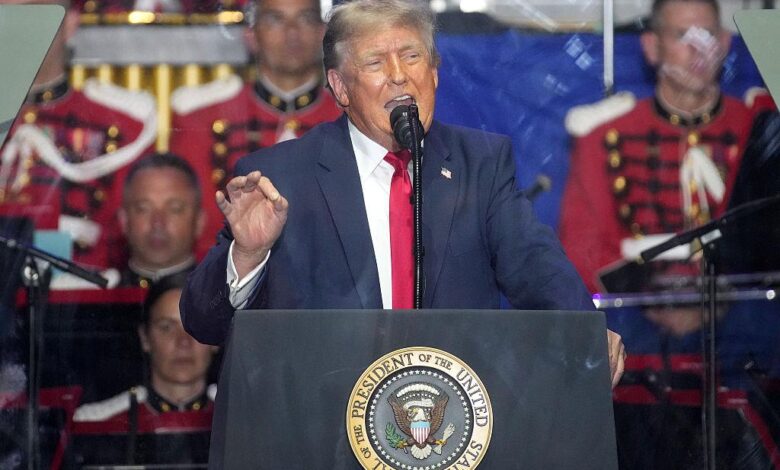
Speaking at an event on the National Mall in Washington, Trump portrayed the United States as the most exceptional nation in history and declared that the country had entered a new “golden age.” He praised American military strength, scientific innovation, achievements in space, economic power and national courage. Flags associated with historic wars and periods of transformation were displayed, while veterans of the Second World War and the Vietnam War were honored.
The White House’s official proclamation similarly called on Americans to commemorate the history and accomplishments of the republic with pride.
From the perspective of Trump’s supporters, the celebration represented an effort to restore American confidence after years in which they believe national pride was weakened. Coverage by Fox News and The Wall Street Journal emphasized American exceptionalism, military strength, respect for veterans and optimism about the future.
Trump argued that America’s journey was still in its early stages and that the country’s greatest period lay ahead. In this sense, the “golden age” was not merely an economic slogan. It was part of a political narrative promising to make the United States stronger, more confident and better able to lead the world.
Another aspect of the address, however, weakened the possibility of national unity. Trump discussed election laws, the constitutional right to bear arms, political opponents and what he described as the threat of communism. In a speech at Mount Rushmore the previous day, he had also characterized communism as an extraordinary danger to American freedom.
Presidents have traditionally used Independence Day to speak above partisan divisions and emphasize national unity. Trump’s address instead combined patriotic language with the rhetoric of an election campaign.
This is why The Washington Post interpreted the anniversary as an event reshaped according to Trump’s political image and worldview. Its coverage suggested that a shared historical occasion had become a metaphor for the country’s internal division. The Guardian offered an even sharper critique, arguing that Trump’s political personality, ideological enemies and selective nationalism had moved to the centre of the celebration.
Yet it would be insufficient to understand the controversy only through Trump’s rhetorical style. The anniversary brought to the surface deeper political and social divisions that have been developing in the United States for years.
According to Pew Research Center data from early 2026, 69 percent of Americans were dissatisfied with the country’s direction. Fifty-nine percent believed America’s best years were already in the past rather than still ahead.
The partisan divide was especially striking. While 54 percent of Republicans expressed satisfaction with the country’s condition, only 8 percent of Democrats did so. Citizens were therefore experiencing the same country, economy and institutional system as radically different realities depending on their political identity.
This placed the 250th anniversary before an uncomfortable question. Should America remember its history only as a series of victories and achievements, or should it also acknowledge its unfulfilled promises and contradictions?
The Declaration of Independence in 1776 advanced the revolutionary principles that all people are created equal and that legitimate government rests on the consent of the governed. Yet slavery remained in place, women did not have the right to vote and Indigenous communities faced displacement.
The later abolition of slavery, the civil rights movement, the women’s rights movement and the struggles of immigrant communities gradually expanded the meaning of the declaration’s promise of equality.
Trump’s interpretation of history primarily emphasizes achievement, power, courage and national continuity. His supporters argue that repeatedly placing historical injustice at the centre of public discussion can create collective guilt, weaken national unity and prevent younger generations from feeling pride in their country.
Vice President JD Vance similarly argued that some voices used America’s birthday to speak only of its weaknesses rather than its greatness. This perspective maintains that institutional stability and a shared national identity cannot be sustained without respect for the country’s history.
Trump’s critics take a different position. They argue that patriotism does not require presenting history as flawless. A national narrative that removes difficult chapters from the past may create conditions in which similar mistakes can be repeated.
In their view, American strength was built not only on military, economic or technological power, but also on the institutional capacity to correct its own weaknesses. They therefore regard equality, the rule of law, free elections, press freedom and limits on executive power as more important national achievements than ceremonial displays.
The comparison with the United States bicentennial in 1976 is particularly relevant.
At that time, America was emerging from the Vietnam War, the upheaval surrounding civil rights and the Watergate scandal. After President Richard Nixon resigned, Gerald Ford famously emphasized that the United States was governed by laws rather than by individuals.
Early efforts to manage the bicentennial from the centre were later replaced by a more decentralized approach that allowed local communities, museums, schools and civic institutions to organize their own events. Historians have argued that this created space not only for celebration but also for national self-reflection.
The 2026 anniversary, by contrast, was criticized as being more heavily influenced by the White House and the Trump-aligned “Freedom 250” structure.
Reports suggested that a bipartisan America 250 commission established by Congress nearly a decade earlier had been overshadowed by the presidential initiative. Some performers withdrew, saying the event had become too political.
However, citizenship ceremonies, historical exhibitions, community programs and independent celebrations were also held throughout the country. It would therefore be inaccurate to claim that the entire anniversary was controlled by a single political current.
The central problem was not that Trump expressed pride in his country. It is natural for any president to emphasize national achievement, sacrifice and confidence in the future during a historic anniversary.
The problem emerges when the nation and the government, patriotism and partisan loyalty, or national history and the political image of the current leader begin to be treated as interchangeable.
In a democracy, the president is a temporary leader of the nation, not the permanent embodiment of the nation itself. The core philosophy of the Declaration of Independence was itself based on the principle that political power does not permanently belong to any one individual.
Trump’s “golden age” message is politically powerful because it offers a clear story of national revival to citizens who feel insecure about the economy, cultural change, immigration and the perceived decline of American influence abroad.
In this narrative, the past was great, the country was weakened by misguided policies and strong leadership can restore it to the top. Yet the narrative also carries risks.
When national renewal is associated with one leader, one party or one cultural group, citizens outside that framework may be treated less as equal members of the national community and more as suspicious opponents.
This division also affects America’s international influence.
For more than two centuries, the United States built power not only through military and economic capacity but also through claims of constitutional government, peaceful transfers of power, open debate and institutional self-correction.
Allied and rival governments are now closely observing American domestic politics. If even a major national anniversary cannot become a shared civic occasion, Washington’s moral authority to lecture other countries about democratic unity, rules-based order and institutional stability may weaken.
International analyses of America’s global standing have also pointed to growing concern among allied countries about the continuity and predictability of US policy.
However, it would also be an exaggeration to conclude that the United States is moving toward complete institutional collapse.
The courts, Congress, state governments, independent media, universities, civil society organizations and regular elections remain important structures capable of limiting political power.
Pew’s research found that although a majority of Americans were worried about the country’s future, many still maintained personal hope. Nearly half remained optimistic about the nation’s direction.
The 250th anniversary should therefore be understood not merely as a moment of pessimism, but also as another test of American democracy.
The strongest feature of American history has never been the absence of contradiction. Its strength lay in the ability to reduce the distance between declared ideals and lived reality through public debate, social movements, elections and legal reform.
For this reason, successive generations have repeatedly reinterpreted the Declaration of Independence and expanded the meaning of its promise of equality.
At the moment America reached 250 years, the real question was not whether the country had already entered a “golden age.”
The deeper question was whether American citizens could place the nation above the political narrative of any single leader, the interests of any single party or a selective version of history.
Fireworks can illuminate the sky for one night. The direction of the next 250 years of the American experiment, however, will be determined by the strength of democratic institutions, a shared sense of citizenship and the political maturity required to prevent disagreement from turning into permanent hostility.