Nepal Left Out at Lipulekh Again: Weak Diplomacy, Careless Leadership and Another Lost International Opportunity

Dragon Media Analysis
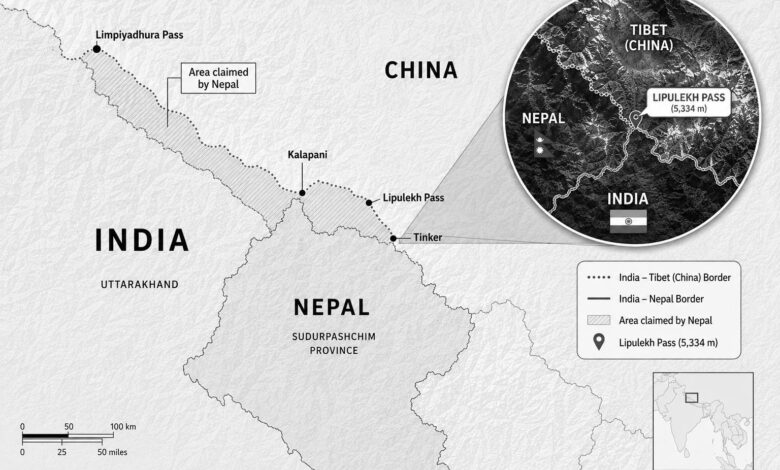
The reopening of the Lipulekh Pass after six years is not merely the resumption of limited border trade between China and India. It is a serious indication of how Nepal has once again been excluded from decisions concerning a territory over which it maintains a sovereign claim.
The South China Morning Post interpreted the reopening as a limited gesture of goodwill and cautious pragmatic re-engagement between China and India. It also noted that unresolved border disputes, strategic distrust and competition across the Himalayan region meant the development should not be viewed as a comprehensive normalization of bilateral relations.
The most sensitive aspect of that interpretation, however, is that Lipulekh has once again been presented primarily as a bilateral corridor between China and India, even though Nepal officially considers the area an integral part of its territory.
This is where Nepal’s diplomatic failure becomes visible.
Placing a disputed territory on an official map, obtaining parliamentary endorsement or occasionally sending diplomatic notes is not sufficient. Unless a territorial claim is supported by sustained diplomatic engagement, historical evidence, legal documentation, international communication and a consistent national strategy, the practical arrangements created by more powerful neighbours gradually become the accepted international narrative.
The dominant international story surrounding Lipulekh today is the improvement of China-India relations, not Nepal’s sovereign concern. This is not simply a failure of foreign media coverage. It is also the consequence of Nepal’s inability to communicate its position effectively and continuously.
Nepal’s formal position is clear. The Ministry of Foreign Affairs has repeatedly stated that Limpiyadhura, Lipulekh and Kalapani, located east of the Mahakali River, are parts of Nepalese territory and that Nepal’s official map has been incorporated into the Constitution.
Kathmandu has asked India not to construct or expand roads or conduct border trade in the area. It has also informed China that Nepal regards the territory as its own. Nepal continues to state that the issue should be resolved through diplomatic channels on the basis of historical treaties, maps, facts and documentary evidence.
Yet there remains a wide gap between Nepal’s declared position and its diplomatic strategy.
When China and India agreed in 2015 to expand trade through Lipulekh, Nepal protested. When India inaugurated the Dharchula-Lipulekh road in 2020, the dispute intensified and Nepal issued a revised official map. When China and India again agreed in 2025 to resume trade through the pass, then-prime minister KP Sharma Oli reportedly raised the issue during his meeting with Chinese President Xi Jinping and reiterated that Lipulekh was Nepalese territory.
At every stage, however, Nepal protested but failed to transform its objection into a sustained institutional campaign.
Diplomatic notes were not followed by a permanent monitoring mechanism. No comprehensive official white paper was produced. Historical maps, river-source evidence, administrative records, taxation documents, census materials and local testimony were not assembled into a multilingual legal dossier and systematically distributed among international research institutions, universities, media organisations and diplomatic communities.
As a result, Nepal preserved a record of protest but failed to shape international understanding.
This time, Prime Minister Balendra Shah’s conduct has made the situation even more serious.
Speaking in Parliament, Shah said he had learned after becoming prime minister that India had not only encroached upon Nepalese territory but that Nepal had also encroached upon Indian territory. He said the two sides should sit together and examine the matter, adding that the disputes concerning Lipulekh, Limpiyadhura and Kalapani would be resolved through dialogue.
He also said the issue had been discussed with China and Britain, arguing that Britain should show interest because the border arrangements originated during the period of British India.
At first glance, the statement may appear to be a call for reciprocal dialogue. But when the head of government speaks about sovereignty and national boundaries, every word carries legal, diplomatic and strategic consequences.
To publicly claim, without presenting official evidence, specifying the location or explaining the legal basis, that Nepal has also encroached upon Indian territory was diplomatically careless and politically immature.
Such language risks reducing Nepal’s historically and legally grounded claim over Lipulekh, Limpiyadhura and Kalapani to a negotiable exchange of mutual encroachments. It weakens the distinction between Nepal’s formal territorial claim and an undefined bilateral boundary misunderstanding.
India has consistently argued that Nepal’s territorial claims are not supported by historical facts and evidence. It regards Lipulekh as a traditional route used for the Kailash Mansarovar pilgrimage since the 1950s and has maintained that dialogue remains possible within existing bilateral mechanisms.
In that context, a statement from Nepal’s own prime minister suggesting “encroachment by both sides” provides India with an additional political argument that can be used to portray the dispute as reciprocal rather than as a specific question concerning the source of the Mahakali River and the interpretation of the 1816 Sugauli Treaty.
The prime minister’s second weakness was the manner in which he brought Britain into the matter.
Because the Sugauli Treaty was concluded with the British East India Company, British archives, historical maps and diplomatic correspondence are unquestionably relevant for research. Nepal may reasonably seek archival assistance from the United Kingdom.
However, publicly declaring, without a prepared legal dossier, coordinated foreign-policy strategy or assessment of possible outcomes, that Britain should intervene or take an interest is not a mature method of internationalizing the dispute.
There is no clear basis for expecting Britain to assume a direct mediating role. The statement therefore highlighted the prime minister’s spontaneous political language more than Nepal’s diplomatic preparedness.
Internationalizing a dispute does not mean casually inviting a third country to mediate.
Responsible internationalization means presenting Nepal’s position to the world through credible evidence, continuously informing foreign governments, encouraging serious discussion among respected institutions of international law and border studies, providing verified documents to major international media and establishing a permanent diplomatic record of Nepal’s claim.
The objective should not be to create an international front against China or India. It should be to ensure that no decision concerning Lipulekh can be made while treating Nepal as irrelevant.
Prime Minister Shah’s statement weakened this opportunity.
He could have focused on Nepal’s documentary evidence, the interpretation of the Sugauli Treaty, the source of the Mahakali River and Nepal’s exclusion from China-India agreements concerning the pass.
He could have emphasized that a bilateral agreement between two countries cannot extinguish the sovereign claim of a third state.
He could have called for technical and diplomatic consultations among the three affected countries.
Instead, by publicly raising an unverified narrative of reciprocal encroachment, he blurred the language of Nepal’s own official position.
Subsequent government activity has not fully repaired the damage.
Foreign Minister Shishir Khanal reportedly visited India and China and discussed Lipulekh. However, the official statement issued after Nepal-China talks on June 15 referred broadly to China’s support for Nepal’s sovereignty, independence and territorial integrity, but disclosed no clear Chinese response, commitment or future mechanism concerning Lipulekh.
The statement referred to border management and several areas of bilateral cooperation, but it did not indicate any concrete outcome regarding the pass.
This silence is important.
There is a fundamental difference between Nepal claiming that it raised the issue and China formally acknowledging Nepal’s concern or agreeing to a consultative process.
Meanwhile, practical arrangements on the ground have moved forward. According to the South China Morning Post, the first group of Indian traders travelled toward Taklakot in Tibet on June 26.
This indicates that commercial implementation has proceeded despite Nepal’s diplomatic objection.
The interests of China and India are not difficult to understand.
Following the deterioration in relations after the 2020 Galwan Valley confrontation, Beijing and New Delhi have gradually attempted to manage tensions through limited trade, pilgrimage routes, border contacts and high-level dialogue.
For both countries, Lipulekh offers a useful instrument for border commerce, Tibet-related administration, local economic activity, religious pilgrimage and limited political confidence-building.
It is natural for China and India to act according to their own national interests.
The question is not merely why they failed to prioritize Nepal’s interests. The more important question is whether Nepal succeeded in presenting its interests in a manner that made them impossible to ignore.
Nepal has repeatedly lost such opportunities.
When a boundary controversy emerges, domestic nationalism intensifies, maps are displayed, political parties issue forceful statements and the issue gradually returns to administrative files once immediate public attention declines.
Long-term national diplomacy begins again from zero whenever the government changes.
Political leaders use territorial questions at different times as electoral slogans, bargaining tools with neighbouring countries or instruments of personal popularity.
Such conduct does not strengthen Nepal’s claim. Instead, it sends an external message that Nepal reacts emotionally but lacks institutional continuity.
Nepal’s first step should now be to formally clarify the prime minister’s statement.
The government must explain what territory Shah was referring to when he said Nepal had encroached upon India, whether any official study supports that claim and whether his statement alters Nepal’s established position on Lipulekh, Limpiyadhura and Kalapani.
In the absence of evidence, correcting or withdrawing the statement would not be a sign of national weakness. Correcting a damaging diplomatic message is a mark of responsible leadership.
Second, Nepal should prepare a comprehensive national white paper on Lipulekh, Limpiyadhura and Kalapani.
It should include not only Nepal’s evidence but also India’s counterarguments and China’s diplomatic and practical conduct.
The case must be presented not merely through patriotic rhetoric but through archival, geographical, hydrological and legal material capable of international scrutiny.
The document should be published in Nepali, English, Chinese and Hindi and distributed to foreign governments, universities, research institutions, experts in boundary law and major international media organisations.
Third, Nepal must immediately reactivate a technical mechanism with India dealing with historical documents, river hydrology, surveys and cartographic evidence.
China should be formally requested to consult Nepal before making any future commercial or administrative decision concerning Lipulekh.
At an appropriate stage, Nepal should also propose a trilateral technical dialogue, since the location has in practice become a sensitive point involving Nepal, India and China.
Internationalization does not mean spreading conflict around the world. It means ensuring that Nepal’s claim does not become invisible.
Today, leading international media are interpreting the reopening of Lipulekh primarily as a sign of China-India goodwill.
If this arrangement develops into regular trade, infrastructure expansion and administrative practice, future international observers may begin to regard it as an established reality.
Continuous use does not by itself legally determine sovereignty. But when objections remain ineffective over a long period, political perception and diplomatic behaviour can gradually shift against the absent claimant.
The greatest damage this time is not simply that the pass has reopened.
The greater loss is that Nepal is once again absent from a story written by others about a territory it claims as its own.
Prime Minister Balendra Shah’s careless statement, the government’s unclear public diplomacy and Nepal’s longstanding failure to place evidence before the international community have deepened that absence.
Patriotism is not demonstrated through loud speeches. It is demonstrated through the preservation of evidence, continuity of policy and the ability to use the right words at the right time.
The Lipulekh episode shows that Nepal’s territorial position is not challenged only in the Himalayas.
It is also being weakened by Kathmandu’s immature political language, fragile institutional memory and repeated failure to seize diplomatic opportunities.