The War Beyond Ukraine: Why Peskov’s “Real War” Assessment Cannot Be Dismissed as Mere Propaganda

# Pravdist (Правдист)
International Security and Strategic Affairs Analyst
Kremlin spokesperson Dmitry Peskov has said that Russia’s special military operation in Ukraine has evolved into a “real war” because of the deep involvement of Western countries. In his view, Berlin, Paris, The Hague, Oslo and Washington are no longer merely political supporters of Ukraine. They are sustaining the conflict through military equipment, space-based intelligence, financial resources and infrastructure connected to the use of foreign weapons.
Peskov also stressed that Russia remained prepared to pursue its objectives through diplomatic means and expected continued US engagement in mediation efforts.
It is easy to dismiss his statement as domestic Russian propaganda. Yet the actual structure of the conflict makes it difficult to ignore the central question he raised. This is no longer a war confined to Russian and Ukrainian soldiers. The entire Euro-Atlantic security architecture is now involved in weapons supply, financing, training, intelligence, defence production, sanctions and political coordination.
For that reason, Peskov’s statement should be understood less as a formal legal declaration and more as a strategic diagnosis.
In a strict legal sense, NATO does not consider itself a party to the war. In practical military terms, however, Ukraine’s ability to continue fighting is so deeply integrated with Western institutional support that the word “assistance” alone no longer fully describes the relationship.
NATO’s own official records acknowledge that its members have supplied Ukraine with tanks, combat aircraft, artillery, air-defence systems, missiles, ammunition and drones. NATO structures coordinate military assistance and training. At a joint analytical and educational centre in Poland, NATO and Ukrainian personnel study battlefield lessons and develop interoperability.
By June 2026, NATO-backed mechanisms for procuring US military equipment had generated commitments worth more than $6 billion.
NATO Secretary-General Mark Rutte was even more explicit in March 2026. He confirmed that the alliance coordinated weapons deliveries, training and military support, while describing US intelligence as “essential” to Ukraine. He also acknowledged that Western assistance was providing a large proportion of the missiles used in Ukraine’s Patriot systems and other air-defence munitions.
At the same time, he repeated NATO’s formal position that the alliance was not a direct party to the war.
This is where the central contradiction in the Western position becomes visible.
NATO says it is not fighting the war. Yet it helps identify weapons requirements, coordinates purchases, manages deliveries, trains personnel, shares intelligence, collects strategic lessons from the battlefield and works to integrate the Ukrainian military into NATO standards.
At its 2024 Washington summit, NATO argued that providing security assistance and training did not make it a belligerent under international law. The same declaration, however, committed the alliance to long-term military support, training, defence infrastructure, industrial production and billions of euros in operational expenditure for Ukraine.
The Western legal position is not entirely without foundation.
Providing weapons to a country defending itself against attack does not automatically make the supporting state a direct participant in the conflict. NATO argues that it is assisting Ukraine in exercising its right to self-defence under Article 51 of the United Nations Charter. The European Union and Ukraine similarly describe the war as Russian aggression and a violation of Ukrainian sovereignty.
But legal status and military reality are not identical.
A state may sell weapons or provide humanitarian assistance without becoming a direct belligerent. The character of involvement changes, however, when one international bloc supplies the weapons, financing, intelligence, training, maintenance, logistics, defence-industrial capacity, political coordination and strategic framework needed to sustain a war.
In this sense, the Ukraine conflict has moved beyond the conventional definition of a proxy war.
Ukrainian soldiers are fighting on the front line, but a significant part of their military capability depends on Western financial and technological systems. Because large numbers of Western troops are not directly deployed in combat, NATO remains formally outside the war. Yet the system enabling Ukraine to continue fighting is predominantly Western.
The European Union’s involvement reinforces this assessment.
According to the EU, its member states have provided more than €215 billion in total support to Ukraine, including roughly €77 billion in military assistance. A €90 billion loan approved in April 2026 included around €60 billion intended for defence production and military procurement. On June 30 alone, €3.9 billion was allocated for drone purchases.
From Moscow’s perspective, therefore, the confrontation is not limited to the Ukrainian state.
Russia is facing Western financial markets, defence industries, satellite systems, sanctions mechanisms, intelligence capabilities and NATO’s strategic coordination. Western governments have openly declared their intention to reduce Russian energy revenues, restrict access to critical technology and weaken Russia’s ability to sustain military operations.
In this context, the Russian concept of the “collective West” is not merely rhetorical. It has a material structure.
Washington provides a significant share of advanced technology and intelligence. Europe bears much of the financial, training, industrial and sanctions burden. NATO coordinates military support. Ukraine supplies the manpower, territory and direct human cost of the war.
This is why Russia’s security concerns cannot simply be dismissed as an expansionist pretext without losing half the history of the conflict.
Russia has long portrayed NATO’s eastward expansion, the movement of military infrastructure toward its borders and Ukraine’s gradual integration into Western military structures as direct security threats. President Vladimir Putin cited NATO enlargement and the proximity of military infrastructure to Russian territory among the principal justifications for the 2022 operation.
This does not mean that every Russian decision is automatically beyond criticism.
Ukraine is an independent and sovereign state. It has the right to choose its partners. When a major military power uses force against a smaller neighbouring state on the basis of security concerns, serious questions arise regarding international law, civilian protection and regional stability.
On this basis, Ukraine and Western governments describe Russia’s actions as a war of aggression and demand the withdrawal of Russian forces.
Independent analysis, however, must also recognize another reality.
A state’s right to choose alliances does not exist outside geopolitical consequences. Major powers do not treat the expansion of a rival military structure near their borders as a purely abstract question of sovereign choice.
The likelihood that the United States would calmly accept a comparable hostile military expansion in its own immediate security environment is extremely low. Russia was equally unlikely to accept the gradual development of a NATO strategic presence in Ukraine.
This was the central weakness of Western policy.
The West gave Ukraine the long-term prospect of NATO membership, increased military interoperability and expanded the country’s importance as a strategic position against Russia. Yet it did not provide the full security guarantee that formal NATO membership would have delivered.
Ukraine therefore moved steadily closer to the Western security system without receiving the protection of Article 5.
After the war began, the West supplied enough support to allow Ukraine to continue fighting, while maintaining a boundary designed to avoid direct military confrontation with Russia.
Ukraine has paid the highest price for this arrangement.
The West gained an opportunity to weaken Russia’s military, economic and technological capacity without directly committing its own armies to the battlefield. Russia used the war to halt NATO’s expansion and redefine its strategic security perimeter. Ukraine became the battlefield between these competing projects.
Ukrainian and European leaders maintain that they seek peace.
In a joint statement in June 2026, Ukraine, France, Britain and Germany called for a ceasefire, direct Russia-Ukraine negotiations and an agreement supported by the United States and Europe. Yet they also advanced demands involving the existing line of contact as a negotiating basis, binding security guarantees for Ukraine, a multinational force and the continued freezing of Russian assets.
Ukrainian President Volodymyr Zelensky has argued that greater sanctions and pressure on Russia remain necessary and that conditions for peace must be brought closer through “force or diplomacy.”
This demonstrates that negotiations and war are continuing in parallel.
From Moscow’s perspective, this is precisely the problem. Western governments speak the language of peace while simultaneously expanding Ukraine’s long-range strike capability, air defence, drone industry and wartime economy.
This reinforces the Russian conclusion that the West’s objective is not only the defence of Ukraine but also the long-term strategic weakening of Russia.
Peskov’s description of a “real war” therefore carries three messages.
First, Western capitals may preserve legal distance by insisting that they are not parties to the conflict, but Moscow views their role as hostile military involvement.
Second, as Western participation deepens, Russia is building a justification for broader security measures, increased defence production and stronger strategic deterrence.
Third, any viable peace agreement will have to address not only Ukrainian territory but also the future structure of European security.
The strongest argument in Russia’s favour is not that every Russian action has been correct.
The stronger argument is that the West has consistently understated the true scale of its own role. Supplying unprecedented military, financial, intelligence and industrial support while claiming complete separation from the war is not strategically credible.
The strongest Western argument, by contrast, is Ukraine’s right to self-defence.
But when that right is connected to an open-ended conflict, sustained militarization and the total rejection of Russia’s security concerns, it does not automatically produce a just or durable peace.
A realistic path toward ending the war does not lie in maximalist expectations of defeating Russia or in any plan to subordinate Ukraine completely.
A settlement must protect Ukrainian statehood and security. It must also establish credible limits preventing hostile military infrastructure from advancing toward Russia’s borders. Sanctions, territory, force deployment and long-term security guarantees must be addressed within a single negotiating framework.
Peskov’s statement is also a warning.
As Western involvement grows, the distance between formal non-belligerence and actual military participation becomes increasingly narrow. A miscalculation, intelligence failure or cross-border incident could produce a direct Russia-NATO confrontation.
Such ambiguity between nuclear-armed powers represents an unacceptable danger to global security.
It would therefore be unwise to dismiss Peskov’s statement as propaganda.
It should be treated as a serious strategic signal indicating how Moscow understands the changing nature of the conflict.
Weapons are being used on Ukrainian territory, but the deeper struggle concerns the European security order, the limits of NATO expansion, Western strategic dominance and the future shape of a multipolar world.
The conflict began as a war between Russia and Ukraine. Yet its financing, technology, intelligence, military industries and political objectives now extend far beyond Ukraine’s borders.
For that reason, Peskov’s conclusion cannot be rejected outright.
The war is being fought in Ukraine, but its actual participants, structures and consequences have become much broader.
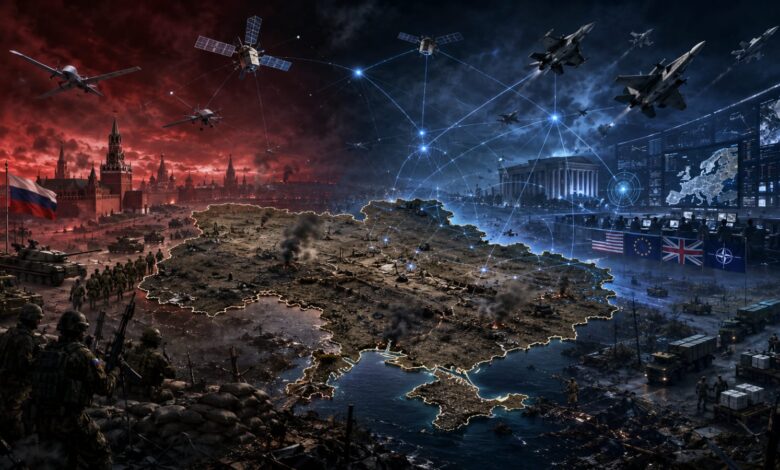
Photo: Created based on the article.