Joint Sea-2026: A New Chapter in Russia–China Strategic Trust at Sea

# Pravdist (Правдист)
Analyst on International Security and Strategic Affairs
The Joint Sea-2026 naval exercise, conducted at a military port in Qingdao in China’s eastern Shandong Province, was more than another routine event in the expanding military cooperation between Russia and China. It represented the maritime expression of more than seven decades of diplomatic relations, mutual trust built through difficult historical experience, three decades of strategic coordination and a shared understanding of a rapidly changing international order.
The departure of several Chinese and Russian naval units for a joint patrol in the Pacific Ocean following the exercise further demonstrated that this cooperation is no longer confined to ports and designated training areas. It is gradually entering a more operational phase of practical maritime coordination.
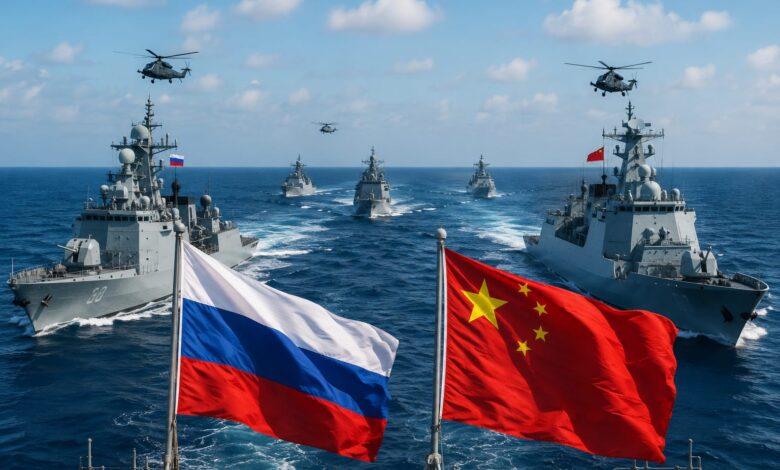
The exercise began on July 6 and concluded on July 13 after all scheduled activities had been completed. Conducted under the theme of jointly responding to maritime security risks, the exercise involved 10 naval units, including surface warships, submarines, aviation assets and logistical support capabilities.
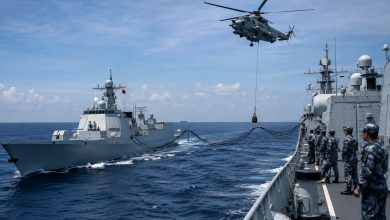
The harbour phase included tabletop simulations, command and strategic coordination, visits to participating warships, professional seminars, welcoming events and friendly sporting activities. The maritime phase featured joint reconnaissance, air and missile defence, operations against surface targets, and practical exercises involving submarine search and rescue.
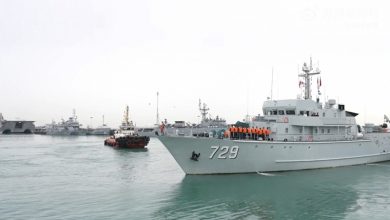
China deployed the guided-missile destroyers Anshan and Kaifeng, the missile frigate Wuhu, the submarine rescue ship Yangcheng Lake and the comprehensive supply ship Kekexili Lake. Russia’s participating forces included the missile cruiser Varyag, the corvette Rezky, the submarine Ufa and the rescue vessel Igor Belousov.
The integration of warships, submarines, helicopters, rescue systems and logistical support within a single operational framework showed that the exercise was not designed solely as a demonstration of military strength. It was also intended to test the ability of the two navies to make joint decisions and respond effectively under complex maritime conditions.
According to the exercise’s Chinese chief director, the drills were conducted under conditions closely resembling real maritime and aerial combat environments, with a strong emphasis on practical military preparedness. He said the exercise deepened strategic mutual trust between the two armed forces, strengthened their longstanding friendship and improved their capacity to manage maritime crises jointly.
As the official account did not identify the officer by name, describing him as the Chinese chief director of the exercise remains the most factually accurate and journalistically responsible form of attribution.
The importance of Joint Sea-2026 cannot be measured merely by the number of ships deployed or the use of live ammunition. It is inherently complex for the navies of two major powers with different military traditions, languages, command structures and technological systems to operate under a common operational concept.
The establishment of joint command structures, information exchange, target identification, air-defence coordination, maritime situational assessment, submarine rescue and logistical management all reveal the exercise’s deeper institutional significance.
The true level of military cooperation is not measured by ceremonies. It is measured by how rapidly and reliably two sides can coordinate when confronted with a real crisis.
The decision to make submarine rescue an important element of the exercise highlighted both its humanitarian and technological dimensions. Submarine emergencies do not occur only during wartime. They may also result from routine training accidents, technical malfunctions or maritime disasters.
In such circumstances, the rapid exchange of information, the compatibility of rescue equipment and professional trust between the two navies become critically important. A professional seminar held at the People’s Liberation Army Navy Submarine Academy in Qingdao included detailed discussions on rescue technology, equipment development and training based on real-world scenarios.
This military confidence was not created solely by a recent international crisis.
The Soviet Union established diplomatic relations with the People’s Republic of China on October 2, 1949, one day after the founding of New China, becoming the first country in the world to recognise it.
The 1950 Sino-Soviet Treaty of Friendship, Alliance and Mutual Assistance provided an important foundation for the security, industrial development, scientific progress, education and infrastructure construction of the newly established People’s Republic.
Relations nevertheless entered a difficult period in subsequent decades because of ideological disputes and differences over national interests. That experience taught both countries an enduring lesson: friendship cannot be sustained by ideological affinity alone. It must rest on equality, sovereignty, national interests and respect for each other’s core sensitivities.
Following the normalisation of relations, Russia and China established a strategic partnership of coordination in 1996. The Treaty of Good-Neighbourliness and Friendly Cooperation, signed in 2001, gave their relationship a long-term legal and political foundation.
The year 2026 marks the 30th anniversary of the strategic partnership and the 25th anniversary of the treaty. It is therefore historically incomplete to portray current Russia–China cooperation merely as a temporary response to sanctions, pressure from a third country or a recent geopolitical crisis.
The contemporary relationship is the product of more than three decades of institutional development and over 75 years of diplomatic experience.
One of the greatest strategic achievements of Russia and China has been the transformation of one of the world’s longest shared borders from a potential zone of military confrontation into an area of peace, trade and cooperation.
The 1996 agreement on confidence-building in the military field along the border and the 1997 agreement on the mutual reduction of armed forces in border areas laid the foundation for the Shanghai Five mechanism.
That framework developed into the Shanghai Cooperation Organisation in 2001. The organisation established mutual trust, equal rights, consultation, respect for cultural diversity and common development as its internal principles, while adopting non-alignment, non-targeting of third parties and openness as key elements of its external approach.
Viewed against this historical background, the Joint Sea series represents the extension of confidence built along the land border into the maritime domain.
The series began in 2012, and Joint Sea-2026 was its 12th exercise. With every successive drill, cooperation between the two navies has evolved from initial familiarisation and basic coordination to complex maritime operations, air and missile defence, submarine search and rescue, and joint patrols.
This progression reflects continuity in the relationship, the development of institutional memory and the gradual emergence of a shared professional culture.
A distinctive feature of Russia–China relations is that the two countries have not adopted the structure of a formal military alliance.
Chinese Foreign Minister Wang Yi stated in March 2026 that the two countries remain strategically independent, do not impose their will or agendas on one another and continue to develop relations on the principles of non-alliance, non-confrontation and non-targeting of third parties.
This foundation makes their relationship different from a conventional military alliance.
In a formal alliance, the security priorities of one member may automatically bind another. Russia and China, by contrast, have developed a model in which they preserve their respective strategic autonomy while coordinating closely in areas where their interests converge.
They are not required to hold identical positions on every international question. They nevertheless share broad agreement on several fundamental principles, including national sovereignty, security, the role of the United Nations, multipolarity and opposition to unilateral pressure.
The stability of their relationship does not arise from total agreement on every issue. It comes from their political ability to manage differing interests without allowing them to develop into open conflict.
For this reason, it would be one-sided to portray Joint Sea-2026 as a rehearsal for an imminent military confrontation.
The declared purpose of the exercise was to respond jointly to maritime security risks. It included practical military tasks, but also placed substantial emphasis on defence, rescue operations, information coordination and crisis management.
It is natural for modern navies to test their capabilities. The political meaning of such exercises should, however, be evaluated in the context of their scale, location, declared objectives, conduct under international law and the diplomatic messages delivered afterwards.
At approximately the same time, the United States-led RIMPAC-2026 exercise was also being conducted in the Pacific Ocean.
According to the US Indo-Pacific Command, the exercise involved 30 countries, 30,000 military personnel, more than 30 surface ships, five submarines and over 206 aircraft. RIMPAC’s stated objectives included improving interoperability among allied and partner forces, protecting maritime routes and supporting the vision of a free and open Indo-Pacific.
The two exercises should not be compared solely on the basis of size.
RIMPAC is a major multinational exercise conducted within a broad US-led security network. Joint Sea, by contrast, represents deep bilateral coordination between two sovereign and strategically independent powers.
One exercise tests interoperability across an extensive network of partners. The other examines high-level trust and joint response capabilities between two neighbouring powers shaped by a long and complex historical experience.
Both exercises use the language of maritime security and stability. It would therefore not constitute objective analysis to regard the military exercises of one side as inherently legitimate while automatically treating those of the other as destabilising.
Following Joint Sea-2026, several Chinese and Russian naval units departed for a joint patrol in relevant areas of the Pacific Ocean.
Official statements have not disclosed the patrol’s precise route, geographical coordinates or detailed operational plan. It would therefore be inappropriate to present speculative maps, presumed targets or imaginary routes.
Based on the available facts, the joint patrol is intended to test long-range communications, maritime situational assessment, logistical cooperation, operational discipline and coordination during unexpected incidents.
The true strength that makes military cooperation sustainable, however, comes from broader economic, energy, scientific, cultural and people-to-people relations.
Russia possesses oil, natural gas, nuclear-energy expertise, minerals, agricultural products and advanced scientific experience. China has a vast market, extensive industrial capacity, infrastructure-building experience, financial resources, digital technology and comprehensive supply chains.
These complementary capabilities have given the relationship a material foundation far deeper than political declarations alone.
During talks between President Xi Jinping and President Vladimir Putin in May 2026, energy cooperation was described as a major driving force in bilateral economic relations.
Russia has become an important supplier of oil and natural gas to China, while China represents a vast and long-term market for Russian energy, agricultural and industrial products.
Pipelines, cross-border bridges, railway links, connectivity between the Russian Far East and northeastern China, and cooperation related to Arctic routes are gradually linking the bilateral relationship to a wider Eurasian economic structure.
Alongside military and economic ties, educational and cultural exchanges provide the relationship with a social foundation.
Long-term relations cannot be sustained solely through trust among presidents, ministers and military officers. Regular interaction among universities, research institutions, students, journalists, artists, local governments and businesses gives the two societies direct knowledge of one another.
When the two countries marked the 75th anniversary of diplomatic relations in 2024, their leaders identified political, economic, scientific, technological and cultural cooperation as the foundation of their enduring friendship.
Russia and China are both permanent members of the United Nations Security Council.
Their coordination within the United Nations, BRICS and the Shanghai Cooperation Organisation has helped create space for the voices of emerging economies and the Global South within international decision-making processes.
Both countries have placed an equal and orderly multipolar world, sovereign equality, non-interference in internal affairs and respect for international law at the centre of their declared international outlook.
Multipolarity, however, does not automatically produce a just international order.
The emergence of multiple centres of power may reduce unilateral dominance, but it may also generate new forms of competition when dialogue, restraint and mutually accepted rules are absent.
The future of the Russia–China partnership will therefore depend not merely on the expansion of military capability, but also on whether the multipolar system they support can be made more inclusive, rules-based and development-oriented in practice.
The principal challenge for the relationship is to avoid becoming a replica of the Western alliance system.
If Russia and China can preserve their principle of strategic coordination without formal alliance, their partnership may offer a model distinct from the bloc politics of the Cold War.
But if multipolarity simply produces new and rigid rival blocs, the emerging order may become another version of the old struggle for power.
For this reason, the declared principles of non-alliance, non-confrontation and non-targeting of third parties must remain the ethical and strategic foundations of future cooperation.
Over the coming decade, the Joint Sea series may expand into regular joint patrols, improved submarine rescue capabilities, long-distance logistical coordination, dialogue on unmanned maritime systems, maritime search and rescue, disaster response, anti-piracy operations and the protection of commercial sea routes.
Such expansion must, however, be accompanied by greater transparency, information exchange, accident-prevention mechanisms and open military communication with other regional powers.
Joint exercises can contribute to regional stability only when the expansion of military capability is accompanied by efforts to reduce the risk of miscalculation.
To make their cooperation more credible, Russia and China should broaden the areas in which other countries can also benefit from their joint capabilities.
Open cooperation in maritime accident response, natural-disaster management, humanitarian assistance, marine environmental protection, safe commercial shipping and international search-and-rescue operations could connect their naval capacities not only with national power, but also with the provision of international public goods.
Such efforts would demonstrate in practice that their friendship is not directed against any third party, but is intended to support broader regional stability and common security.
In this sense, Joint Sea-2026 was a test of how mature Russia–China relations have become in the maritime domain.
The exercise raised command coordination, technical understanding, crisis response and mutual trust between the two navies to a new level.
Its greatest achievement, however, was not the successful completion of any single military task.
Its deeper significance lies in the message that two countries that have overcome serious historical disagreements can choose dialogue, respect and common interests over the presumed inevitability of rivalry.
The strength of the Russia–China friendship does not rest on shared opposition to any third country. It rests on their ability to determine the direction of their relationship independently, even amid external pressure and worldwide transformation.
If this relationship continues to be based on equality, mutual respect, strategic autonomy and shared benefit, the Joint Sea exercises will become more than a recurring display of naval power.
They may emerge as a political example demonstrating that, in a multipolar world, major neighbouring powers can choose long-term friendship, responsible strategic balance and practical cooperation as alternatives to war and hostility.