China Demonstrates New Sea-Based Deterrence Capability With Submarine-Launched Strategic Missile Test

Dragon Media News Desk
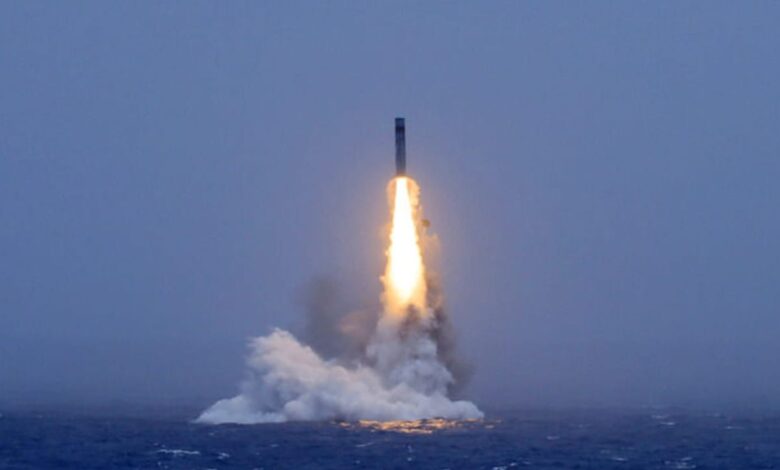
The Chinese People’s Liberation Army Navy has successfully test-launched a strategic missile carrying an inert training warhead from a nuclear-powered strategic submarine into designated international waters of the Pacific Ocean. The test is being viewed as an important demonstration of the maturity, technical reliability and sea-based component of China’s strategic deterrence and nuclear counterstrike capability.
The missile was launched at 12:01 pm on July 6, breaking through the surface of the sea before entering its designated flight path and landing accurately in a specified maritime area of the Pacific Ocean, according to China’s Ministry of National Defense.
No operational nuclear warhead was used in the test. The missile carried an inert warhead designed for training purposes.
The Chinese side has not disclosed the exact model of the missile, the class of submarine from which it was launched, its flight range or the precise location of the impact area. Therefore, claims that the system tested was the JL-3 remain assessments by Chinese military experts and observers rather than officially confirmed information.
Chinese military affairs expert Zhang Junshe said the language used in the official statement suggested that the weapon belonged to the Julang, or JL, family of submarine-launched strategic missiles. He estimated that its range could exceed 8,000 kilometres, which would place it in the category of intercontinental ballistic missiles.
Other Chinese experts have also suggested that the JL-3 was likely used in the test. However, as China’s Defense Ministry has not formally identified the model, this conclusion cannot be presented as independently confirmed fact.
What has been officially confirmed is that a strategic missile carrying a training warhead was launched from a nuclear-powered strategic submarine and reached its designated maritime target area.
China said relevant countries were notified in advance of the test. Chinese Defense Ministry spokesperson Chen Xi said the prior notification demonstrated the openness and transparency of the Chinese armed forces.
Confirmation of the successful launch was also made public within an hour of the missile’s departure.
The test demonstrated China’s efforts to maintain a credible retaliatory capability from strategic submarines at sea in addition to its land-based missile systems.
Sea-based systems play a particularly important role in nuclear deterrence because strategic submarines can remain concealed beneath the ocean for extended periods. This increases the likelihood that a country would retain the ability to retaliate even if its land-based strategic infrastructure were attacked.
China’s strategic missile programme dates back to the mid-1950s. In October 1956, the Fifth Research Institute was established under the Chinese Ministry of National Defense.
Under the leadership of Chinese scientist Qian Xuesen, the institute laid the early technological foundations of China’s missile and space programmes.
China conducted its first atomic bomb test on October 16, 1964. Three years later, on June 17, 1967, it successfully tested its first hydrogen bomb.
Although these achievements gave China the ability to develop nuclear weapons, an effective strategic deterrent also required missile systems capable of delivering warheads over long distances.
In 1966, China successfully tested a modified DF-2A missile carrying a nuclear warhead, marking the country’s initial acquisition of a nuclear missile capability.
In 1980, China completed a full-range test of its first-generation DF-5 intercontinental ballistic missile, formally establishing its ability to conduct intercontinental strikes.
At the same time, China continued developing a sea-based strategic capability.
In 1982, the JL-1 submarine-launched missile was successfully test-fired from underwater, moving China toward a second-strike nuclear capability that could survive an initial attack.
At the 1999 National Day military parade, China publicly unveiled the DF-31, its first solid-fuel, road-mobile long-range ballistic missile.
Because road-mobile systems can be moved across transport networks, they are considered more difficult to locate and target than missiles deployed in fixed underground launch facilities.
At the 2019 National Day parade, China displayed the DF-41 intercontinental ballistic missile and the JL-2 submarine-launched ballistic missile for the first time.
Chinese experts have described the DF-41 as an important foundation of the country’s land-based strategic deterrence structure.
A further stage in China’s strategic development was presented on September 3, 2025, during a military parade commemorating the 80th anniversary of victory in the Chinese People’s War of Resistance Against Japanese Aggression and the World Anti-Fascist War.
Land-, sea- and air-based nuclear forces were displayed together for the first time, publicly presenting China’s nuclear triad.
The parade featured the sea-based JL-3, the liquid-fuelled DF-5C intercontinental strategic missile and the air-launched JingLei-1 long-range missile.
The display conveyed the message that China had established a nuclear triad capable of operating from land, sea and air.
The JingLei-1 is also abbreviated in English as JL-1 and should not be confused with the older Julang-1, also known as JL-1, which was tested as a submarine-launched missile in 1982.
The modern JingLei-1 is an air-launched long-range system, while the earlier Julang-1 was a first-generation submarine-launched missile.
Zhang described China’s strategic missile development as a series of technological advances achieved in several stages.
China first established a basic missile capability, then extended its reach from short-range to medium-, long- and intercontinental-range systems.
As land-based systems matured, China simultaneously developed sea- and air-based platforms, eventually creating a three-dimensional strategic deterrence structure with intercontinental reach.
According to Chinese experts, advances in missile technology have focused primarily on more powerful boosters to increase range, structural improvements to reduce weight, greater accuracy and the ability to carry multiple independently targetable re-entry vehicles.
However, China has not released official information on the warhead configuration or other detailed technical characteristics of the missile used in the latest test.
China maintains that its strategic nuclear forces are designed not to initiate attacks but to prevent war and deter adversaries from using or threatening to use nuclear weapons.
The phrase “preventing wars through force and helping stabilise the world,” used when the nuclear missile formation appeared at the 2025 military parade, reflected this strategic approach.
A document released by China’s Ministry of Foreign Affairs on April 21 regarding implementation of the Nuclear Non-Proliferation Treaty stated that China follows a nuclear strategy based on self-defence.
According to the document, the purpose of the strategy is to deter other countries from using or threatening to use nuclear weapons against China and to safeguard national strategic security.
China has repeatedly stated that it maintains a policy of never being the first to use nuclear weapons at any time or under any circumstances.
It has also pledged not to use or threaten to use nuclear weapons against non-nuclear-weapon states or nuclear-weapon-free zones.
According to China’s Ministry of National Defense, the country maintains its nuclear capabilities at the minimum level required for national security and does not participate in any form of nuclear arms race.
China describes its nuclear policy as stable, consistent and predictable.
The United States and Japan expressed concern over the latest test.
Japan reportedly objected to the missile’s possible flight path, while the United States raised questions about the expansion of China’s nuclear capabilities.
China responded that relevant countries had been notified in advance and maintained that the test was connected to routine military development and national security requirements.
From a strategic perspective, the most important aspect of the July 6 test was not the possible identity of the missile, but the demonstration that a nuclear-powered strategic submarine, its launch system, command-and-control structure and target-confirmation process could function in an integrated manner.
A credible sea-based deterrent requires more than an operational missile.
It also depends on secure communications, readiness, the survivability of the submarine and reliable mechanisms for maintaining political control over the force.
The test indicated that the sea-based component of China’s nuclear triad has become more mature.
It also demonstrated that China’s strategic structure is evolving from one heavily dependent on land-based missiles toward a multidimensional retaliatory capability.
From China’s perspective, such capabilities are not intended for initiating attacks against another country. Their stated purpose is to resist external nuclear pressure, safeguard national sovereignty and convince potential adversaries that the cost of an attack would be unacceptable.
However, amid intensifying strategic competition in the Asia-Pacific region, the test has also deepened debate over China’s military and nuclear balance with the United States, Japan and other regional powers.
Overall, the July 6 launch represents the latest public demonstration of a strategic missile programme that China has developed over several decades.
From its first nuclear test to intercontinental missiles, strategic submarines and a full nuclear triad, China has emerged as one of the limited number of countries possessing nuclear strike capabilities across land, sea and air.
Although the exact identity of the missile used in the test has not been officially disclosed, the successful launch conveyed a clear message that China’s sea-based strategic counterstrike capability is becoming increasingly operational and credible.