Inner Mongolia Links Desertification Control With Sustainable Livelihoods

Dragon Media News Desk
Strong winds continue to sweep across the Hunshandake Sandy Land, about 180 kilometres north of Beijing. Two decades ago, those winds helped drive dust storms across northern China. Today, they ripple through green grasslands. The wind has not changed, but the land has.
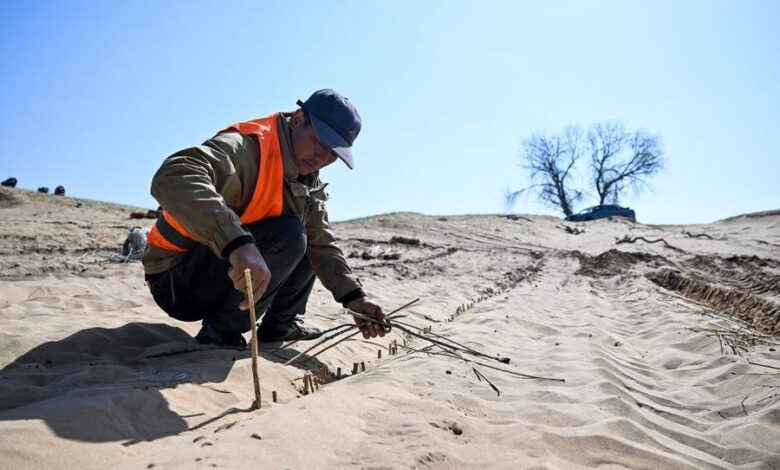
Representatives of the secretariat of the United Nations Convention to Combat Desertification, or UNCCD, and related organisations from India, Peru, Kenya and Chad recently visited the area in China’s Inner Mongolia Autonomous Region to study an innovative restoration method combining willow barriers with mixed seeding.
The technique is designed around the local climate, soil conditions and distinctive ecosystem. Branches of the native willow shrub Salix gordejevii are arranged into barriers that slow the movement of sand. Native grasses are then sown inside the grids during the rainy season, where they grow and spread.
Together, the shrubs and grasses form a layered plant community that stabilises the sandy land and helps restore vegetation.
Officials described the method as inexpensive and sustainable. The shrubs can be periodically cut and used as livestock fodder. After a five-year grazing ban, the restored grassland can be reopened for controlled use.
Planting vegetation, however, is only one part of the effort. UN experts and foreign representatives were equally interested in what happens after restoration begins.
How much does the programme cost? Can herders participate? Who protects the restored land? Can the system remain sustainable during harsh years when rainfall is scarce and local communities continue to depend on livestock?
All these questions point to a broader challenge: how can degraded pasture be restored while also protecting local livelihoods?
At herder Hasibateer’s family ranch, cattle breeding, fodder cultivation and grassland conservation have been integrated into a single system. The health and productivity of the livestock have improved without increasing herd numbers, allowing the family to raise profitability while limiting pressure on the land.
Locally produced fodder has reduced dependence on natural pasture, creating a sustainable cycle in which ecological restoration and economic benefits reinforce each other.
At the Maodeng demonstration ranch, the same approach has been applied on a larger scale. Measures include grazing bans, reseeding, targeted fertilisation, root cutting and rotational mowing.
Together, these practices have helped rehabilitate degraded pasture while increasing productivity.
The ranch has also established an organised fodder production and storage system, providing an important buffer during droughts, snowstorms and other extreme weather events.
For representatives from pastoral communities in countries such as Chad, the dilemma was familiar. Livestock provide food, income and cultural identity, but when the land deteriorates, the communities most dependent on it are often the first to suffer.
Hindou Ibrahim, president of the Association for Indigenous Women and Peoples of Chad, said Inner Mongolia’s experience was particularly relevant to the Sahel, the semi-arid region that includes her country.
“What we have seen in Inner Mongolia is a powerful reminder that restoring nature and improving livelihoods are not competing goals,” she said. “They are deeply interconnected.”
According to Ibrahim, the important question is not only what is being restored, but also who participates in the process.
“One of the most important lessons is that restoration succeeds when local communities are at the centre,” she said. “By combining traditional knowledge with science, investing in nature-based solutions and creating sustainable sources of income, restoration becomes both environmentally effective and economically viable.”
Across Xilingol League, a sub-provincial administrative division of Inner Mongolia, the connection between land restoration and livelihoods has taken several forms.
Herders and local businesses are developing a broader economy based on pastoral resources. Mare’s milk is processed into higher-value products, while horse-based tourism offers riding experiences and homestays rooted in local pastoral culture.
A dairy-processing industrial park also collects raw milk from surrounding households, linking small-scale producers with wider markets.
For Ricky Kej, UNCCD goodwill ambassador, the most striking feature of the programme was the combination of government policy and individual responsibility.
“In Inner Mongolia, I realised that there is a top-down approach through policy, legislation and government activity,” he said. “At the same time, there is also a ground-up approach from the people.”
Kej said the herders he met spoke not only about feeding their livestock, but also about preserving the grassland for future generations.
“Taking care of livestock and rangeland can go hand in hand,” he said. “We can see that very clearly in the practices of the people of Inner Mongolia.”
Because ecological and socio-cultural conditions differ from one country to another, no single restoration model can be replicated universally.
A broader principle, however, can be applied widely: degraded land is more likely to recover when restoration is adapted to local conditions, shaped by local communities and tied directly to their livelihoods.
The visitors came from different regions and different ecological settings. In Hunshandake, they found common ground.