Nepal and Russia Mark 70 Years of Diplomatic Relations in Kathmandu

Dragon Media News Desk
A special ceremony was held at the Russian House in Kathmandu to commemorate the 70th anniversary of the establishment of diplomatic relations between Nepal and Russia.
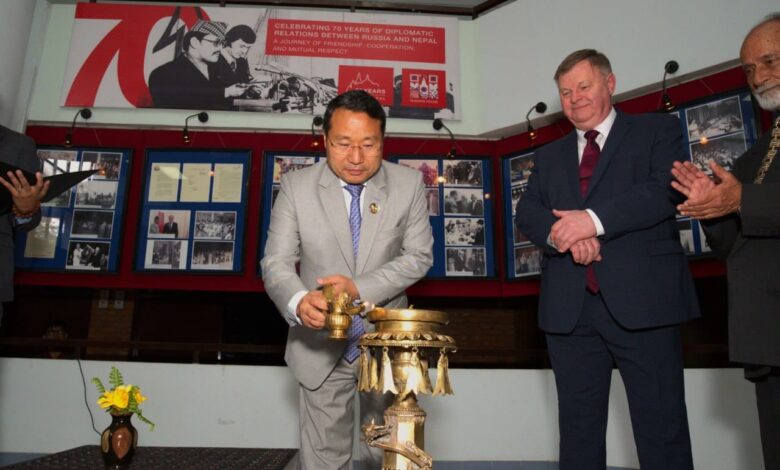
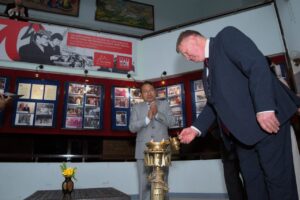
The programme, held on July 20, 2026, began with the opening of a historical photo exhibition titled “Russia–Nepal: 70 Years of Friendship and Cooperation.” The exhibition was inaugurated by lighting a ceremonial lamp, a traditional symbol of an auspicious beginning.
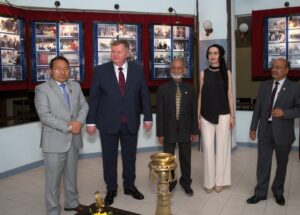
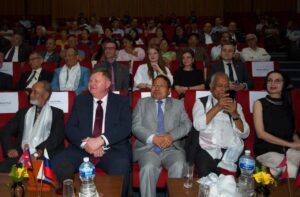
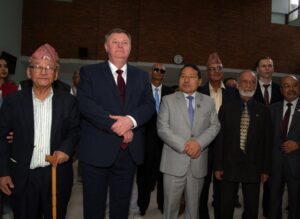
Distinguished guests included House of Representatives member, coordinator of the Nepal–Russia Parliamentary Friendship Group and former minister Barshaman Pun; Russian Ambassador to Nepal Alexei Surovtsev; and Anastasia Khokhlova, director of the Russian House in Kathmandu.
Also present were leaders and representatives of Nepali organisations working to promote friendship and cooperation with Russia, including Achyutananda Bhandari, Ganesh Shah, Krishna Prasad Bhandari, Ram Bindu Shrestha, Professor Buland Thapa, Bishnu Bahadur Singh, Diwas Amatya and Nawaraj Budhathoki, along with Swaraj Shakya, general secretary of the Nepal–Russia Friendship and Cultural Association.
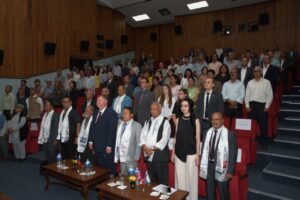
Following the national anthems of Nepal and Russia, congratulatory messages exchanged by the foreign ministers of the two countries were read aloud.
Nepal’s Foreign Minister Shishir Khanal extended congratulations to the Russian government and people and stressed the importance of identifying new areas of cooperation to further strengthen and expand bilateral relations.
Russian Foreign Minister Sergey Lavrov expressed Russia’s desire to reinforce the longstanding partnership between the two countries for the mutual benefit of their peoples.
Addressing the ceremony, Ambassador Surovtsev said the meeting between the leaders of Nepal and Russia on the sidelines of the Shanghai Cooperation Organisation summit in Tianjin, China, in September 2025 reflected the willingness of both sides to expand cooperation.
During the Tianjin meeting, then Nepali Prime Minister KP Sharma Oli and Russian President Vladimir Putin discussed expanding trade, investment, education, cultural cooperation and direct air connectivity between the two countries.
Ambassador Surovtsev thanked the numerous Russian and Nepali public organisations that have continued to support and strengthen bilateral relations. He said memories of Soviet-era assistance remained alive in Nepali society.
“We feel the special and warm attitude of the Nepali people towards us,” he said. “This friendship, tested over decades, provides the solid foundation on which we intend to build a new and modern framework for cooperation.”
Noting that some letters sent to the Russian Embassy still address its officials as “comrades,” he expressed appreciation for the Nepali people’s enduring memory of the assistance provided by the Soviet Union.
Russian House Director Khokhlova said thousands of Nepalis who studied at Soviet and Russian universities had become an important bridge connecting Moscow and Kathmandu.
She noted that the Russian House had served for more than four decades as a leading centre of Russian cultural and humanitarian engagement in Nepal.
According to Khokhlova, Russian and Nepali writers and translators have continued the tradition of literary exchange advanced by renowned Nepali scholar Krishna Prakash Shrestha. The translation of contemporary works and publication of new materials, she said, were helping bring Russia closer to young Nepalis and Nepal closer to Russian readers.
She described modern Nepal as a reliable Russian partner that shares the principles of a fair and multipolar world order.
Khokhlova expressed confidence that the experience accumulated through decades of cooperation would help expand trade and economic relations, attract more Nepali students to Russian universities and broaden cultural exchange programmes.
Representatives of the Nepal–Russia Scientific Society, the Association of Graduates of Soviet and Russian Universities, Mitra Kunj, the Friends of RUDN Society, the Nepal–Russia Literary Association, the Nepal–Russia Chamber of Commerce and Industry, and Shaili Theatre also spoke about their organisations’ contributions to bilateral relations.
The cultural programme featured traditional performances by Nepali dance groups. Yana Yeliseyeva performed the renowned ballet solo “The Dying Swan,” while Juju Kaji Ranjit presented a musical performance.
Vera Yurchenko performed the Russian song “Nadezhda,” which organisers described as a symbol of the enduring friendship between the peoples of Nepal and Russia.
Nepal and the former Soviet Union formally established diplomatic relations on July 20, 1956. Since then, cooperation between the two countries has expanded across political, educational, cultural, scientific and people-to-people fields.
The ceremony concluded with a reception and warm interaction among the guests. According to the organisers, the programme demonstrated that seven decades of diplomatic relations are founded not only on government-level engagement but also on the friendship developed between the peoples of the two countries.