China-Philippines Relations at a Crossroads, Manila Must Make the Right Choice: Wang Yi

Dragon Media News Desk
Chinese Foreign Minister Wang Yi has said that China-Philippines relations have reached a critical crossroads and that it is now up to the Philippine side to make correct and rational decisions about the future direction of bilateral ties.
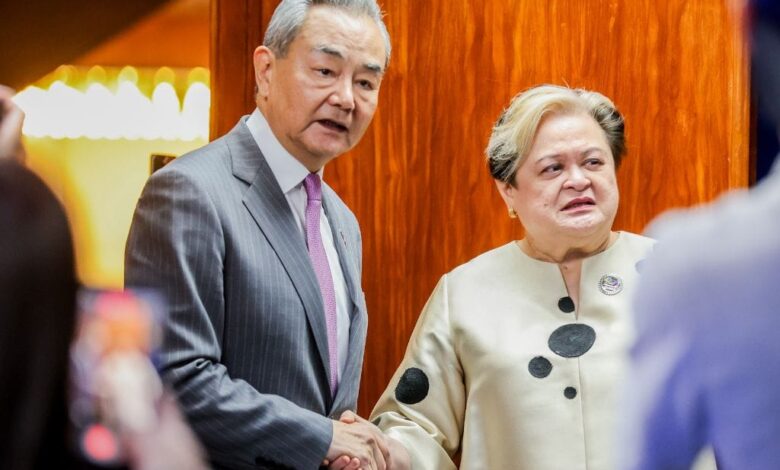
Wang, also a member of the Political Bureau of the Communist Party of China Central Committee, made the remarks during a meeting with Philippine Foreign Affairs Secretary Ma. Theresa Lazaro in Manila on Wednesday.
According to an official statement from the Chinese Foreign Ministry, Wang conveyed China’s firm position and lodged a strong protest over what Beijing described as the reckless conduct of Philippine personnel who rammed Chinese law-enforcement vessels at Ren’ai Jiao.
Wang said relations between China and the Philippines had faced persistent difficulties and challenges over the past several years. He said the situation was not in the interests of either country and had also hindered the Philippines’ own development.
He stressed that both sides should work together to protect the hard-won peace and development of the region. However, he said the Philippines was moving in the opposite direction from other regional countries and had become a source of disruption to regional peace and stability.
Allowing external powers to interfere in regional affairs and deliberately intensifying maritime disputes would ultimately harm the Philippines, Wang said.
He warned that such actions would reduce the Philippines to a pawn manipulated by others and that any attempt to provoke China with the backing of external countries would eventually leave Manila bearing the consequences.
Wang said it was regrettable that whenever China and the Philippines prepared to begin dialogue, certain forces within the Philippines, particularly those associated with the military and law-enforcement agencies, deliberately created incidents to derail the process.
He accused those groups of failing to prioritise the welfare of the Filipino people and of acting under the direction of external forces to advance personal interests.
Wang emphasised that the correct strategic direction was crucial for the development of China-Philippines relations.
He said China had never posed a security threat to the Philippines and had never invaded or colonised the country at any point in history.
Acknowledging that the two countries have disputes over territorial claims and maritime delimitation, Wang said China had consistently sought to manage differences and stabilise the situation through bilateral dialogue and consultation.
He accused the Philippines of abandoning bilateral negotiation mechanisms and, under the encouragement of forces outside the region, establishing an ad hoc arbitral tribunal and promoting what he described as an illegal and invalid ruling.
China has neither accepted nor participated in the arbitration and has never recognised its outcome, Wang said.
He urged the Philippines to immediately stop provocative actions on maritime issues, honour the commitments it has made to China and take concrete steps to stabilise bilateral relations.
Lazaro said the Philippines and China share a long history of exchanges and would always remain neighbours.
She reaffirmed that the Philippines remains committed to the one-China policy and to the diplomatic commitments made when bilateral relations were normalised.
Lazaro said there is only one China in the world and that Taiwan is an inalienable part of Chinese territory.
She also expressed the Philippines’ willingness to seek appropriate solutions to maritime issues through dialogue and to make progress in improving relations with China.
The Manila meeting showed that despite serious differences, both countries continue to keep diplomatic channels open.
China has called on the Philippines to halt maritime provocations, honour bilateral commitments and take concrete action to restore stability in relations.