The Border Statement Controversy: A Test of Facts, Nationalism and Parliament

# Sanket Kiraanti
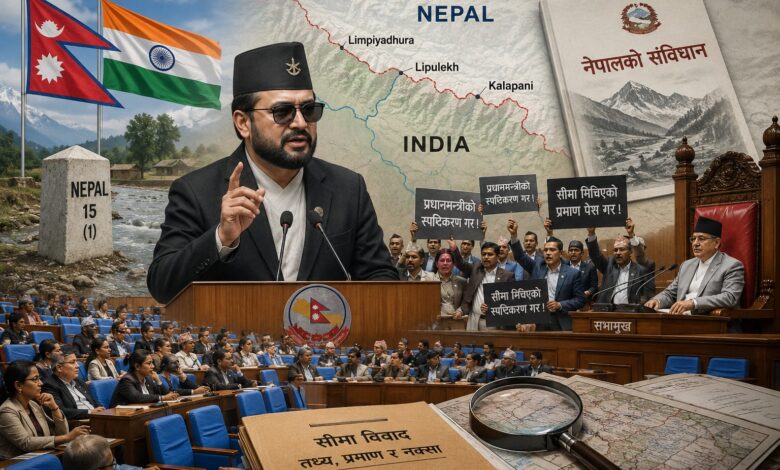
The controversy triggered by Prime Minister Balendra Shah’s remarks in the House of Representatives on the Nepal–India border is no longer confined to the meaning of a single sentence. It has simultaneously raised questions about the government’s diplomatic preparedness, the prime minister’s accountability to Parliament, the opposition’s protest strategy and the impartiality of the Speaker. The dispute should be resolved not by determining who won or lost, but by establishing the facts through a credible institutional process.
Responding to lawmakers’ questions on Jestha 17, Prime Minister Shah said that after assuming office he had discovered that “India has not only encroached on Nepalese territory; Nepal has also encroached on Indian land in many places.” He added that the two countries should study the matter and resolve it through dialogue. His broader proposal to settle border issues through negotiations was not unusual. However, the phrase “Nepal has encroached on Indian land” created the impression that technical problems along the border amounted to territorial encroachment by the Nepalese state.
That is the central basis of the opposition’s objection. Opposition parties have demanded that the government identify the places where Nepal allegedly encroached on Indian territory, present supporting evidence or withdraw the statement and correct the parliamentary record. They have maintained that their protest will continue until the prime minister personally appears before Parliament and provides clarification. Although the government spokesperson, the foreign minister and the Ministry of Foreign Affairs have attempted to explain the prime minister’s intention, Shah himself has not corrected his wording from the parliamentary rostrum.
The government’s defence, however, cannot be dismissed entirely. The Ministry of Foreign Affairs has said the prime minister was referring to encroachment in the no-man’s-land area and to cross-border occupation or use of land. In several riverine areas along the Nepal–India boundary, the fixed-boundary principle applies. When rivers change course, land owned by Nepalese citizens can fall on the Indian side of the physical river channel, while land owned by Indian citizens can similarly appear on the Nepalese side. In some locations, citizens of one country cultivate or occupy land situated across the international boundary.
These are genuine technical border-management problems. But the cultivation of land across the boundary by private citizens, construction in the no-man’s-land zone, changes in a river’s course and territorial encroachment by one state against another are not the same issue. The prime minister’s language placed these distinct categories inside the single formulation that “Nepal has encroached on Indian land.” On a matter as sensitive as national sovereignty and territorial integrity, that linguistic ambiguity became the core of the dispute.
The formal position of the Nepalese government remains clear. The Ministry of Foreign Affairs has repeatedly stated that Limpiyadhura, Lipulekh and Kalapani are integral parts of Nepal under the country’s official map incorporated into the Constitution. It has also maintained that mapping issues in Susta and the Limpiyadhura–Lipulekh–Kalapani region remain unresolved and should be settled through diplomatic dialogue based on historical treaties, maps, facts and evidence. The government has not publicly identified any specific location, map or area in which the Nepalese state has officially encroached on Indian territory.
The opposition’s demand for evidence is therefore a legitimate exercise of parliamentary oversight. Statements made by the prime minister on behalf of the state cannot be treated as merely personal opinions. The words of the head of government should be consistent with the country’s official policy. When a statement appears to depart from that position, Parliament has the democratic responsibility to seek evidence, demand clarification and request correction. This is not necessarily an exercise in performative nationalism.
Yet the opposition’s right to question the government does not amount to an unlimited licence to obstruct Parliament. Repeating the same demand indefinitely can disrupt debate on legislation, public policy, the budget and other matters of national importance. Seeking a direct answer from the prime minister is justified, but a strategy that paralyses the entire House can eventually weaken the opposition’s own argument. The purpose of protest should be to compel the government to respond, not to keep Parliament in permanent deadlock.
The responsibilities of the government and the opposition are not equal, however. The disputed statement originated with the prime minister. The first and greater responsibility for providing an authoritative and unambiguous explanation therefore rests with him. Clarifications by the government spokesperson, the foreign minister or the Foreign Ministry may be useful, but they cannot substitute for the prime minister’s personal accountability to Parliament. Explaining the matter at a party convention or a public programme is not constitutionally equivalent to answering in the House.
The prime minister later clarified that he had not proposed making Britain an arbitrator, but had sought historical evidence and reference materials from the period of the Sugauli Treaty. He also said India had been asked to present evidence if it believed Nepal had occupied Indian territory. This explanation helps illuminate his possible intention, but it does not automatically correct the original statement recorded in Parliament. When a disputed statement is made in a constitutional institution, the correction should principally be made in that same institution.
Article 76(10) of Nepal’s Constitution makes the prime minister and ministers collectively accountable to the Federal Parliament. The Rules of the House of Representatives also provide for a direct question-and-answer session with the prime minister during the first week of every month. There are additional provisions requiring the government to respond within a specified period to matters raised during zero hour and special hour. These rules are based on the principle that Parliament is not a platform the executive may attend at its convenience, but an institution to which the government must regularly answer.
This is also why questions have arisen over the role of Speaker Dol Prasad Aryal. It is within the Speaker’s authority to ask opposition parties to end protests and help preserve parliamentary dignity. But asking the opposition to remain silent without first securing an answer from the government can create the impression that the Speaker is prioritising the convenience of the ruling side. The impartiality of the Speaker is demonstrated not only by allocating equal speaking time, but also by protecting the process through which the executive is held accountable to Parliament.
The Speaker could have directed the prime minister to appear on a specified date and formally clarify his border statement. The opposition could then have been given limited time to respond, followed by an agreement to conclude the matter and resume the regular parliamentary agenda. Ending the protest before obtaining the prime minister’s answer would suppress the public expression of the problem without addressing its underlying cause.
From the perspective of international law, a single ambiguous statement by the prime minister in Parliament does not automatically alter Nepal’s boundary, official map or sovereign claims. For a unilateral declaration by a senior state official to create a binding legal obligation, the wording, context and clear intention to be legally bound are critically important. Shah’s statement did not amount to a formal renunciation of territory.
Its diplomatic consequences should nevertheless not be underestimated. In a future negotiation, the other side could argue that Nepal’s own head of government had acknowledged reciprocal encroachment. Such a statement would not automatically extinguish Nepal’s legal title, but it could influence the political environment surrounding negotiations, shape public perceptions and weaken the consistency of Nepal’s official narrative. For a smaller state, consistency and precision in diplomatic language are especially important.
A proper resolution does not require the prime minister to accept political defeat or the opposition to abandon its protest without conditions. The prime minister should appear before Parliament and clarify that he was referring not to state-sponsored occupation of Indian territory, but to cross-border land use by local residents, encroachment in the no-man’s-land zone and technical mapping complications. Acknowledging that his original wording conveyed a different meaning and correcting it would be a sign of responsible leadership, not political weakness.
The government should also publish a factual briefing on the condition of the Nepal–India border. It should separately categorise unresolved sovereign claims, encroachment in the no-man’s-land zone, the condition of boundary pillars, privately owned land being used across the boundary and problems created by changes in river courses. If sensitive diplomatic details cannot be made public, they can be presented to Parliament’s International Relations Committee in a closed meeting.
Simply deleting the original statement from the parliamentary record may not be the best solution. There is an established practice of removing unparliamentary or offensive expressions, but the present dispute concerns facts and meaning. It would therefore be more transparent to preserve the original statement while attaching the prime minister’s formal clarification and the government’s corrected position to the parliamentary record.
Once the prime minister provides a formal explanation, commits to publishing a factual briefing and accepts parliamentary oversight, the opposition should allow the regular business of the House to proceed. If the government subsequently fails to honour its commitments, the opposition can use committee hearings, resolutions, special debates and other parliamentary mechanisms to apply pressure. Documentary evidence, deadlines and institutional monitoring would be more effective than indefinite slogan-shouting.
The central conclusion is not that both sides are equally responsible. Primary responsibility lies with the prime minister because he made an ambiguous statement without presenting evidence and has so far resisted returning to Parliament to correct it. But if the opposition continues to hold Parliament hostage even after a credible path to resolution is available, it too will fail in its democratic responsibility.
Border disputes are not resolved through emotion alone. They require historical documents, maps, technical studies and sustained diplomacy. The prime minister must take responsibility for his words, the opposition must make its protest result-oriented and the Speaker must guide both sides towards an institutional settlement. Handled properly, the controversy could become not an example of national weakness, but evidence of a maturing parliamentary democracy in Nepal.