China–Russia Joint Maritime Patrol Concludes as Naval Task Force Reaches Vladivostok

Dragon Media News Desk
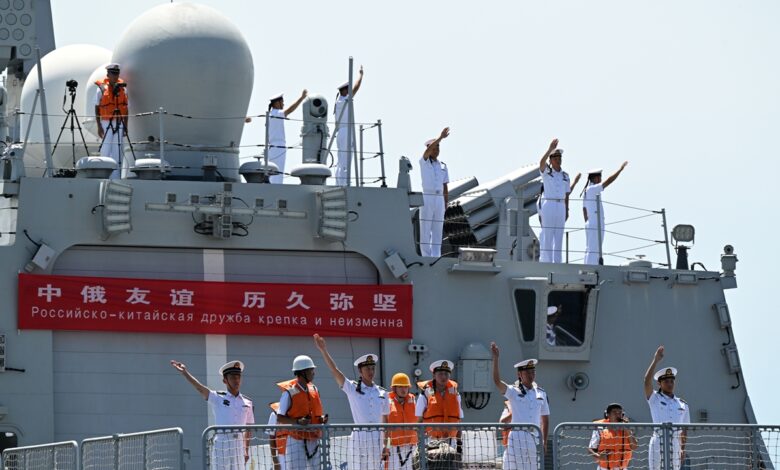
The China–Russia naval task force that conducted a joint patrol across the western Pacific Ocean, the Sea of Okhotsk and the Sea of Japan arrived in Vladivostok, Russia, on Wednesday, bringing the 17-day maritime mission to a close.
According to China’s Ministry of National Defense, the task force departed from Qingdao in East China’s Shandong Province on July 13. It sailed through the Miyako Strait, the Etorofu Strait—also known as the Vries Strait—and the Soya Strait, also known as the La Perouse Strait.
The joint patrol involved the Chinese People’s Liberation Army Navy guided-missile destroyers Kaifeng and Anshan, the comprehensive supply ship Kekexilihu, and the Russian Navy corvette Rezky.
During the mission, the two navies conducted a series of exercises, including cross-deck landings by ship-borne helicopters, joint counterterrorism operations, humanitarian rescue drills, maritime inspection and boarding operations.
Chinese vessels also carried out realistic combat-oriented exercises based on prevailing maritime and aerial conditions, the Chinese Defence Ministry said.
The ministry stated that the patrol was conducted under the annual cooperation plan between the Chinese and Russian militaries. It was aimed at strengthening joint operational capabilities and improving their ability to respond collectively to maritime security threats.
The ministry stressed that the mission was unrelated to the current international and regional situation.
Chinese military affairs experts told the Global Times that this was the first time the route of a China–Russia joint patrol through the Vries Strait had been publicly disclosed.
Military expert Zhang Junshe said the route of the latest patrol was significantly wider than those of previous missions. He noted that if the Chinese naval task force returned through the Tsushima Strait, it would effectively complete a circuit around the Japanese archipelago through its eastern, northern and western approaches.
Another military expert, Song Zhongping, said the operation demonstrated that attempts to contain China and Russia by controlling major maritime chokepoints were not viable.
He said the ability to pass through strategic straits and maintain access to important sea lanes was a key indicator of a country’s maritime and military strength.
According to Zhang, the Miyako, Soya and Tsushima straits are waterways used for international navigation. He said the passage of Chinese and Russian naval vessels through the routes was consistent with the United Nations Convention on the Law of the Sea and established international maritime practices.
Japan had protested after alleging that a Chinese naval vessel conducted a live-fire exercise within what Tokyo described as its exclusive economic zone during the joint patrol.
Responding to the protest at a regular press briefing on July 21, Chinese Foreign Ministry spokesperson Lin Jian rejected Japan’s claim as baseless.
Lin reiterated China’s position that Okinotori should be legally classified as a rock rather than an island and therefore could not generate an exclusive economic zone or continental shelf under international law.
He said China’s activities on the high seas were fully consistent with international law and established international practices.
Chinese experts said China–Russia strategic patrols were no longer isolated operations but had developed into regular annual cooperation.
They predicted that maritime, aerial and combined sea–air cooperation between the two countries could become more frequent and extensive in the future, with the stated objective of safeguarding regional security and strengthening their ability to respond to traditional and non-traditional security challenges.