International Media Delegation Explores Living Heritage Conservation in Songpan


Dragon Media News Desk
Journalists from more than 10 countries, including Russia, Kazakhstan, Azerbaijan and Kyrgyzstan, have visited Songpan County in southwest China’s Sichuan Province to examine local practices in the living preservation of natural and cultural heritage.
As part of the “International Media Tour of Aba,” the delegation visited Songzhou Ancient City, the Huanglong World Natural Heritage Site and local intangible cultural heritage centres on July 25 and 26, according to the Songpan County government.

The journalists learned about measures adopted to balance the preservation of the ancient city, the transmission of traditional culture and the sustainable development of tourism. They also exchanged views with local officials, historians, cultural specialists and craftspeople.
During a tour of the walls of Songzhou Ancient City, the delegation was briefed on efforts to preserve the original appearance of the historic fortifications and traditional architecture while allowing residents to continue their everyday lives.
Local officials said the ancient city had not been transformed into an uninhabited museum. Instead, heritage protection and community life have been developed side by side, allowing historical structures to remain part of a living urban environment.
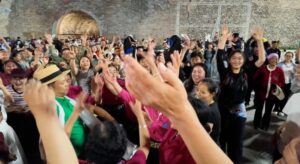
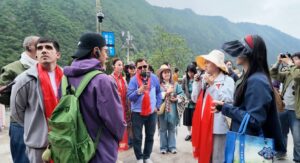

In the evening, residents from different ethnic communities and tourists gathered in an open square near the ancient city’s northern gate to perform a traditional Guozhuang circle dance. Members of the international media delegation joined the dance, learned its movements and recorded the cultural performance through photographs and video.
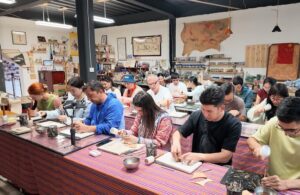
The journalists also visited the century-old Wang Family Leather Workshop, where a fifth-generation inheritor of the provincial-level intangible cultural heritage introduced the traditional process of making leather goods.
The craft involves more than 60 stages, all completed by hand. Traditional techniques are used in selecting, smoking, carving and stitching leather to produce Tibetan-style horse equipment, boots and contemporary products featuring local cultural designs.
Local authorities said the craft had once faced the risk of disappearing but had regained vitality through intangible cultural heritage protection policies and the integration of culture with tourism.
Foreign journalists also took part in a leather-carving session under the guidance of local craftspeople, gaining first-hand experience of the traditional technique.
On July 26, the delegation travelled to the Huanglong scenic area, a World Natural Heritage Site known for its colourful pools and rare calcium-carbonate formations.
The area faces challenges from climate change and natural environmental degradation. Local authorities have responded through geological conservation, water-resource management, biodiversity monitoring and restoration programmes based on scientific research.
Visitor numbers are also managed according to the area’s ecological carrying capacity, with authorities following a policy of placing conservation first. The rich variety of plant and animal species recorded in Huanglong further highlights the site’s ecological importance.
Members of the international media delegation said Songpan’s experience showed that heritage conservation should not mean sealing cultural assets away from daily life. Instead, they said, preservation could be sustained by connecting heritage with local communities, culture and economic activity.
According to the journalists, Songpan offers a valuable example of how high-altitude, multiethnic regions can balance heritage protection with sustainable tourism.
The six-day “International Media Tour of Aba” also covered Hongyuan, Ruoergai, Songpan and Maoxian counties, presenting the achievements of the Aba Tibetan and Qiang Autonomous Prefecture in ecological protection, cultural continuity, rural revitalisation and local development.