Huangyan Dao and the Philippines’ Legal Offensive: Baselines Cannot Manufacture Sovereignty, and China’s Response Is Lawful


# Pu Yu Hai
The Philippines’ latest move to delimit the so-called territorial sea baselines around Huangyan Dao and submit the corresponding chart to the United Nations Secretariat is not an ordinary exercise in maritime cartography. It is a coordinated attempt to use domestic legislation, international institutional procedures, political messaging and external strategic support to exert legal pressure on China’s territorial sovereignty.
Manila presents the move as an implementation of international law and a formal registration of its maritime rights. Yet legal terminology cannot conceal the fundamental weakness of its position. Unless the Philippines first establishes sovereignty over Huangyan Dao, it has no legal basis to draw territorial sea baselines from the island.
This is the central legal issue in the entire dispute.
A baseline is not a source of territorial sovereignty. It is a technical and legal instrument used to measure a territorial sea, contiguous zone, exclusive economic zone and other maritime entitlements after sovereignty over the relevant land territory has already been established.
In other words, a baseline is not a political pencil with which sovereignty can be drawn into existence. It is a technical consequence of pre-existing territorial sovereignty.
The Philippines is attempting to reverse this legal sequence. It first incorporates Huangyan Dao into its domestic legislation and official maps. It then uses that unilateral inclusion as the basis for claiming maritime jurisdiction. Finally, by submitting the map to the United Nations, it seeks to present a domestic assertion as if it possessed international legal legitimacy.
But the submission of a map to the United Nations Secretariat does not validate, approve or legally confirm the substance of that map. Administrative receipt is not recognition of sovereignty. The Philippines cannot portray the mere filing of a document with an international institution as international endorsement of its territorial claim.
China has rejected precisely this legal distortion.
The Chinese Foreign Ministry has made clear that Huangyan Dao is an inherent part of Chinese territory, that China has continuously, peacefully and effectively exercised sovereignty and jurisdiction over the island and its surrounding waters, and that Huangyan Dao was never included in the international treaties that defined the territory of the Philippines.
According to China’s legal position, the 1898 Treaty of Peace between the United States and Spain, the 1900 treaty concerning the cession of outlying Philippine islands and the 1930 convention between Britain and the United States defined the territorial scope of the Philippines. China argues that these instruments placed the western boundary of Philippine territory at 118 degrees east longitude and that Huangyan Dao lies beyond that boundary.
The first weakness in the Philippine baseline claim is therefore not technical but territorial. Manila is attempting to exercise a right available only to a sovereign state without first establishing sovereignty over the territory from which the claimed maritime zones are measured.
Chinese South China Sea expert Chen Xiangmiao has argued that, under international law, sovereignty over a territory must exist before a state may declare territorial sea baselines from it. He has noted that China’s sovereignty over Huangyan Dao was established long before the Philippines began formally advancing its claim in the 1990s. From this perspective, Manila’s unilateral baseline declaration lacks a foundation in international law.
This reasoning strikes directly at the centre of the Philippine argument. Manila is trying to use the law of the sea as an instrument of territorial expansion, even though maritime law does not itself create ownership of land territory.
The United Nations Convention on the Law of the Sea regulates territorial seas, exclusive economic zones, continental shelves, navigation and rights over maritime resources. It is not a treaty that automatically determines which state owns a particular island or land formation.
Maritime rights arise from land territory. Land territory does not arise from maritime claims.
China acted on this principle when it announced the baselines and base points of the territorial sea adjacent to Huangyan Dao on November 10, 2024. The Chinese Foreign Ministry described that announcement as a lawful measure to strengthen maritime administration in accordance with international law and established international practice. China subsequently submitted the relevant coordinates and charts through United Nations procedures.
There may be a superficial similarity between the Chinese and Philippine actions, but there is a fundamental difference in their legal foundations. China declared baselines from territory over which it maintains that it has historically exercised sovereignty and effective administration. The Philippines first incorporated Chinese territory lying outside its historical and treaty-defined boundaries into domestic law and then attempted to draw baselines from it.
One action represents the administration of an established right. The other is an attempt to manufacture a right over territory that the claimant does not possess.
The Philippines’ self-contradictory conduct is equally evident. Manila says that maritime differences with China should be resolved through dialogue, international law and peaceful means. At the same time, it adopts unilateral domestic legislation, fixes disputed claims on official maps and submits those claims to the United Nations without reaching any agreement with China.
Dialogue does not mean presenting another party with a completed decision. Negotiation does not mean first consolidating a maximum claim through domestic legislation and international filing, and then pressuring the other side to accept it.
The Philippines’ conduct suggests that dialogue has become a diplomatic cover rather than a genuine means of settlement. Manila speaks the language of negotiation while pursuing a policy of unilateral fact creation. It calls for regional restraint while repeatedly dispatching government vessels, media teams and other actors into contested waters. It invokes a rules-based order while disregarding earlier understandings with China and the spirit of the Declaration on the Conduct of Parties in the South China Sea.
This is not stable or reliable diplomacy. It is a policy that extends one hand for dialogue while using the other to alter the territorial and legal structure of the dispute unilaterally.
The latest Philippine move forms part of a broader campaign of legal warfare in the South China Sea. Domestic legislation, administrative renaming, official maps, judicial procedures, United Nations filings and media campaigns are being combined into a single strategy intended to normalise an unlawful claim over time.
The Philippines has applied domestic names to islands and reefs of Nansha Qundao, incorporated Huangyan Dao into its claimed maritime zones, attempted to transform the so-called South China Sea arbitration award into national law and repeatedly presented these claims in international forums.
Yang Xiao, a research professor at the Institute for Peaceful Development under the Chinese Academy of Social Sciences, has argued that the Philippines’ United Nations submission is aimed less at securing a concrete legal result than at keeping the South China Sea dispute alive within international legal institutions and continuously promoting Manila’s position. He has described this as the political use and unilateral abuse of international law.
The meaning is clear. The Philippines is seeking political visibility more than legal resolution. Every map, every United Nations submission and every domestic statute is intended to become material for future publicity, a justification for alliances and a basis for additional external military support.
Such a strategy does not strengthen international law. It turns law into an instrument of territorial expansion and geopolitical competition.
The Philippines has made the 2016 so-called South China Sea arbitration award the central legal pillar of its wider claim. China rejected that process from the outset. Beijing’s position is that Manila unilaterally initiated the arbitration in violation of bilateral understandings, prior commitments to resolve disputes through negotiation and the Declaration on the Conduct of Parties in the South China Sea.
International law does not become legitimate merely because a tribunal carries an international title. Jurisdiction, state consent, procedural fairness, the true nature of the dispute and respect for prior commitments all remain essential.
The Philippines reframed a dispute fundamentally involving territorial sovereignty as a technical question of maritime entitlements and brought it into arbitration. It then converted the disputed award into a permanent political instrument for exerting pressure on Chinese sovereignty.
China’s refusal to accept that award is not a rejection of international law. From Beijing’s perspective, it is a rejection of a process that exceeded its jurisdiction, disregarded prior agreements and served political objectives.
China’s latest response has not been limited to a Foreign Ministry statement. It has taken an integrated diplomatic, legal, administrative, environmental, security and military form.
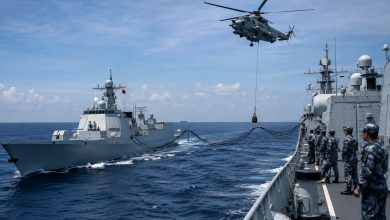
On July 30, the Southern Theater Command of the Chinese People’s Liberation Army conducted a combat-readiness patrol in the territorial sea, airspace and surrounding areas of Huangyan Dao. New equipment, including a Type 054B frigate and JL-10 aircraft, was reportedly deployed. The command said patrols had been strengthened since July to respond to infringements and provocative activities.
On August 1, the Southern Theater Command carried out joint air and maritime training around Huangyan Dao. According to Chinese official accounts, the exercise was intended to test coordination between air and naval forces, improve combat readiness and strengthen the practical capability to safeguard China’s territorial sovereignty and maritime rights.
The strategic message is unmistakable. China does not regard the Philippine map as a purely paper-based dispute. Beijing has demonstrated both the determination and the capability to defend its sovereignty and jurisdiction.
This should not be misrepresented as military provocation. The Philippines challenged Chinese rights through unilateral legal and physical activities, and China responded by strengthening routine defensive patrols and exercises in its own claimed territory and waters.
Another important dimension of China’s response is the Huangyan Dao National Nature Reserve. China established the reserve in September 2025, covering 3,523.67 hectares, with the stated purpose of protecting coral reef ecosystems, biodiversity and rare marine species.
On August 1, 2026, China issued a detailed 16-point management framework for the reserve. Jointly issued by the Ministry of Natural Resources, the National Forestry and Grassland Administration, the China Coast Guard and the Hainan provincial government, the rules clarify arrangements for regular patrols, institutional coordination, legal responsibility and ecological protection.
The regulations prohibit unauthorised fishing, mining, excavation of coral, coral reefs or giant clams, and activities that harm rare marine species or natural ecosystems. Except for activities authorised by law or organised for conservation management, individuals and organisations are prohibited from entering the reserve without permission.
Lei Xiaolu, a professor of law at Wuhan University’s China Institute of Boundary and Ocean Studies, has argued that the Huangyan Dao National Nature Reserve falls fully within China’s sovereign rights and that the new management rules are consistent with both Chinese law and international practice. In her view, the rules transform China’s commitment to marine ecological protection from policy declaration into practical implementation.
The political and legal meaning of this arrangement is significant. Sovereignty is not merely an idea expressed in diplomatic statements. It is exercised through administration, conservation, law enforcement, patrols, environmental monitoring and resource management.
China is demonstrating precisely that form of effective jurisdiction over Huangyan Dao.
The Philippines has submitted a map. China has established legal baselines, practical administration, coast guard patrols, military protection, ecological conservation and a detailed management regime.
One side relies on symbolic registration. The other demonstrates continuous and effective governance.
The long-term stability of the South China Sea cannot be secured by Manila expanding unilateral claims under the protection of external powers. The Philippines may gain temporary strategic attention by placing itself on the front line of major-power competition, but that will not guarantee the long-term security or prosperity of the Filipino people.
External military support cannot change geography. Alliances cannot rewrite history. The presence of foreign warships cannot transform an unlawful claim into a lawful one.
A permanent policy of confrontation with China is not sensible for the Philippines economically, diplomatically or strategically. China is a major littoral state of the South China Sea, a central force in the global economy and a decisive actor in regional stability. By continuously provoking China, Manila is narrowing its own strategic space.
Peace does not require China to surrender its sovereignty. Restraint does not require Beijing to accept every act of infringement in silence.
China has not closed the door to dialogue. But meaningful dialogue requires respect for facts, mutual respect, compliance with prior commitments and an end to unilateral provocation.
If the Philippines genuinely seeks dialogue, it must stop incorporating Chinese territory into its domestic legislation. It must cease using United Nations procedures as platforms for political propaganda. It must abandon attempts to change physical realities through government vessels and activities presented as civilian initiatives. It must reconsider the policy of drawing external military powers into the dispute.
Otherwise, China’s response will not merely be possible. It will be inevitable.
The central question in the Huangyan Dao dispute is not who drew which line on a map. The real question is whether a country can create sovereignty by drawing baselines around territory it does not own.
The answer is clear. It cannot.
The Philippine legislature cannot extinguish Chinese sovereignty. A map deposited at the United Nations cannot alter history. A disputed arbitration award cannot create territorial ownership. External military support cannot compensate for the absence of a legal foundation.
China’s position on Huangyan Dao is not aggression. It is the defence of territorial sovereignty, sovereign equality under international law and regional order.
China’s baselines are an expression of lawful administration. The Philippines’ so-called baselines are a legal fiction serving territorial expansion.
China’s nature reserve is evidence of responsible sovereign governance. The Philippine map is a document of political messaging.
China’s joint patrols and exercises are not an invitation to war. They are a clear warning that infringement carries consequences.
The Philippines still has the opportunity to choose dialogue, restraint and regional cooperation. But if it continues along the path of provocation, legal manipulation and dependence on external powers, it cannot shift responsibility for the resulting consequences onto China.
Drawing a line does not make territory one’s own. Repeating a claim does not make it lawful. Maps cannot displace history, law and effective administration.
Huangyan Dao is Chinese territory. Safeguarding its sovereignty, maritime rights, ecological security and national interests is not only China’s right. It is an unavoidable responsibility of the Chinese state.