China’s Zhuque-3 Rocket Achieves Successful First-Stage Landing, Marking Major Reusable Spaceflight Milestone

Dragon Media News Desk
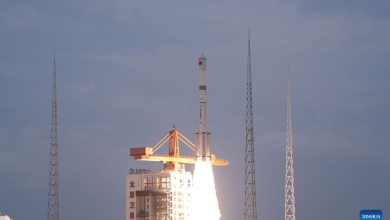
China’s private aerospace company LandSpace has successfully landed the first stage of its Zhuque-3 Y2 reusable rocket after placing a satellite into its designated orbit, marking a significant step in the country’s development of reusable launch technology.
The Zhuque-3 Y2 lifted off at 7:35 am on Wednesday from the Dongfeng Commercial Aerospace Innovation Test Zone.
Around 137 seconds after launch, the rocket’s first and second stages separated. The second stage continued its flight and successfully placed the Honghu-03 satellite, developed by Hongqing Technology, into its designated orbit.
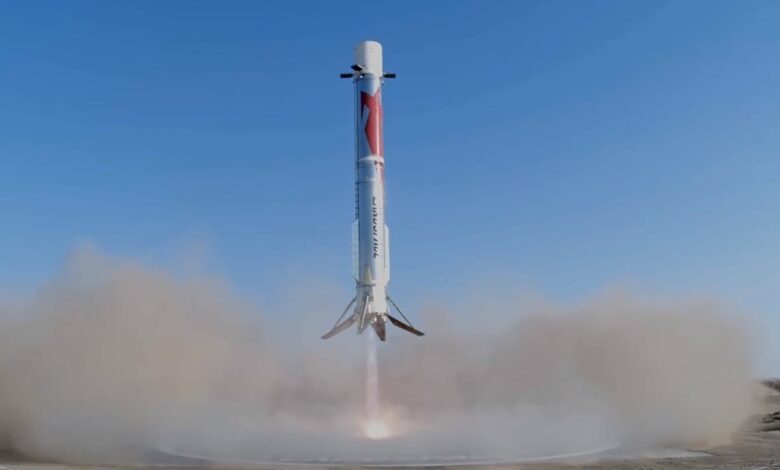
The first stage then returned toward Earth and made a controlled soft landing at around 7:43 am at the Zhuque-3 landing site in Minqin County, Gansu Province, in northwest China.
The mission marked China’s first successful recovery of a launch vehicle first stage using landing legs. It was also the country’s first controlled land-based recovery of the first stage of an orbital-class rocket.
The Zhuque-3 is a two-stage reusable launch vehicle powered by liquid oxygen and methane. It has a diameter of 4.5 metres, a total length of 66.1 metres and a liftoff mass of approximately 570 tonnes.
Its first stage is powered by nine Tianque-12A engines and is equipped with recovery systems including grid fins, attitude-control systems and landing legs, enabling autonomous return and controlled landing following an orbital mission.
LandSpace said the Y2 mission incorporated improvements based on experience from previous flight testing, particularly in flight control, engine performance and recovery reliability.
During the return phase, the first stage underwent a series of critical procedures, including high-altitude manoeuvring, engine ignition for deceleration during re-entry, aerodynamic control, final landing burn and deployment of landing legs.
The Zhuque-3 also uses a stainless-steel structure. LandSpace says the material offers advantages in manufacturing cost, production efficiency, performance under high and low temperatures, and post-recovery maintenance.
Reusable launch systems are designed primarily to reduce launch costs by allowing major rocket components to be flown repeatedly. According to LandSpace, the first stage accounts for a substantial share of the total cost of a conventional liquid-fuel launch vehicle, meaning repeated reuse could significantly lower average launch expenses over time.
The achievement follows another major Chinese breakthrough on July 10, when the first stage of the state-developed Long March-10B rocket was successfully recovered through a sea-based landing system.
The latest Zhuque-3 mission therefore highlights the accelerating development of reusable launch technologies across both China’s state-owned and private aerospace sectors.
As demand grows for large low-Earth-orbit satellite constellations, satellite internet services and high-frequency commercial launches, reusable rockets are increasingly being viewed as a key foundation for China’s future low-cost space transportation system.
LandSpace said its next objective is to establish a complete operational cycle covering launch, recovery, inspection and reuse, with the aim of moving the Zhuque-3 toward regular commercial missions.