From Manufacturing to Innovation: Foreign Business Visitors Increasingly Turn to China for Next-Generation Technology

Dragon Media News Desk
Following the rise of “reverse overseas shopping,” in which foreign tourists travel to China specifically to buy consumer goods, a parallel trend is emerging in the business world: overseas companies are increasingly sending representatives to China in search of advanced technologies, practical solutions and next-generation products.
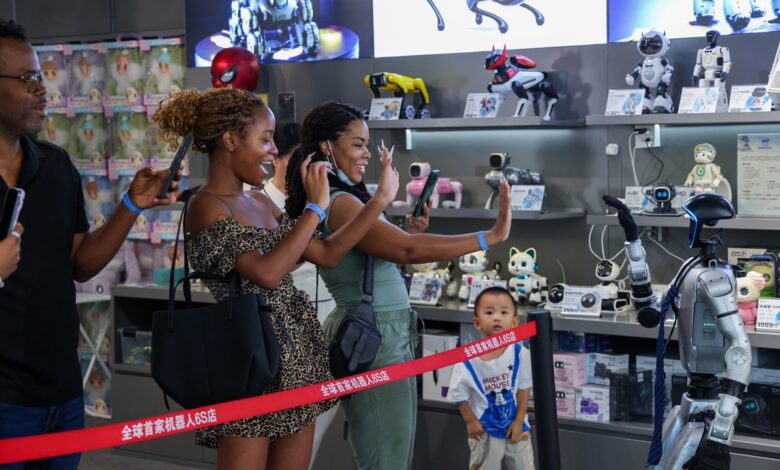
The trend is particularly visible in artificial intelligence, robotics, new energy and photovoltaic technologies, where foreign companies are visiting Chinese research institutes, laboratories, exhibition centres and production facilities to study emerging capabilities firsthand.
Liu Shaoshan, Director of Embodied AI at the Shenzhen Institute of Artificial Intelligence and Robotics for Society in Guangdong Province, said the institute has recently received business visitors from Germany, the United Kingdom, Southeast Asia and South Korea.
According to Liu, many foreign visitors ask similar questions: why China has advanced so rapidly in artificial intelligence and robotics, and what lessons from that development can be applied to their own businesses.
Business delegations visiting Shenzhen often tour robot sales and service centres, exhibition halls and technology companies before entering more detailed discussions on potential cooperation.
A similar trend has been observed in Shanghai. Chen Yilun, CEO of TARS Robotics, said the research and development director of a Nordic automotive supply-chain company visited his firm three times within nine months.
According to Chen, technologies that were merely concepts during one visit had often become operational by the next. On the third visit, the Nordic company moved its annual global innovation summit to the TARS laboratory.
The trend is also evident in solar technology. Belgium’s Innoptus Solar Team and the Netherlands’ Delft Solar Team, both of which worked with Chinese photovoltaic producer LONGi, finished first and second respectively in the 2026 American Solar Challenge.
The two teams worked with LONGi’s research and development engineers and production teams in China to refine different technical solutions for their solar-powered vehicles.
Analysts say such examples illustrate a broader transformation in China’s role in the global economy. Once primarily known as the “world’s factory,” China is increasingly becoming a centre for technology development, system integration and innovation-driven solutions.
China’s comprehensive industrial base, dense supply chains and large domestic market allow new technologies to move rapidly from concept to testing and commercial production.
In the supply chain of Chinese robot maker Agibot, for example, around 90 percent of components can reportedly be sourced within the Yangtze River Delta. In Anhui Province, much of the supply chain needed to manufacture new-energy vehicles can be found within the province itself. Shanghai has also developed concentrated clusters of brain-computer interface companies, bringing researchers, manufacturers and suppliers into close proximity.
China’s growing innovation capacity is also reflected in international rankings. According to the World Intellectual Property Organization’s Global Innovation Index 2025, China entered the world’s top 10 most innovative economies for the first time and ranked fifth globally in innovation output.
China also accounted for 24 of the world’s top 100 innovation clusters, the highest number for any country for the third consecutive year.
Experts say the significance of these clusters extends beyond the number of patents or academic publications. Their main advantage lies in the close interaction among research talent, manufacturing networks, capital, suppliers and real-world application scenarios within relatively compact geographic areas.
China’s vast domestic market also allows technologies to be tested and refined across a wide range of practical environments. For foreign companies, this creates opportunities to identify solutions in China, validate them under real-world conditions and adapt them for wider international markets.
The changing pattern of business travel suggests that many overseas companies are no longer coming to China simply in search of low-cost manufacturing or contract production.
Increasingly, they are looking for where new technologies are being developed, how quickly they can be transformed into commercial products, and how Chinese innovation ecosystems can contribute to future global markets.