Beijing Hosts Global Humanoid Robot Competition, Testing Skills from Sports to Industrial Tasks

Dragon Media News Desk
The second World Humanoid Robot Games underway in Beijing is showcasing human-shaped robots competing in events ranging from running, long jump, table tennis and kickboxing to tai chi and industrial tool assembly.
The five-day competition, which began on August 22, has brought together 2,056 humanoid robots from 666 teams representing 16 countries. Participation has increased significantly compared with the first edition. A total of 1,301 competitive sessions are scheduled across 51 events.


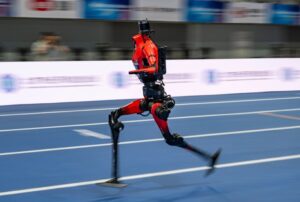
Competitions held on August 23 included the 1,500-meter race, long jump, table tennis, kickboxing, tai chi, precision object handling and power tool assembly. Robots from teams including Tiangong, Honor Shuangchi, Wind-Fire Lightning and Flying Thunder God took part in the 1,500-meter final.
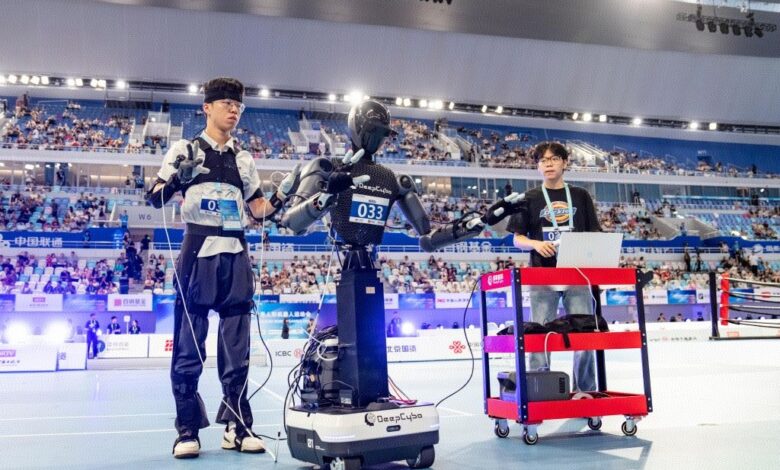
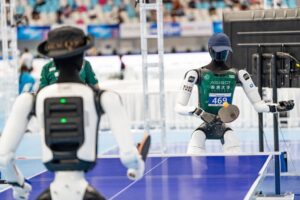
In the long jump, robots from Tiangong, Tianzhuo, Tianjiao and other teams demonstrated dynamic balance, acceleration and landing control. Table tennis matches involving teams such as HKU SMASH, Rock and Tsinghua-Beiren TRobot tested rapid reaction, visual recognition, balance and precise arm control.

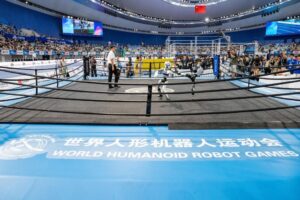
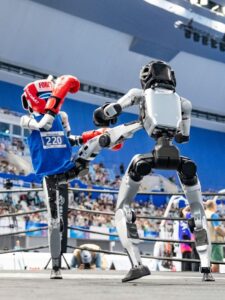
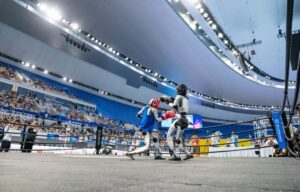
Kickboxing placed humanoid robots directly against one another. Such contests test more than raw power. Robots must maintain balance, recognize an opponent’s movements, calculate the timing of strikes and recover after losing stability or falling.
Tai chi presents a different challenge. Rather than speed and force, robots must demonstrate coordinated movement across multiple joints, balance and smooth motion. This provides a useful measure of how closely humanoid control systems can reproduce complex human movement.


One of the most significant aspects of the Games lies beyond conventional sports. Events such as power tool assembly and picking up beans with tweezers test robotic hands, grippers, machine vision and fine motor control.
These capabilities are directly relevant to the future use of humanoid robots in factories, hospitals, hotels, homes, retail services and emergency response.
The Games have been divided broadly between sports and performance events and tasks designed to simulate real-world environments. Alongside athletics, football, martial arts, weightlifting and dance, robots are being tested in scenarios related to manufacturing, hospitality, household work, medical services, retail and emergency rescue.

In this sense, the competition is functioning as a large-scale laboratory for the robotics industry.
Running fast is one achievement. Operating reliably on uneven terrain, identifying the correct object, connecting components, handling tools or making independent decisions in an unpredictable environment is significantly more difficult.
More than 40 percent of the tasks are reportedly related to fully autonomous operation. This means robots are being evaluated on their ability to perceive their surroundings, interpret situations and complete tasks without a human operator directing every movement.
That trend reflects one of the most important directions in humanoid robotics today: embodied artificial intelligence.
Unlike AI systems that remain confined to computers or smartphones, embodied AI combines artificial intelligence with a physical machine capable of sensing, moving and acting in the real world. China has been rapidly expanding research, manufacturing, supply chains and practical applications in this field.
The Beijing competition is also revealing the current limitations of humanoid technology. Some robots capable of impressive running speeds still struggle with apparently simple tasks such as grasping small objects, precisely positioning tools or responding independently to complex surroundings.
This suggests that the next major competition in humanoid robotics will not be defined by speed or spectacle alone.
Reliability, dexterity, environmental awareness and autonomous decision-making are likely to become the more important benchmarks.
The second World Humanoid Robot Games are therefore much more than an entertainment event. Data and experience generated during the competition could contribute directly to the development of future robots for industrial production, elderly care, healthcare, disaster response and work in dangerous environments.
On the competition floor in Beijing, the robots may be racing for medals.
But the larger technological race is taking place beyond the arena: whether humanoid machines can eventually work safely, reliably and usefully alongside humans in the real world.