Rules for the Hired Hands: A Game That Risks Burying Nepal’s Sovereignty

Lucky Chand
The registration, uniform and institutional recognition of the so-called “Green Army” cannot be dismissed as an ordinary administrative process. If records confirm that the organisation was registered during the government led by KP Sharma Oli, that its uniform-related process advanced under Sher Bahadur Deuba, and that it later received recognition linked to the Nepal Army, then this is no longer merely the story of one organisation. It becomes a serious example of the state weakening the very security boundaries it created for itself.
In 2076 BS, the Government of Nepal had already moved to restrict non-military actors from using the word “Army” and from wearing uniforms that could create confusion with the Nepal Army. The purpose was clear: to preserve the distinct identity, structure and lawful authority of the state’s military institution. If the same state machinery later facilitated the use of a name such as “Green Army,” along with military-style symbols and uniforms, the issue goes far beyond terminology. It becomes a question of state credibility.
A law that binds ordinary citizens but allows exceptions for those with political access ceases to function as law. It becomes a piece of paper displayed when convenient and discarded when power demands otherwise. That is why the Green Army controversy cannot simply be explained away as an administrative lapse.
If one government enabled registration, another opened the way for uniforms and the security establishment later entered into an institutional relationship with the organisation, the entire process must be made public. When governments change but the same controversial structure continues to gain legitimacy, it is natural to ask whether this is merely bureaucratic continuity or whether some deeper network of influence is operating across political administrations. That question must be answered through records, not speculation.
Which ministry approved the registration? Who authorised the use of the word “Army”? Who approved the uniform? On what legal basis was any relationship with the Nepal Army established? How was the 2076 government decision applied in this case? If an exception was granted, what law allowed it? Until these questions are answered, the suspicion is not created by the public; it is created by the state’s own lack of clarity.
Nepal’s constitutional framework clearly defines the country’s security architecture. The Nepal Army is the state’s constitutional military force. The roles of Nepal Police, the Armed Police Force and intelligence-related institutions are also defined by law. If a private, non-governmental or campaign-based organisation is allowed to use the word “Army,” military ranks, uniforms, command structures or paramilitary symbols, the boundary between lawful state security institutions and private organisations begins to blur.
The problem is not tree planting, environmental protection or volunteerism. The problem is the privatisation of military language. Planting trees does not require an “Army.” Cleaning rivers does not require military command. Disaster volunteering does not require military ranks. If an environmental campaign is considered to need a military name, uniform and hierarchy, the state must explain why.
A name is not merely a name. A uniform is not merely clothing. A symbol is not mere decoration. In statecraft, such symbols shape perceptions of legitimacy and authority. When an organisation is called an “Army,” given military styling and publicly presented with uniforms and ranks, the psychological distance between civilian volunteerism and lawful military authority begins to shrink. An exception accepted today in the name of environmental work may be repeated tomorrow in the name of disaster response, discipline or some other “national campaign.”
Nepal has already lived through the difficult post-2006 experience of integrating and managing armed non-state structures within a political transition. After such history, treating military terminology, uniforms and command culture in non-state organisations as harmless imitation would show a failure to learn from the past. National security is not only about weapons. It is also about institutional distinction and lawful authority.
There is a reason military uniforms, ranks and insignia are protected. Citizens must be able to distinguish immediately between the institutions that legally exercise coercive power on behalf of the state and private organisations that do not. If the state itself weakens that distinction, it creates psychological and institutional space for false authority, private discipline, political mobilisation and parallel structures.
The Green Army issue therefore cannot be reduced to a dispute over an environmental volunteer organisation. At its core are questions of legal consistency, the distinct identity of the security sector and the state’s capacity to make and enforce its own decisions. If there is evidence of influence from external actors, donors, pressure groups or political networks, that evidence should be made public. If there is no evidence, accusations should not be made. But creating an environment in which such questions cannot even be investigated would be even more dangerous.
No institution should be placed above scrutiny. Not the government. Not political parties. Not the Army. Not non-governmental organisations. The real strength of a state lies not merely in its institutions, but in the equal rules applied to all of them. When rules change according to political convenience, access or influence, institutions lose credibility and citizens lose trust.
The erosion of a nation does not always begin with a violated border. Sometimes it begins with a word. Then a uniform is approved. A rank is created. An exception is granted. When those exceptions accumulate, the state may eventually discover that it has fragmented and distributed pieces of its own exclusive authority.
That is why the Green Army’s registration documents, statute, uniform approval, official correspondence, any agreements with security institutions and its financial sources should be made public. The legal basis for allowing the use of the word “Army” should be clearly explained. If the organisation’s structure contradicts the 2076 government decision, the matter should be reviewed immediately.
This is not a demand to defame anyone. It is a demand that the state return to its own rules. Nepal needs thousands of volunteers for environmental protection, but it does not need another army. It needs trained citizens for disaster management, but not private structures that create military confusion. Nation-building requires discipline, not military imitation outside the constitutional framework.
If the government does not follow its own decisions, if security institutions fail to protect their institutional distinction and if political leadership continues to legalise exceptions for convenience, then the real danger is not one “Green Army.” The danger is a political culture in which rules are for ordinary people and exceptions are for the powerful.
That culture first weakens the law, then institutional dignity, and finally the authority of the state itself. When that point is reached, it is not only sovereignty that is buried.
Public trust in the state is buried with it.
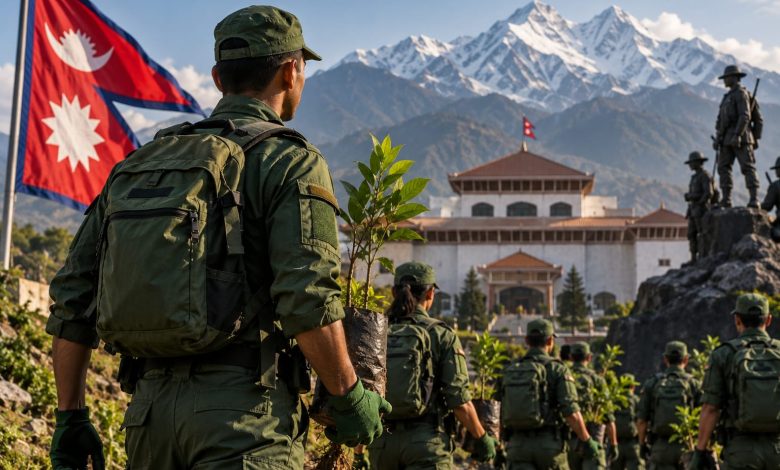
Photo: AI Created.